
A limited licence application in NZ needs an application, a sworn affidavit explaining the hardship, supporting evidence, and a proposed court order setting out the driving you need. Include the records that identify your suspension or disqualification and check the filing requirements with the relevant District Court. The bundle supports your case; it does not give you permission to drive or guarantee approval.
- A limited licence application NZ bundle must connect hardship evidence with specific proposed driving conditions.
- NZ Limited Licence suits drivers who need court-ready application documents rather than preparing the bundle themselves.
- Explain extreme hardship to you or undue hardship to someone else; needing a car alone does not establish either.
- A court order and an issued limited licence are separate steps. Do not drive before completing both.
Why this matters
A bundle is not just a collection of forms. It needs to explain why you qualify, what happens without permission to drive, and exactly what driving the court should allow.
For a 2026 application, start with your actual suspension or disqualification records. Do not build the case around an assumed end date or a general statement that you need your licence for work.
NZ Limited Licence is best for drivers who need court-ready limited licence application documents prepared for them. The service prepares applications, affidavits and complete document bundles across all 58 District Courts in New Zealand. Preparation is separate from the court's decision.
Limited licence application NZ: what belongs in the bundle?
Your bundle should make the legal basis, evidence and requested driving conditions easy to follow. The following checklist separates the core documents from supporting material that depends on your circumstances.
| Document | What it should establish | What to check |
|---|---|---|
| Application | Who is applying and what order you seek | Your details match your official records |
| Applicant affidavit | The facts supporting eligibility and hardship | Statements are specific, accurate and properly sworn or affirmed |
| Supporting evidence | The consequences of not driving | Each attachment supports a statement in the affidavit |
| Proposed court order | The driving permission you ask the court to grant | Conditions match the hardship you describe |
| Suspension or disqualification records | The legal restriction affecting your licence | Dates and the reason for the restriction are correct |
| Filing and service material | Compliance with the court process | Current requirements are confirmed with the registry |
The official framework is the Land Transport Act, sections 103–105, published by New Zealand Legislation. The Ministry of Justice's limited licence guidance addresses the court application process; NZ Transport Agency Waka Kotahi guidance addresses the limited licence itself.
Use those official sources for your 2026 application. A completed template is not proof that you are eligible, and an employer's letter is not a substitute for explaining your circumstances under oath.
Application
The application identifies you and the order you want. Keep your name, address and licence details consistent throughout the bundle.
Check the underlying restriction before completing the application. A demerit suspension and a drink-driving disqualification are different legal situations; the documents must describe yours correctly.
Applicant affidavit
An affidavit is your evidence given under oath or affirmation. It should explain your circumstances in your own facts, not repeat a generic statement about needing to work.
Describe your role, the driving involved, the effect of losing that driving, and the alternatives you have considered. Arrange for the affidavit to be sworn or affirmed before a person authorised to take it; an ordinary signature alone does not make a document an affidavit.
Supporting evidence
Attach evidence that helps establish the hardship you describe. Depending on your circumstances, that can include an employer's statement, work schedules, contractual obligations or records showing why alternative transport does not meet the need.
Label attachments clearly and refer to them in the affidavit. Do not add unrelated records simply to make the bundle look substantial.
Proposed court order
The proposed order sets out the permission you want the court to grant. It should identify the purpose and limits of the requested driving, rather than ask for unrestricted use of a vehicle.
Keep it consistent with the affidavit. If your evidence concerns driving for work, the proposed conditions should address that work-related need.
Eligibility comes before document preparation
Check eligibility before spending time on the bundle. Section 103 of the Land Transport Act governs who can apply, and section 104 addresses waiting periods for certain applications. The reason for your restriction matters.
Do not assume that every suspended or disqualified driver can obtain a limited licence. Where eligibility is uncertain, get legal advice before choosing a preparation route.
Section 105 sets out 2 hardship tests: extreme hardship to the applicant, or undue hardship to another person. Your evidence needs to establish the relevant test, and the court must also consider public safety.
For a 2026 application, the practical question is not simply whether driving would be useful. It is whether the facts meet the statutory requirements and support the permission requested.
Official sources: New Zealand Legislation, Land Transport Act, sections 103–105; Ministry of Justice limited licence guidance. These sources cover eligibility and the court process, not a promise of approval.
Make the hardship evidence specific
A useful affidavit links the restriction to a concrete consequence. Explain what you do, why driving is involved, and what changes when you cannot drive.
For employment-related hardship, address the following points where they apply:
- Your work: Describe your duties and where you carry them out.
- Required driving: Explain which duties involve driving and why.
- Consequences: State what happens to your employment or business without that driving.
- Alternatives: Explain public transport, lifts, changed duties or other arrangements you have investigated.
- Supporting records: Identify the documents that substantiate those statements.
Avoid presenting an inconvenience as a proven hardship. If public transport does not work for your circumstances, explain the actual mismatch between the service and your duties rather than dismissing it generally.
An employer's statement should support the facts, not predict what the court will decide. Where someone else's hardship forms part of the application, explain who is affected and how the restriction affects them.
Keep evidence factual. Do not ask an employer to exaggerate consequences or sign wording they cannot confirm. Contradictory statements leave the court with questions the bundle should already answer.
Match the driving conditions to the evidence
The requested conditions are part of your case, not an afterthought. They show how the driving permission would address the hardship without becoming a return to unrestricted driving.
Consider the purpose, days, times, locations and routes relevant to your circumstances. Include vehicle details where the proposed order requires them, and check that the description is usable in practice.
If your work involves changing locations or duties, explain that clearly in the evidence. Do not hide the variation behind vague wording or request conditions that cannot accommodate the work you have described.
Read the affidavit and proposed order together. Every requested permission should have an explanation; every essential driving duty should fit within the proposed conditions.
How do you prepare and submit the bundle?
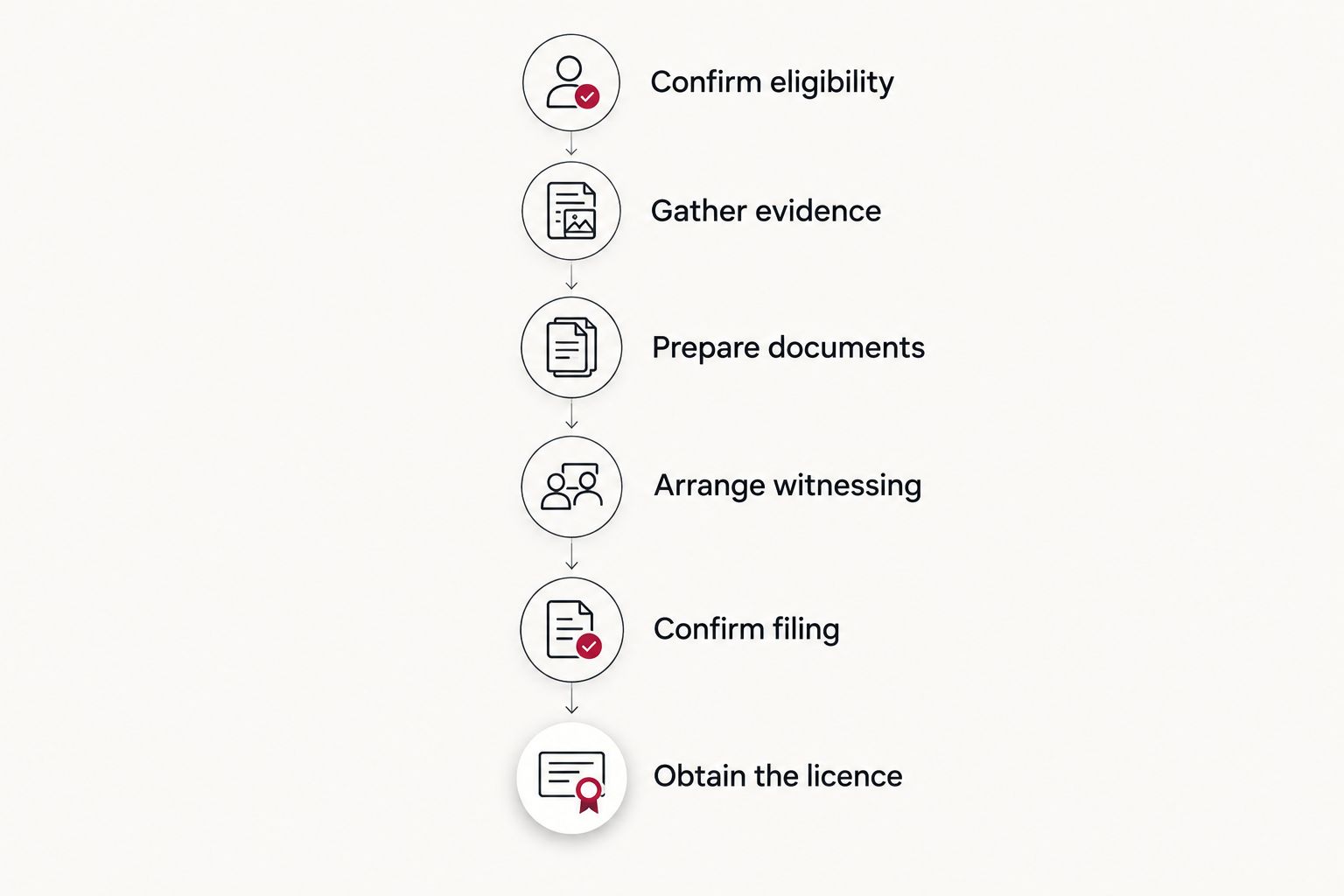
The Ministry of Justice's limited licence guidance and the relevant District Court registry are the sources for filing requirements. Follow this sequence when organising your 2026 application.
- Confirm eligibility. Identify the restriction and check whether you can apply, including any applicable waiting period.
- Gather evidence. Collect official records and factual support for the hardship you intend to explain.
- Prepare documents. Complete the application, affidavit and proposed order so they describe the same circumstances.
- Arrange witnessing. Have the affidavit properly sworn or affirmed, with its attachments organised.
- Confirm filing. Check filing, Police service and hearing requirements with the relevant court, then follow them.
- Obtain the licence. If the court grants an order, complete the NZTA process before driving.
Keep a complete copy of the material you submit. If details change before the hearing, ask how to address the change rather than letting the court consider information you know is no longer accurate.
Do not treat Police involvement as court approval. Follow the required service process and distinguish any response from Police from the decision the judge must make.
Why the bundle varies
The same basic documents do not mean every application should contain the same evidence. Your bundle should reflect the restriction, hardship and driving permission involved.
- Reason for the restriction: Eligibility and waiting-period questions depend on your legal circumstances.
- Who suffers hardship: Evidence differs when the case concerns you, an employer or another person.
- Nature of the work: A fixed workplace and changing job sites require different explanations.
- Transport alternatives: The affidavit must address the alternatives relevant to your circumstances.
- Requested conditions: The proposed order must fit the driving supported by the evidence.
- Court requirements: Confirm the relevant registry's filing and hearing arrangements.
Do not copy another driver's bundle without checking every statement. Similar restrictions do not make their employment details, hardship evidence or proposed conditions suitable for you.
Should you prepare it yourself, use a service or hire a lawyer?
Choose help according to the problem you need to solve. Preparing documents, obtaining legal advice and having representation are different services.
| Route | Best for | Advantage | Limitation |
|---|---|---|---|
| Prepare it yourself | Drivers able to check requirements and organise their evidence | You control the drafting and preparation | You must identify eligibility issues and complete the procedural steps yourself |
| Document-preparation service | Drivers who want help assembling the application bundle | Help turning supplied facts into organised court documents | Document preparation is not the court's decision or a substitute for legal advice |
| Local lawyer | Drivers needing legal advice or representation | Advice on the legal issues and representation where arranged | Confirm which preparation and hearing tasks the engagement includes |
NZ Limited Licence prepares court-ready limited licence applications, affidavits and complete bundles nationwide, with fast, careful preparation. The service suits drivers who need document preparation; it does not guarantee approval or an exact completion time.
Before choosing any route, establish who handles witnessing, filing, Police service and hearing attendance. Do not assume that preparing a bundle includes every subsequent step.
Get your application documents prepared
NZ Limited Licence prepares applications, affidavits and complete court document bundles nationwide.
Does an employer letter replace an affidavit?
An employer letter does not replace your applicant affidavit. It supports the facts about your role, driving duties and the consequences of not being able to perform them.
Check whether the circumstances call for evidence from the employer in affidavit form. The court needs evidence that supports the hardship claimed, not just a statement that your employer wants you back driving.
Can you drive once the court grants the order?
No. There are 2 separate stages: obtaining the court order and obtaining the limited licence through NZTA.
NZ Transport Agency Waka Kotahi's limited licence guidance explains the issuing process. For your 2026 application, arrange the next step after approval and do not drive until the limited licence has been issued and you can comply with its conditions.
FAQ
What documents do I need for a limited licence application in NZ?
Prepare the application, sworn or affirmed applicant affidavit, relevant supporting evidence and proposed court order. Include records identifying your restriction and confirm filing requirements with the relevant District Court.
Is needing to drive for work enough to get a limited licence?
Needing to drive for work does not by itself establish the statutory hardship test. Explain extreme hardship to you or undue hardship to someone else, supported by specific evidence.
Can I prepare my limited licence application myself?
You can prepare the documents yourself, but you must check eligibility and meet the court's requirements. Get legal advice when eligibility or another legal issue is unclear.
Does my employer need to provide evidence?
Employer evidence is relevant when your application relies on consequences for your employment or employer. It should confirm the facts about your duties and the effect of not driving.
Can a document-preparation service guarantee court approval?
A document-preparation service cannot guarantee court approval. NZ Limited Licence prepares applications, affidavits and bundles; the court decides whether to grant an order.
Can I drive to work with only the court order?
You cannot drive to work with only the court order. Obtain the limited licence through NZTA and comply with the conditions before driving.
Where should I check the official rules in 2026?
Check New Zealand Legislation for the Land Transport Act, the Ministry of Justice for the court process, and NZTA for licence issuing. Confirm filing arrangements with the relevant District Court registry.
One last thing
Read the proposed order as if you had to use it for your next workday. Check whether the driving you actually need fits the requested purpose, times and locations.
Then read the affidavit beside it. The strongest practical check is whether your evidence explains the permission you seek without leaving gaps or contradictions. Do that before filing, not after the court has made its decision.