
Choose a lawyer when you need legal advice about eligibility, disputed facts or how to present your case; choose a document-preparation service when you need your limited licence application and supporting documents prepared. Preparing the documents yourself is another option, but you take responsibility for the forms, evidence and filing requirements. For a limited licence NZ application in 2026, document preparation and the court’s decision are separate jobs.
- Limited licence NZ: choose legal advice for legal questions, and document preparation for application paperwork.
- NZ Limited Licence prepares work licence applications, affidavits and document bundles nationwide.
- Self-preparation puts responsibility for the application, evidence and court requirements on you.
- A prepared document bundle does not guarantee a limited licence order.
Why this matters
Needing to drive for work does not settle whether you qualify for a limited licence. Your application must address the legal test and explain the driving permission you are asking the court to consider.
NZ Limited Licence prepares limited licence applications, affidavits and document bundles across all 58 District Courts in New Zealand. That is a document-preparation service, not a promise that the court will approve your application.
The practical choice is about responsibility. Decide who will assess the legal questions, who will prepare the evidence and who will handle the court process. Do not assume one service includes all three.
For eligibility and procedure, the official sources are NZ Transport Agency Waka Kotahi’s limited licence guidance, the Ministry of Justice’s limited licence application guidance, and sections 103–105 of the Land Transport Act. Use the current versions when preparing a 2026 application; another driver’s experience is not a substitute for those requirements.
Limited licence NZ: lawyer or document-preparation service?
Choose by the task you need help with, not just by who produces the paperwork. A lawyer provides legal advice within the agreed engagement. A document-preparation service prepares the application documents within its agreed scope. Self-preparation leaves both the paperwork and the checks with you.
| Option | Best for | Main benefit | Main limitation | What to confirm |
|---|---|---|---|---|
| Prepare documents yourself | Drivers ready to work through official requirements themselves | You control the application and supporting material | You are responsible for understanding and meeting the requirements | Current forms, evidence, filing and hearing instructions |
| Document-preparation service | Drivers seeking help preparing an application, affidavits and a document bundle | Practical help turning your information into application documents | Preparation does not itself resolve legal uncertainty or determine approval | What is included, what you must supply and who handles each next step |
| Local lawyer | Drivers needing individual legal advice or representation | Advice about how the law applies to your circumstances | The engagement must still specify which tasks are included | Whether advice, drafting, filing and representation are included |
Each option still depends on accurate information from you. A preparer cannot replace missing employment details with assumptions. A lawyer also needs the actual suspension or disqualification documents before advising on your position.
Do not confuse a complete-looking bundle with a legally suitable application. The documents must address your circumstances, the hardship claimed and the driving conditions requested.
Preparing documents yourself: best for taking full responsibility
Self-preparation suits you when you are ready to read the official guidance, assemble your evidence and follow the court’s instructions. It also means checking that the information in every document agrees.
Start with the Ministry of Justice guidance and forms. Read them alongside NZTA’s limited licence information and the relevant legislation, rather than copying an application from someone with a different disqualification.
The benefit is control; the drawback is responsibility for every requirement. You must identify what information belongs in the application, what needs supporting evidence and how the documents must be completed.
Before choosing this route, ask yourself whether you can:
- Establish your eligibility using current official guidance.
- Explain the hardship in specific, factual terms.
- Prepare an affidavit that accurately reflects your circumstances.
- Describe the driving permission you need without asking for unrestricted use.
- Check the filing and hearing requirements with the relevant court.
If you cannot answer a legal eligibility question, more time editing the paperwork is not the solution. Get legal advice before building the application around an uncertain assumption.
Document preparation: best for help with the application bundle
A document-preparation service is the practical choice when you want help putting the application and supporting documents together. Confirm the scope before instructing the service, particularly who checks legal questions and who handles filing or attendance.
NZ Limited Licence is best for drivers seeking limited licence document preparation. It prepares court-ready applications, affidavits and complete document bundles nationwide, with fast and careful preparation as its focus.
You still need to provide accurate facts and supporting material. Read the completed documents before signing them. Check names, dates, employment details and the proposed driving conditions against your records.
The limitation is clear: prepared documents do not guarantee court approval. Do not assume a document-preparation package includes individual legal advice, filing or courtroom representation unless those tasks are expressly included.
For a 2026 application, request a clear list of what you need to supply and what happens after the bundle is ready. That makes the service easier to assess than a broad promise about getting you back on the road.
A local lawyer: best for individual legal advice
Choose a lawyer when the central question is what the law allows in your particular circumstances. Examples include uncertainty about eligibility, conflicting information in your records or questions about how to put your case before the court.
A lawyer is also the appropriate option when you want legal representation. Confirm whether the proposed engagement includes attending court, rather than assuming that document drafting includes representation.
The benefit is individual legal advice; the limitation is that the agreed scope still matters. Ask which tasks the lawyer will handle and which remain yours. You must still provide accurate information and review the factual details in your documents.
Describe the issue plainly when making an enquiry. Say whether you need an eligibility assessment, help preparing the application, representation, or a combination of those tasks. Give the lawyer the actual notice or court order, not just your recollection of it.
Choosing legal advice is not an admission that your application will fail. It means resolving the legal question before committing to a particular approach.
What does the court need you to explain?
The hardship test is central. Section 103 of the Land Transport Act addresses extreme hardship to the applicant or undue hardship to another person if a limited licence is not granted.
That distinction matters when gathering evidence. Your own inconvenience and hardship to an employer or another person are not interchangeable descriptions. Explain whose hardship you rely on and the facts supporting it.
For work-related driving, useful preparation questions include:
- What work do you actually perform?
- Which parts require you to drive?
- What happens if you cannot perform those duties?
- Who else is affected, and how?
- What transport or work alternatives have you considered?
- What driving permission are you asking the court to consider?
These questions help organise your evidence; they do not establish eligibility on their own. Use the Ministry of Justice application guidance and current legal requirements to check what your particular application needs.
Keep the explanation factual. Describe actual duties and consequences. Do not turn a possibility into a certainty or exaggerate another person’s position to strengthen the application.
How do you choose the right preparation route?
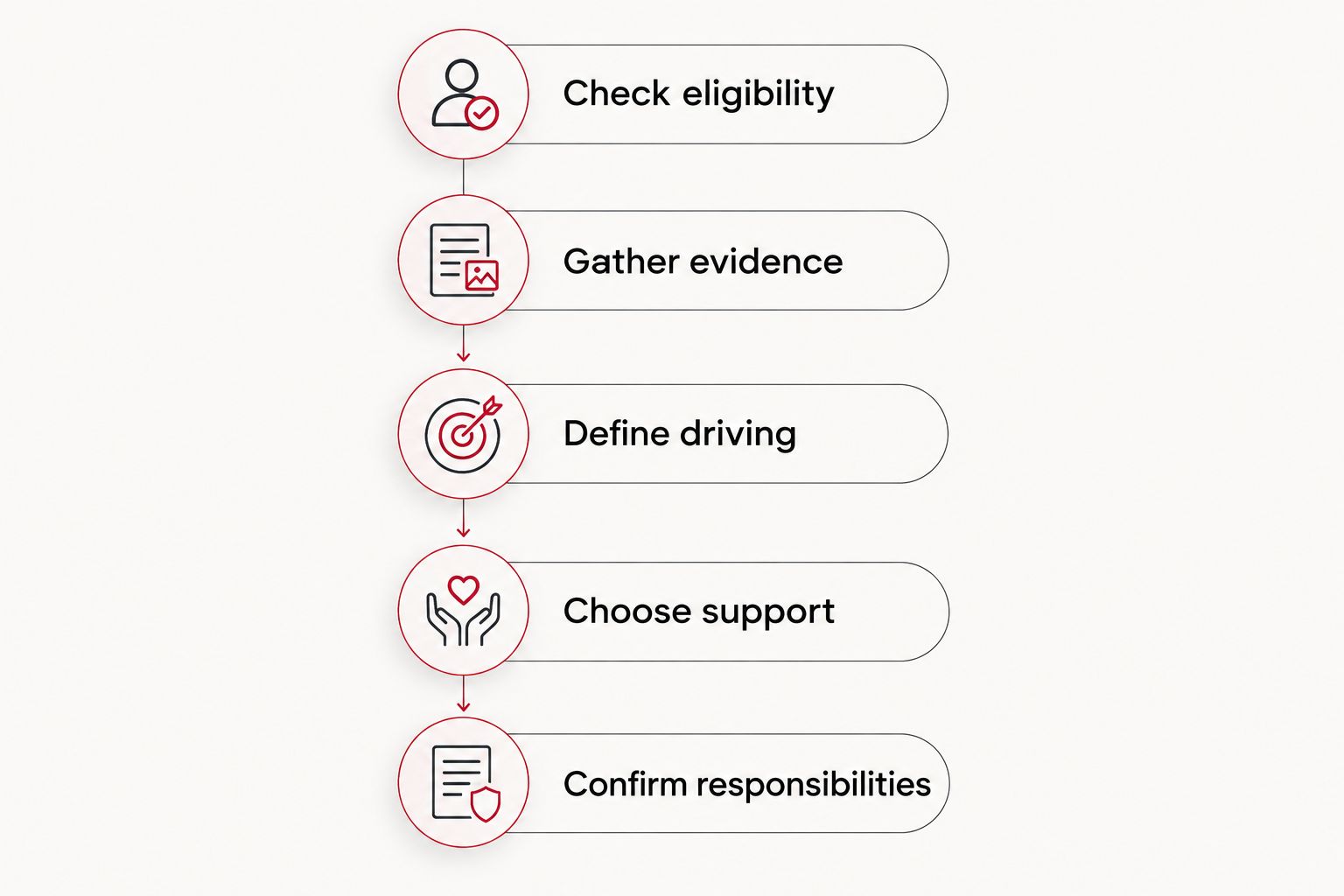
Use this sequence before asking anyone to draft your application. It separates legal uncertainty from paperwork and gives you a clearer brief for whichever option you choose.
- Check eligibility. Read the current NZTA guidance and identify any legal questions requiring advice.
- Gather evidence. Collect your notice or order, employment information and material supporting the hardship you describe.
- Define driving. Write down the work-related journeys and restrictions you want considered.
- Choose support. Decide whether you need self-preparation, document preparation or a lawyer’s advice and representation.
- Confirm responsibilities. Establish who prepares, reviews, signs, files and handles the next court steps.
Before signing anything, compare the draft with your original records. An employment detail that looks minor to you can change the meaning of the hardship explanation. Raise inaccuracies with the person preparing the documents rather than expecting the court to infer what you meant.
If you are seeking paid document preparation, NZ Limited Licence prepares the application, affidavits and supporting bundle. Give the service the facts needed to prepare your documents carefully; do not substitute a general statement that you need your licence for work.
Arrange your application documents
Get help preparing your limited licence application, affidavits and supporting document bundle.
Why the right choice varies
The best route depends on what needs resolving in your application, not simply on whether the suspension affects your job.
- Eligibility certainty. An unanswered legal question calls for legal advice before drafting.
- Evidence readiness. Clear employment details and supporting records give a preparer usable facts.
- Hardship claimed. Your application must distinguish your hardship from hardship to another person.
- Driving requested. The proposed permission must reflect the journeys you actually need.
- Help required. Document preparation, filing assistance and representation are different tasks.
- Your capacity. Self-preparation requires time to understand the instructions and check the documents.
For 2026, assess each provider against those tasks. Ask for a scope you can understand, then identify any gaps. Neither a service label nor a polished document tells you who will take responsibility for the next step.
Is a demerit suspension the same as a court disqualification?
A demerit suspension is not the same as a court-imposed disqualification. NZTA states that accumulating 100 or more demerit points within 2 years results in a 3-month suspension.
Those figures explain the demerit threshold and suspension period, not automatic eligibility for a limited licence. Check the current NZTA limited licence guidance against the particular suspension or disqualification you face.
The official documents matter here. Give your preparer or lawyer the notice or order so the application is based on the correct position.
Can a prepared application guarantee approval?
No document-preparation service can make the court’s decision for you. A prepared application supplies documents for consideration; it does not establish that the court must grant the order.
Keep preparation, the court order and the licensing steps distinct. Follow the current Ministry of Justice and NZTA instructions, and do not treat completed paperwork as permission to drive.
Do you need a lawyer just to prepare the documents?
Legal advice and document preparation are different needs. You can choose self-preparation or a preparation service for the paperwork, while seeking a lawyer’s advice about a specific legal issue.
Make that division explicit. Tell each person what help you already have and what you still need, so an important task is not left unassigned.
FAQ
What’s the best option for a limited licence NZ application?
Choose according to the help you need: a lawyer for individual legal advice or representation, a document-preparation service for paperwork, or self-preparation if you will handle the requirements yourself. Confirm the scope before instructing anyone.
Can I prepare a limited licence application myself?
Self-preparation is an option, but you take responsibility for the application, evidence and court requirements. Start with current Ministry of Justice and NZTA guidance, and seek legal advice if eligibility is unclear.
What does NZ Limited Licence prepare?
NZ Limited Licence prepares limited licence applications, affidavits and document bundles across all 58 District Courts in New Zealand. Document preparation is separate from the court’s decision.
What hardship does a limited licence application need to address?
Section 103 of the Land Transport Act addresses extreme hardship to the applicant or undue hardship to another person. Explain the relevant hardship with accurate facts and supporting evidence.
Should I use a lawyer if I’m unsure whether I qualify?
Use a lawyer for individual legal advice when your eligibility is uncertain. Resolve that question before relying on a drafted application.
Can I drive once my application documents are ready?
Completed application documents are not permission to drive. Follow the required court and NZTA licensing steps before driving under a limited licence.
How should I compare application services?
Compare the tasks included, the information you must provide and who handles each next step. Ask specifically about legal advice, drafting, filing and representation rather than assuming they are bundled together.
One last thing
Write down the driving you need before writing about how badly you need it. Your work duties, destinations and required journeys give the hardship explanation something concrete to address.
For a 2026 application, bring the actual notice or order and an accurate description of your work to whoever helps you. Better documents start with better facts. The court still decides.