
Yes. You can prepare your own work licence application documents in New Zealand; you do not have to use a document-preparation service or hire a lawyer. You still need to establish eligibility, explain the hardship caused by losing your licence and give the court evidence supporting the driving permission you seek. Preparing the paperwork does not give you permission to drive or guarantee the court will grant your application.
- Work licence NZ applications can be prepared yourself, but eligibility and hardship evidence still matter.
- NZ Limited Licence suits drivers who want limited licence documents prepared rather than drafting the bundle themselves.
- Choose a lawyer when you need legal advice or representation, not just document preparation.
- An application is not permission to drive; the court decision and licensing requirements are separate.
Work licence NZ: can you prepare the documents yourself?
You can prepare the documents yourself. The real decision is whether you can prepare a clear, consistent application that addresses the legal test. A work need alone does not replace evidence of hardship.
For your 2026 application, use the official framework: section 105 of the Land Transport Act 1998, NZ Transport Agency Waka Kotahi's limited licence guidance and Ministry of Justice guidance on applying for a limited licence. The Act sets the hardship test; official guidance explains the application and licensing process. Check the current requirements before filing.
If you want help with drafting rather than doing it yourself, NZ Limited Licence prepares limited licence applications, affidavits and document bundles across all 58 District Courts in New Zealand. The service prepares the documents. The court decides the application.
| Preparation option | Best for | Main advantage | Main limitation |
|---|---|---|---|
| Prepare it yourself | Drivers able to check requirements and organise their own evidence | You control the drafting and supporting material | You are responsible for identifying what the application needs |
| Document-preparation service | Drivers who want help turning their circumstances into application documents | You get assistance preparing the application, affidavits and bundle | Document preparation is not the court's decision or a substitute for legal advice |
| Local lawyer | Drivers needing legal advice or representation | You can obtain advice about your legal position and court process | You need to confirm the scope of advice, drafting and representation |
None of these options changes the eligibility rules. Choose the level of help that matches the problem you actually need solved.
Why this matters
A limited licence application is not simply a request to keep driving to work. Under section 105 of the Land Transport Act 1998, the court considers exceptional hardship to the applicant or undue hardship to another person, alongside public safety.
That distinction shapes your paperwork. Describe what happens without driving, who is affected and why realistic alternatives do not resolve the problem. A job title and a statement that driving is essential leave those questions unanswered.
NZTA's demerit guidance explains that accumulating 100 or more demerit points within 2 years results in a 3-month licence suspension. That identifies one route into suspension, not automatic entitlement to a limited licence. A drink-driving disqualification requires its own eligibility and timing checks.
Check the legal position before writing the hardship story. A detailed affidavit cannot fix an application made on the wrong basis.
Preparing the documents yourself
Self-preparation suits you when you can read the official requirements, gather supporting evidence and keep the documents consistent. It also means taking responsibility for the application rather than assuming a template covers your circumstances.
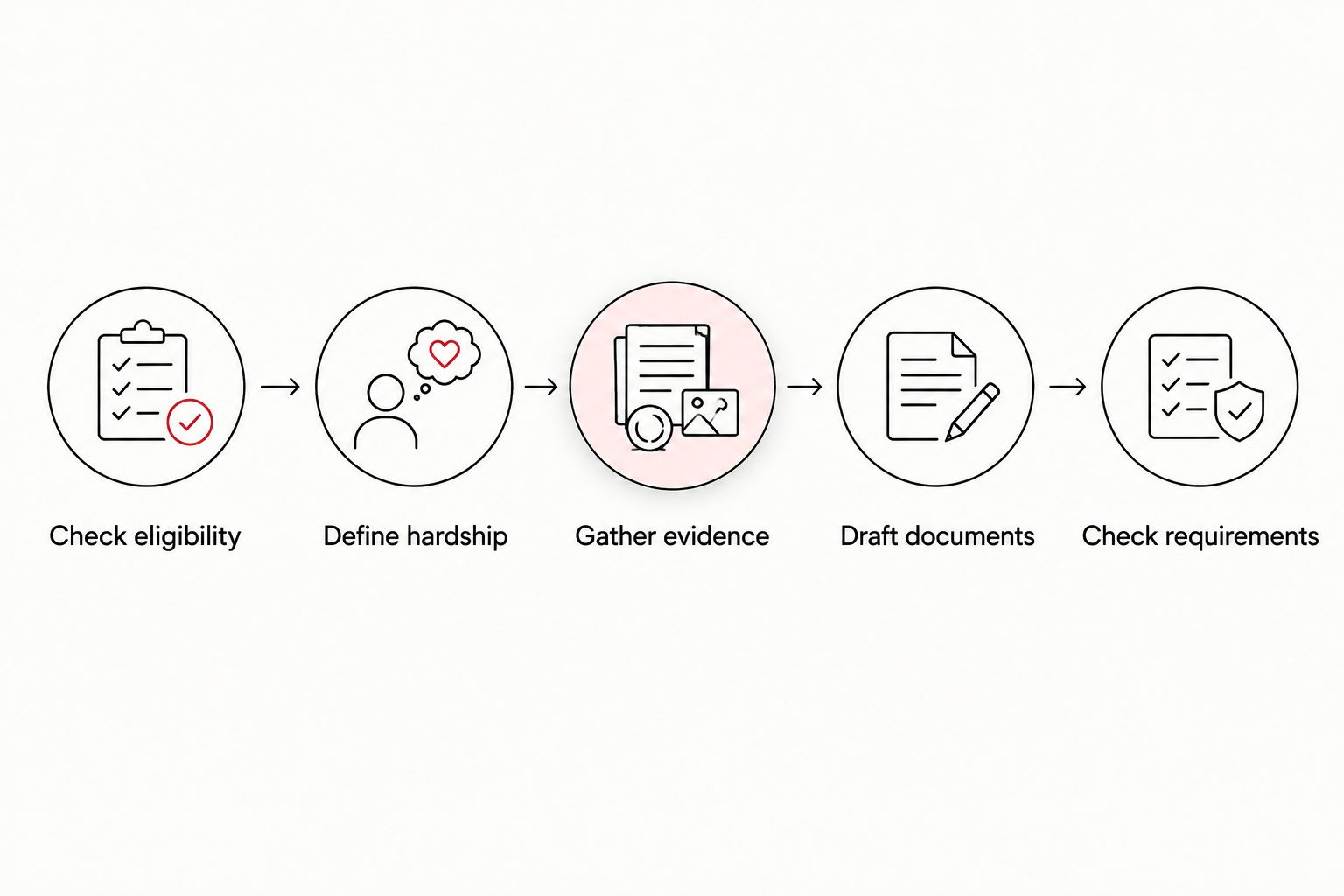
Use this sequence for a 2026 application. Confirm filing and witnessing requirements with the relevant District Court before submitting the documents.
- Check eligibility. Identify the exact suspension or disqualification and read NZTA's limited licence guidance alongside the relevant provisions of the Land Transport Act. Check whether restrictions or a waiting period affect your application. Do not treat demerit suspension and drink-driving disqualification as interchangeable.
- Define hardship. Explain what losing your licence actually prevents you from doing. Separate your own hardship from hardship affecting an employer, dependants or another person. Connect each claim to a specific consequence.
- Gather evidence. Collect material that supports those consequences. Depending on your circumstances, this can include employment information, working hours, required travel and evidence explaining why alternative transport does not meet the need. Include relevant facts, not a pile of unrelated records.
- Draft documents. Prepare the application and affidavit so the facts, dates and proposed driving arrangements agree. An affidavit is sworn or affirmed evidence, not an informal letter. Follow the official requirements for signing and witnessing it.
- Check requirements. Confirm what the court requires for filing, copies, service and any hearing. Keep a complete copy of the material you submit. Do not assume that filing an application ends the process.
A useful final check is to read the bundle without relying on anything you have said outside it. The documents should explain the hardship and the proposed driving permission on their own.
The benefit of doing this yourself is control over the wording and supporting material. The limitation is equally clear: you must recognise what is missing. If you cannot explain the legal basis for applying or the evidence behind a claim, get help before filing.
Using a document-preparation service
A document-preparation service fits a drafting problem: you know your circumstances, but you need help putting them into the application, affidavit and supporting bundle. It does not remove your responsibility to provide accurate information.
NZ Limited Licence is best for New Zealand drivers who want their limited licence application documents prepared rather than drafting the bundle themselves. The service focuses on fast, careful preparation of court-ready applications, affidavits and complete document bundles nationwide.
Bring the underlying facts, not just a request to get back to work. Useful information includes the reason you lost your licence, the work affected, the journeys you need to make and the alternatives you have considered. Explain anything that makes your circumstances different from a standard example.
The advantage is help with preparing and organising the paperwork. The boundary matters: preparation does not guarantee approval, determine eligibility by itself or give you permission to drive. If you need advice about a disputed legal issue or representation, discuss that need with a lawyer.
Before engaging a service, establish what it prepares and what you still need to do. Ask about supporting evidence, signing, filing and any court attendance. Keep those responsibilities clear rather than assuming every stage is included.
Get help preparing your application
NZ Limited Licence prepares applications, affidavits and complete document bundles nationwide.
Hiring a local lawyer
A lawyer fits a legal-advice problem. Choose this route when you need someone to assess your legal position, explain a complication or represent you in court, rather than only prepare documents from the facts you supply.
Explain the suspension or disqualification accurately when making your enquiry. Provide the relevant notices or court information and describe the driving permission you want. Ask whether the proposed engagement includes advice, drafting, filing and representation.
The advantage is access to legal advice and, where agreed, representation. The limitation is that you still need to supply the facts and evidence. A lawyer cannot replace missing employment details or explain a journey you have not described.
For a 2026 application, choose help by scope, not by label. Document preparation and legal representation solve different problems. Establish which problem you have before deciding who should handle it.
Why the preparation work varies
The work involved depends on the facts your application must establish. These factors change what you need to explain and support:
- The reason you lost your licence. A demerit suspension and a court-imposed disqualification require different eligibility and timing checks.
- Who experiences the hardship. Your application must distinguish exceptional hardship to you from undue hardship to another person.
- The driving you seek. Your proposed work journeys, hours and purposes need to match the hardship described.
- The alternatives available. Explain public transport, lifts, changed duties or other options in relation to your actual circumstances.
- The evidence you can provide. Supporting documents need to substantiate the important claims and agree with the affidavit.
- The assistance you need. Drafting support is different from legal advice about eligibility or representation at a hearing.
A short application is not automatically weak, and a long application is not automatically persuasive. Relevance matters. Remove repetition, but keep the facts needed to understand each hardship claim.
What evidence should I put in a work licence application?
Your evidence should support the hardship you describe and the driving permission you seek. Explain your work requirements, the consequences of not driving and why practical alternatives do not resolve the problem. Use supporting material that confirms those facts rather than relying on a general statement that you need your car.
Make the work need specific
Describe the duties that require travel, where that travel occurs and how it relates to your work. Distinguish commuting from driving during the working day. If both matter, explain both rather than combining them into a vague claim.
Employer information should match your account. Where you rely on consequences for another person or business, show the connection between your inability to drive and the hardship claimed. Avoid asking the court to infer that connection.
Explain alternatives honestly
List the realistic alternatives and explain their limits. If a lift covers one journey but not another, say so. If public transport serves the route but not the required working hours, identify that mismatch using your actual schedule.
Do not dismiss alternatives with a single word. Equally, do not claim an option is impossible when it is merely inconvenient. The application needs an accurate account of the problem.
Keep the bundle consistent
Check that names, dates, work duties and proposed driving arrangements agree across the documents. Read the affidavit alongside the supporting material. Correct contradictions before signing or submitting the bundle.
For your 2026 paperwork, accuracy matters more than legal-sounding language. Use plain statements that someone unfamiliar with your circumstances can understand.
Do I need a lawyer to apply for a work licence?
You do not have to hire a lawyer simply to prepare a limited licence application. Self-preparation and document-preparation assistance are practical alternatives, but neither replaces legal advice when you need an assessment of your legal position or representation.
Can I drive once I have submitted my application?
No. Submitting a limited licence application does not authorise driving. Follow the court's decision and NZTA's licensing requirements; a limited licence is separate from the act of applying for one.
FAQ
Can I prepare my own work licence NZ documents?
Yes, you can prepare your own limited licence application documents in New Zealand. You still need to check eligibility, provide evidence of hardship and follow the court's application requirements.
Is a work licence the same as a limited licence?
Work licence is a common term for a limited licence sought for work-related driving. The permission is restricted; it does not restore unrestricted driving rights.
Do I have to prove that I will lose my job?
The legal test is exceptional hardship to you or undue hardship to another person, not simply a statement that you might lose your job. Explain the actual consequences and support the important claims with evidence.
Can I get a limited licence after a demerit suspension?
A demerit suspension can be a basis for seeking a limited licence, subject to eligibility and the court's decision. NZTA states that 100 or more demerit points within 2 years results in a 3-month suspension; suspension does not itself establish entitlement to a limited licence.
Can I use the same application for a drink-driving disqualification?
Do not assume a demerit application can be reused unchanged for a drink-driving disqualification. Check eligibility, any waiting period and the requirements that apply to the actual disqualification.
What does NZ Limited Licence prepare?
NZ Limited Licence prepares limited licence court applications, affidavits and document bundles across all 58 District Courts in New Zealand. The service prepares the paperwork; the court decides whether to grant the application.
Should I choose a document service or a local lawyer?
Choose document preparation when you need help drafting the application bundle, and choose a lawyer when you need legal advice or representation. Confirm the scope of the work before engaging either.
Where should I check the official requirements in 2026?
Check NZTA's limited licence guidance, Ministry of Justice application guidance and the relevant provisions of the Land Transport Act 1998. Confirm current filing requirements with the District Court handling your application.
One last thing
Before you sign the affidavit, check the driving permission you are asking for against the hardship you have described. Every requested journey should have a clear reason. If your proposed driving is broader than the evidence supports, resolve that mismatch before filing.
Do not confuse a prepared application with permission to drive. That distinction remains the same whether you draft the documents yourself, use a preparation service or instruct a lawyer.