
Before seeking a limited licence after drug driving in New Zealand, check the exact offence, the legal basis of your suspension or disqualification, and whether the law allows an application in your circumstances. Then check any waiting requirement, the hardship evidence you need, and the driving conditions you would ask the court to approve. Needing to drive for work does not, by itself, establish eligibility or guarantee approval.
- Limited licence NZ drug driving checks start with the offence and disqualification, not your work schedule.
- Check eligibility against current legislation before preparing a work licence application or hardship affidavit.
- NZ Limited Licence prepares application documents; the court decides whether to grant the application.
- Get legal advice if the offence, eligibility or effect of your court order is unclear.
Limited licence NZ after drug driving: what must you check?
Start with the documents that explain why you cannot drive. A description such as drug driving is not enough to determine whether a limited licence application is available.
- Identify the offence. Find the charge, statutory provision and outcome recorded in your paperwork.
- Identify the restriction. Establish whether you face a suspension, a court-ordered disqualification, or another restriction.
- Check legal eligibility. Read the current limited licence provisions and any exclusions that apply to your circumstances.
- Check timing. Confirm whether a waiting requirement applies before planning a filing or driving date.
- Assess hardship. Separate the consequences of not driving from the inconvenience of arranging other transport.
- Define the request. Identify the work, journeys, hours and vehicles your proposed application would cover.
NZ Limited Licence prepares applications, affidavits and document bundles. Resolve an uncertain eligibility question before commissioning document preparation.
Official legal starting point for 2026: New Zealand Legislation, Land Transport Act, sections 103–105. Read the current provisions together, including the eligibility restrictions, rather than relying on a summary of hardship alone.
Why this matters
A carefully written affidavit cannot remove a legal bar to applying. Nor does a strong employment problem automatically answer questions about the offence, your driving history or an applicable waiting requirement.
Keep the legal question and the evidence question separate. First establish whether an application is legally available; then prepare evidence explaining why the court should grant the particular driving permission you seek.
For a 2026 application, use current official guidance from NZ Transport Agency Waka Kotahi alongside the legislation. Use Ministry of Justice guidance and the relevant District Court registry to check filing requirements, not to replace advice about a disputed eligibility issue.
Check the offence, not just the description
Drug driving describes a subject, not a complete legal position. Your charge paperwork and court order provide the detail needed to identify the relevant provisions.
Read the actual documents. Do not reconstruct the offence from a conversation, an appointment reminder or what happened to another driver.
Collect the source documents
Put the following together before asking someone to assess your situation:
- The charge or offence notice identifying the statutory provision.
- The court order or notice recording the restriction on driving.
- The start date and duration shown in that paperwork.
- Documents about any other current suspension or disqualification.
- Relevant previous orders or convictions for a lawyer to assess.
These documents answer different questions. The offence identifies the legal starting point; the order records what the court imposed; other restrictions establish whether another issue also needs attention.
If the wording is unclear, ask a lawyer to interpret it. Do not choose an application route from the phrase drug driving alone.
Keep pending proceedings separate from a final order
Tell the person advising you whether your case is still before the court or whether an order has already been made. Also identify any separate notice affecting your ability to drive.
Do not assume an upcoming hearing, an existing suspension and a final disqualification have the same effect. Take each document to the adviser so the advice addresses your actual position.
Check eligibility before writing the hardship story
The Land Transport Act sets the legal framework for limited licences. Sections 103–105 are the official starting point for checking availability, restrictions and the grounds for an order.
For your 2026 application, ask a precise question: Does the current law allow someone with this offence, this order and this history to apply? That is more useful than asking whether people convicted of drug driving can generally get a work licence.
A lawyer assessing eligibility needs the underlying paperwork. Giving only the length of the disqualification leaves out the offence and other facts relevant to the assessment.
What should you confirm about timing?
Confirm whether your circumstances carry a waiting requirement and when any relevant period starts. Keep the date written in the order separate from a date you have calculated yourself.
Do not promise your employer a return-to-driving date because documents are being prepared. Preparation, court consideration and the steps required before lawful driving are separate matters.
What if another restriction also applies?
Identify every current restriction when seeking advice. An answer about a single disqualification does not establish your position under a separate suspension or order.
Ask the adviser to explain what each restriction means for the proposed application. Keep that explanation with your preparation notes so the application is built around the right facts.
Show hardship with facts the court can assess
Section 105 of the Land Transport Act distinguishes extreme hardship to the applicant from undue hardship to another person. Your evidence should identify whose hardship you rely on and explain the practical consequences of losing the ability to drive.
A statement that you need your licence for work is a starting point, not a complete explanation. Describe the work, the journeys it requires, the alternatives considered and what happens without driving permission.
Explain the work requirement
Set out your role in ordinary language. Identify whether driving is the work itself, travel between work locations, or transport to a workplace.
Use supporting material that matches your situation. An employer's explanation, work schedule, contracts or business records can help substantiate the facts you describe; choose relevant evidence rather than adding unrelated paperwork.
For self-employed applicants, distinguish the business consequence from the personal consequence. Explain what work cannot be completed and support any financial claim with records rather than an unsupported estimate.
Explain the alternatives
Address public transport, lifts, taxis, changed duties and other arrangements that are genuinely relevant to you. Explain what you checked and why an option does or does not meet the particular work requirement.
Be specific without overstating the problem. A bus route that does not serve the workplace is a different issue from a service that runs outside your shift hours.
Explain hardship to someone else separately
If another person would experience hardship, identify that person and describe the effect on them. Do not assume your own employment difficulty proves someone else's hardship.
Keep the account factual. Explain the dependency, the task affected and the alternatives considered, then provide supporting evidence where available.
Build the driving request around actual journeys
A useful preparation exercise is to connect every requested journey to a stated need. Broad wording leaves the reader guessing about where you intend to drive and why.
For a 2026 application, use current work arrangements. Check that the affidavit, supporting letters and proposed driving conditions describe the same duties and schedule.
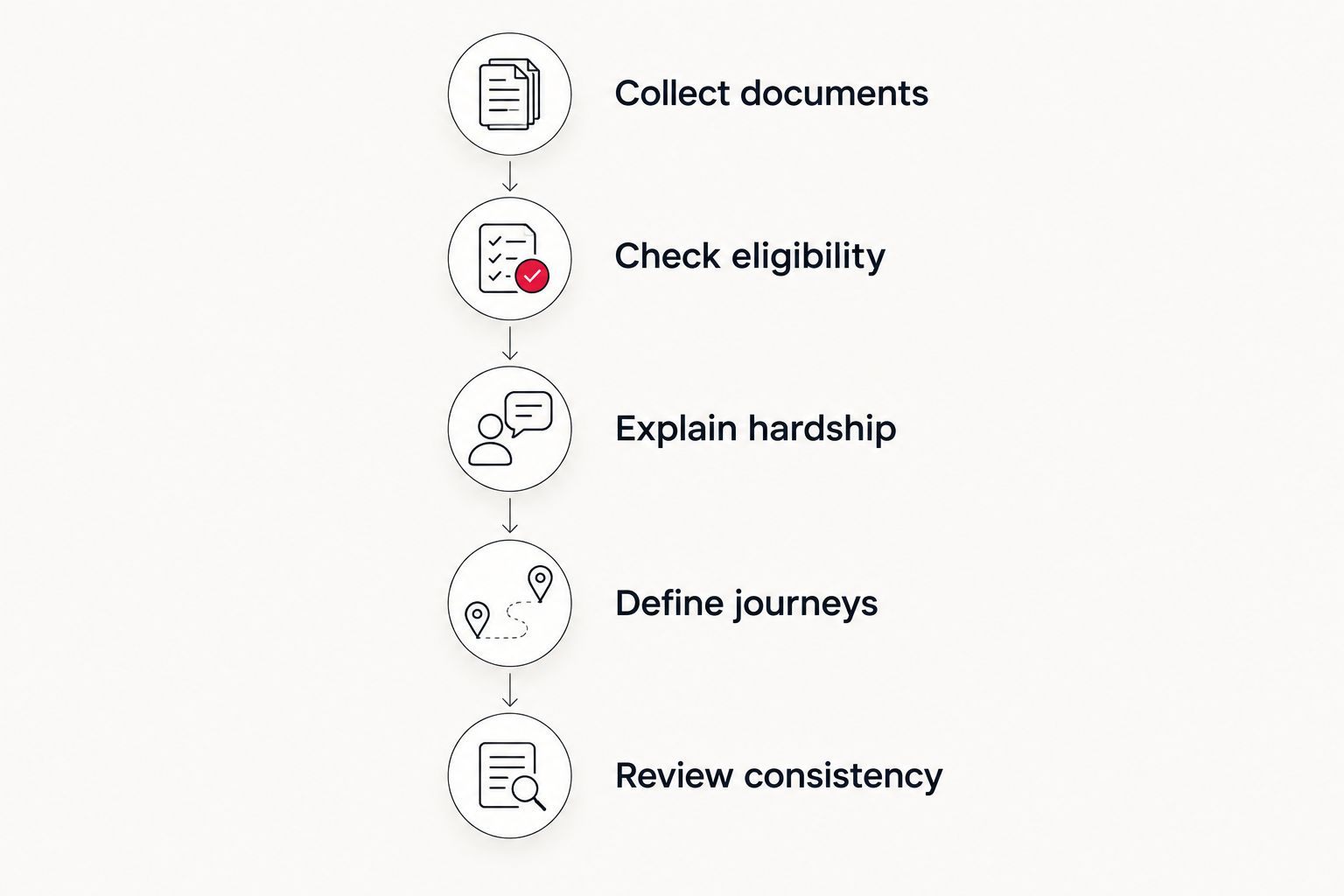
Use this sequence to organise your preparation:
- Collect documents: assemble the order, offence details and supporting records.
- Check eligibility: resolve the legal route and any timing issue.
- Explain hardship: describe the consequences and transport alternatives.
- Define journeys: connect locations, hours and vehicles to the need.
- Review consistency: compare every document before finalising the bundle.
If your hours change, explain how the roster works. If your work locations change, explain how those locations are assigned rather than presenting a fixed schedule that does not reflect your job.
Ask for driving that your evidence explains. Do not add personal errands to a work-based request without addressing their purpose and legal basis with your adviser.
Prepare it yourself, use document preparation or hire a lawyer?
Choose the help that matches the unresolved problem. A drafting problem and a disputed legal question are not the same thing.
| Option | Best for | Main advantage | Main limitation |
|---|---|---|---|
| Prepare documents yourself | Applicants ready to understand the requirements and organise their own evidence | You control the drafting and supporting material | You must identify the requirements and resolve inconsistencies yourself |
| Document-preparation service | Applicants seeking help turning their facts into an application bundle | Focused help preparing applications, affidavits and supporting documents | Preparation does not decide eligibility or secure court approval |
| Local lawyer | Applicants needing advice about eligibility, an unclear order or a contested issue | Legal advice directed at the facts and legal questions | You need to confirm the scope of advice and any representation separately |
NZ Limited Licence is best for drivers seeking limited licence document preparation rather than a substitute for legal advice. The service prepares court-ready applications, affidavits and complete document bundles across all 58 District Courts in New Zealand, with fast, careful preparation.
Choose legal advice first where the offence or order needs interpretation. Once the legal route is clear, decide whether you want to draft the documents yourself or pay for preparation support.
Prepare your application documents
Get help preparing your limited licence application, affidavit and document bundle.
Why does the preparation needed vary?
The paperwork should follow your circumstances, not a generic account of drug driving. These factors determine what you need to clarify or substantiate:
- The exact offence: it identifies the provisions relevant to the eligibility check.
- The restriction imposed: the order or notice establishes the starting point for advice.
- Other driving restrictions: disclose each one so none is overlooked.
- The hardship relied on: your own hardship and another person's hardship need distinct explanations.
- The work pattern: changing shifts, locations or vehicles require an accurate description.
- The evidence available: supporting records should substantiate the claims in the affidavit.
For 2026, check the current official requirements rather than copying an older application. Another person's bundle is not proof that the same legal route or proposed conditions fit your case.
Can I apply if I need to drive to keep my job?
Needing to keep your job does not establish eligibility by itself. Check the legal route first, then explain the employment consequences and the transport alternatives with supporting evidence.
Does paying for preparation guarantee a limited licence?
Paying for preparation does not guarantee a limited licence. Document preparation produces the application material; the court makes the decision under the applicable law.
Can I drive once my application is filed?
Filing an application is not permission to drive. Check the official requirements for obtaining and using a limited licence, and do not drive until you are legally authorised to do so.
FAQ
Can I get a limited licence after drug driving in NZ?
Eligibility depends on the exact offence, your restriction and the current law. Check the limited licence provisions in the Land Transport Act and get legal advice if their application to your case is unclear.
What should I check before paying for application documents?
Check that an application is legally available in your circumstances. Also clarify any waiting requirement and identify the hardship evidence your proposed application needs.
Is a work licence different from a limited licence?
Work licence is a common description of a limited licence sought for work-related driving. The permission you receive is governed by the actual licence and its conditions, not the informal name.
What evidence should my employer provide?
Your employer should explain the relevant job duties, driving requirements and consequences of being unable to perform them. The explanation should match your affidavit and actual work arrangements.
Do I need a lawyer or a document-preparation service?
Use a lawyer when you need legal advice about eligibility, an unclear order or a disputed issue. Use document preparation when you need help assembling the application material and have resolved the legal route.
Will a complete document bundle guarantee approval?
A complete document bundle does not guarantee approval. The court assesses the application under the applicable legal requirements.
Which official sources should I check in 2026?
Check New Zealand Legislation for the current Land Transport Act provisions and NZ Transport Agency Waka Kotahi for limited licence guidance. Use Ministry of Justice guidance and the relevant District Court registry to confirm filing requirements.
One last thing
Before sending your documents for preparation, write down the exact offence provision and the restriction recorded in your order. That small step keeps the application focused on your actual legal position rather than the broad label drug driving.
NZ Limited Licence prepares the documents. Establish the legal route first, then build the evidence around the driving you genuinely need.