
Changing employer does not automatically change the conditions of your New Zealand work licence. Your new job’s driving must fit the conditions in your existing court order and limited licence; if it does not, arrange the necessary change before making those trips. Check the employer, work purpose, hours, routes and vehicle restrictions rather than assuming that permission to drive for one job covers another.
- Work licence NZ changing employer: check your existing conditions before driving for the new job.
- A new employer’s permission does not change a court order or limited licence.
- Compare your new hours, routes and vehicle against the driving already authorised.
- NZ Limited Licence prepares limited licence application documents; the court decides whether to authorise driving.
Why this matters
A work licence is not general permission to drive whenever work requires it. A job change can alter the journeys you need, even when your occupation stays the same. The important question is whether the new driving fits the permission you already hold.
For your 2026 job change, start with the paperwork, not your start date. NZ Limited Licence prepares limited licence applications, affidavits and document bundles across all 58 District Courts in New Zealand. Document preparation and the court’s decision are separate.
NZTA’s limited-licence guidance explains that limited licences carry conditions. The Land Transport Act’s limited-licence provisions govern the court’s authority. Use those official sources when checking the legal framework, and your own order and licence when checking what you personally can do.
What happens to your work licence NZ if you change employer?
A new job does not rewrite your work licence. Read the actual wording before deciding whether a change is needed. An order naming your former employer raises a different issue from conditions that describe permitted employment driving without naming a particular business.
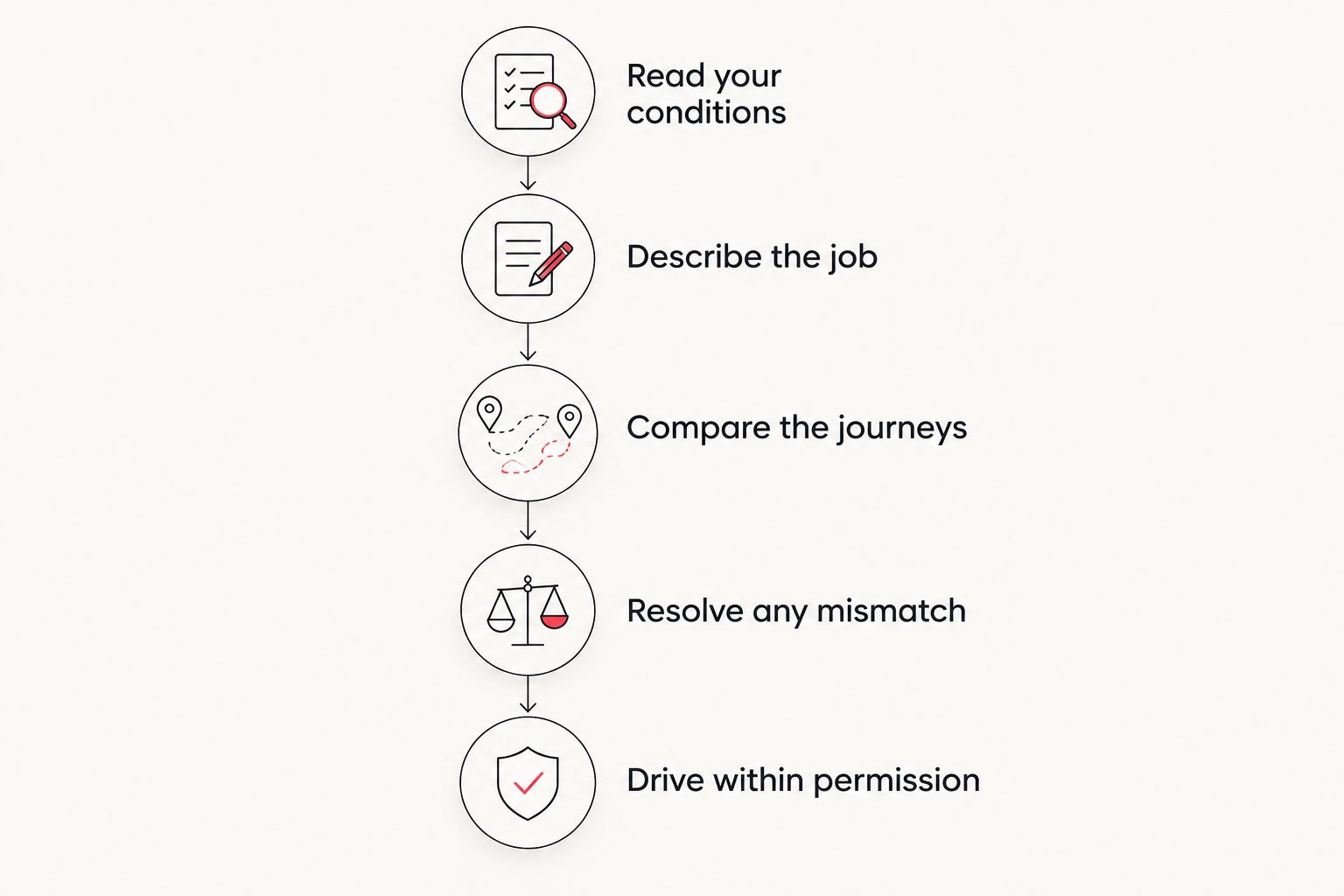
Follow these steps before your first driving shift.
- Read your conditions. Put the court order and limited licence together. Check employer names, permitted purposes, days, times, areas, routes and vehicle restrictions wherever they appear.
- Describe the new job. Record the employer’s legal name, workplace, duties, expected hours, driving destinations and proposed vehicle. Separate commuting from driving during work.
- Compare the journeys. Check whether each proposed trip fits the existing conditions. A similar job title does not establish that different journeys are covered.
- Resolve any mismatch. Contact the court registry about the process for changing the order, and obtain legal advice where the meaning or scope is unclear. Check NZTA’s requirements for any corresponding licence change.
- Drive within permission. Do not treat a pending request, an employer letter or an expected outcome as permission to drive outside your current conditions.
Keep 2 documents together for this check: your court order and your limited licence. If the wording appears inconsistent, get it clarified rather than choosing whichever version suits the new job.
Which parts of the new job need checking?
An employer change can affect several conditions at once. Use this comparison to identify the issue you need to resolve, not to decide eligibility from a job description alone.
| Change | What to compare | Practical next step |
|---|---|---|
| Employer | Any named employer or employment restriction | Check whether the wording covers the new business |
| Workplace | Permitted destinations, area or route | Compare the actual journey to the new workplace |
| Hours | Authorised days and driving times | Include travel before and after the shift |
| Duties | The work purpose described in the conditions | Separate commuting from deliveries, visits or other work travel |
| Vehicle | Any vehicle identification or class restriction | Check the replacement vehicle before using it |
Do not stop at the employer’s trading name. A business name on a uniform, the legal employer on an agreement and the workplace address answer different questions. Give whoever reviews your documents the actual employment details.
For example, moving to another depot changes your journey even if your duties stay identical. A new role with customer visits also raises a different driving question from a role based entirely at one workplace. Describe the work you will actually do.
Why the effect of changing employer varies
The effect depends on your existing conditions and the new driving required. These are the main points to check:
- Employer wording: A condition tied to a named business needs close attention when that employment ends.
- Driving purpose: Travel to work and driving as part of work are different activities. Check which activity the wording permits.
- Working hours: A changed roster can move travel outside authorised driving times, including the journey home.
- Location and routes: A different depot, worksite or customer area changes where you need to drive.
- Vehicle details: A replacement company vehicle needs checking against any vehicle or licence-class conditions.
- Employment arrangements: Moving from employment to contracting or self-employment changes the facts you need to explain.
For a 2026 application or enquiry, provide current information rather than simply replacing the employer’s name in an old statement. The new duties, travel and supporting evidence should tell the same story.
What should you gather before asking for a change?
Prepare a clear account of what has changed. The registry can explain filing procedure; a lawyer can advise on your legal position. Neither task is helped by an incomplete description of the new driving.
Gather the following as a practical starting point, then confirm what your particular application requires:
- Your existing court order and limited licence.
- The new employer’s name and workplace details.
- An employment agreement, offer or other evidence explaining the new role.
- A statement of ordinary hours and any roster variations.
- A description of commuting and driving during work.
- Relevant vehicle details.
- An explanation of the consequences if you cannot make the proposed journeys.
Describe the change precisely. If you previously drove only to a fixed workplace but now need to visit customers, explain that difference. A general statement that you need a licence for work leaves the actual request unclear.
Do not sign an affidavit until its contents are accurate and you understand them. Check names, addresses, duties and hours against the supporting documents. Keep an unchanged copy of what you submit so you can answer questions consistently.
How do you get conditions changed?
Start with the order you already have. Ask the court registry how to seek a change to that order, what documents are required and how the application must be filed. Get legal advice if you need help deciding what to request or interpreting the existing restrictions.
The guide to changing your limited licence conditions addresses the wider issue. An employer change should be explained alongside any changes to hours, locations, duties or vehicles, rather than treated as an isolated name correction.
For the legal framework in 2026, consult the limited-licence provisions published by NZ Legislation and NZTA’s limited-licence guidance. Confirm the current procedural requirements with the court registry. Do not assume that submitting documents completes the process or changes your permission immediately.
After any decision, read the resulting order carefully. Check with NZTA what is required before driving under amended conditions. Keep the distinction clear: requesting a change, obtaining a court decision and holding the necessary driving authority are not interchangeable.
Should you prepare documents yourself, use a service or hire a lawyer?
You have 3 practical options for handling the paperwork and advice. Choose according to the task you need completed, not simply whether the employer change sounds straightforward.
| Option | Best for | Main benefit | Limitation |
|---|---|---|---|
| Prepare documents yourself | Drivers comfortable checking requirements and drafting evidence | You control the wording and document collection | You take responsibility for understanding requirements and keeping the bundle consistent |
| Document-preparation service | Drivers wanting help preparing application documents | Support with drafting and assembling the paperwork | Document preparation does not decide eligibility or guarantee the court’s decision |
| Local lawyer | Drivers needing legal interpretation, advice or representation | Advice on how the law applies to the particular circumstances | Confirm the scope of advice, drafting and representation before instructing |
NZ Limited Licence is best for drivers who want limited licence application documents prepared rather than preparing the bundle themselves. The service prepares applications, affidavits and complete document bundles nationwide, with fast, careful preparation.
For an employer change, explain that you already hold a limited licence and provide the existing paperwork before agreeing on the work required. If your main question is whether disputed wording permits a particular journey, seek legal advice rather than treating document drafting as a substitute.
Get help preparing your documents
NZ Limited Licence prepares limited licence applications, affidavits and complete document bundles nationwide.
Can I drive to my new job while a change is being considered?
You can drive only within your existing lawful permission while a requested change is being considered. Sending an application does not extend the driving conditions you currently hold. If the new journey falls outside them, arrange another way to travel.
Tell the new employer about the restriction before a driving shift is scheduled. An employer’s willingness to let you drive does not change the court order or limited licence. Keep the proposed start date separate from the date you are legally authorised to make the required trips.
Do I need a change if my hours and route stay the same?
Unchanged hours and routes do not settle the employer question. Read whether the conditions also restrict the employer, work purpose, workplace or vehicle. Every relevant restriction needs to fit, not just the travel time.
If the wording does not name an employer, do not add a restriction that is not there. Equally, do not assume broad wording covers a new arrangement without checking the full order and licence. Get advice when the interpretation affects whether you can lawfully drive.
Can my new employer’s letter replace a court change?
An employer letter does not amend your court order or limited licence. It can explain the role, hours, travel requirements and effect of being unable to drive, but it is evidence rather than permission.
Ask for a factual letter that matches the job you will actually perform. Avoid broad requests for unrestricted driving when the job requires identifiable journeys. Accurate details make the request clearer without promising a particular outcome.
FAQ
Does my work licence automatically end when I leave my employer?
Changing employer does not automatically rewrite or cancel your limited licence conditions. Check whether the existing wording still authorises the proposed driving, especially where it names the former employer.
Can I use my work licence for a new employer in 2026?
You can use it only for driving covered by your current lawful conditions. Compare the new employer, duties, hours, routes and vehicle with your order and limited licence before making the trip.
What if my new employer needs me to start driving immediately?
An immediate start does not extend your driving permission. Arrange another way to travel or duties that do not require driving outside your existing conditions while you resolve the change.
Do I need to check a new company vehicle as well?
Yes, check a new company vehicle against any vehicle and licence-class restrictions in your existing conditions. Permission connected with your work does not remove separate vehicle restrictions.
Who decides whether my work licence conditions can change?
The court decides applications concerning the court order. Check with the registry about procedure and with NZTA about any corresponding limited-licence requirements before driving under changed conditions.
Can NZ Limited Licence guarantee approval for my new job?
No document-preparation service can guarantee the court’s decision. NZ Limited Licence prepares limited licence applications, affidavits and document bundles; the court decides the application.
One last thing
Check the journey home, not just the start of the shift. A roster can look compatible until overtime or a late finish pushes your return trip outside the permitted hours. Build the travel you actually need into your 2026 check before agreeing to driving duties.