
Passenger-service drivers’ limited licence applications seek permission for specific non-passenger-service driving, not a return to carrying paying passengers. A limited licence cannot authorise you to drive a passenger service vehicle. For your 2026 application, separate your taxi, rideshare, shuttle or bus work from any other driving you need, then check whether that other driving can support an application.
- Limited licence NZ passenger service checks start with NZTA’s rule: a limited licence cannot authorise passenger-service driving.
- Separate passenger-service work from commuting or other proposed driving before preparing evidence.
- A passenger endorsement and a limited licence serve different purposes; neither replaces the other.
- NZ Limited Licence prepares application documents; the court decides whether to grant an order.
Why limited licences matter for passenger-service drivers
Losing driving income creates a practical problem. But evidence that your income depends on carrying passengers does not remove the restriction on passenger-service driving.
NZTA’s official limited-licence guidance is the starting point for that restriction. Its passenger-endorsement guidance addresses a separate issue: the authority needed for passenger-service work. Read both before deciding what to request in 2026.
You need 3 separate checks: whether you can apply, whether the proposed driving is permitted, and whether your evidence supports the hardship claimed. Passing one check does not settle the others.
Start by separating the journeys in your proposed work routes. A journey to another job is different from a journey transporting customers. Describe the actual activity, not just the vehicle or your job title.
This guide covers document preparation and the questions to resolve before filing. Get legal advice where your eligibility, disqualification or proposed vehicle use is uncertain.
How to prepare a passenger-service driver’s application
Check the passenger-service restriction first
Read NZTA’s official limited-licence guidance before collecting employer letters or writing an affidavit. The restriction on passenger-service driving is the first decision point, not a detail to address after drafting.
A work-related purpose does not automatically make driving eligible. Calling a journey essential, urgent or your only income source does not change the kind of driving involved.
Do not prepare an application on the assumption that hardship overrides the passenger-service restriction. If your only proposed driving is carrying customers, resolve that issue with a lawyer before paying for document preparation.
- Identify whether each proposed journey involves passenger-service work.
- Describe the actual service, including who is being transported.
- Check NZTA’s limited-licence guidance for the restriction.
- Ask a lawyer about any uncertainty over vehicle use.
- Remove assumptions that an employer’s support creates permission.
Separate the driving you actually need
Write down each proposed journey yourself. A plain list is enough to begin; you do not need a polished affidavit at this stage.
Distinguish 2 different trips: driving to a workplace and driving passengers as the work itself. For example, travelling to a separate non-driving role raises different questions from collecting a fare-paying customer. This distinction does not establish eligibility, but it prevents the application from asking for the wrong activity.
Do not assume that an empty passenger-service vehicle is automatically outside the restriction. Vehicle use and the proposed activity need careful checking. Where that distinction matters, get legal advice rather than changing the label on the journey.
- List the purpose of each journey.
- Record the start and destination.
- State whether customers would be carried.
- Identify the vehicle you propose to use.
- Separate commuting from driving performed during work.
Choose the right preparation support
Start by reading the Ministry of Justice’s official limited-licence application information and reviewing the required documents. That gives you a practical way to assess whether you can prepare the application yourself.
Use document preparation when you need help turning your circumstances and supporting evidence into the application bundle. Use a lawyer when you need legal advice about eligibility, disputed facts or the passenger-service restriction.
NZ Limited Licence is best suited to drivers seeking document preparation, not permission to carry passengers. NZ Limited Licence prepares court-ready applications, affidavits and complete document bundles across all 58 District Courts in New Zealand. Its service focuses on fast, careful preparation; the court’s decision remains separate.
- Review the official application requirements yourself first.
- Identify whether your difficulty is paperwork or legal uncertainty.
- Choose document preparation for help assembling the application.
- Choose a lawyer for advice about a disputed legal position.
- Confirm what support is included before instructing anyone.
Build evidence of the actual hardship
Start with records you already hold: your suspension or disqualification documents, work arrangements and evidence of the consequences of being unable to drive. Keep the account factual.
The legal test concerns extreme hardship to you or undue hardship to another person. The Land Transport Act’s limited-licence provisions are the official source for that distinction. An inconvenience and a supported hardship claim are not interchangeable.
For a passenger-service driver, explain which consequences relate to prohibited passenger work and which relate to the driving you actually seek. Do not present lost fare income as proof that passenger-service driving can be authorised.
- Describe the consequence of each missed journey.
- Attach records that support the claimed work arrangement.
- Explain who else is affected and how.
- Record alternative transport you have investigated.
- Keep estimates clearly separate from confirmed figures.
Match the proposed conditions to the evidence
Draft a practical outline of the driving requested before turning it into formal documents. Describe the purpose, area, vehicle and work pattern without asking for unrestricted driving.
Passenger-service rosters and customer destinations can change. That does not justify a request to drive anywhere at any time. Your proposed conditions must address eligible driving and be supported by the facts you provide.
For a 2026 application, use current work information rather than an old roster that no longer represents your circumstances. Explain any genuine variation directly. Do not conceal it behind wording that sounds precise but is inaccurate.
- Identify the specific non-passenger-service purpose.
- Describe the necessary driving area.
- Provide the relevant work hours or changing pattern.
- Identify the proposed vehicle accurately.
- Check that every requested condition has supporting evidence.
Check the application bundle for consistency
Read the application, affidavit and supporting material together. You can do this manually by comparing each document against your original journey list.
The same proposed driving should appear consistently throughout. An affidavit describing commuting should not sit beside an employer letter asking for a return to passenger duties. That mismatch needs resolving before filing, not an explanation added later.
NZ Limited Licence prepares the application, affidavits and document bundle from the information supplied. Careful preparation helps organise that information, but you remain responsible for providing truthful facts and checking the documents before signing.
- Match names and licence details across documents.
- Check the suspension or disqualification information.
- Compare the requested driving with the employer’s description.
- Remove contradictory explanations of your duties.
- Follow the applicable signing and witnessing instructions.
Confirm the authority before you drive
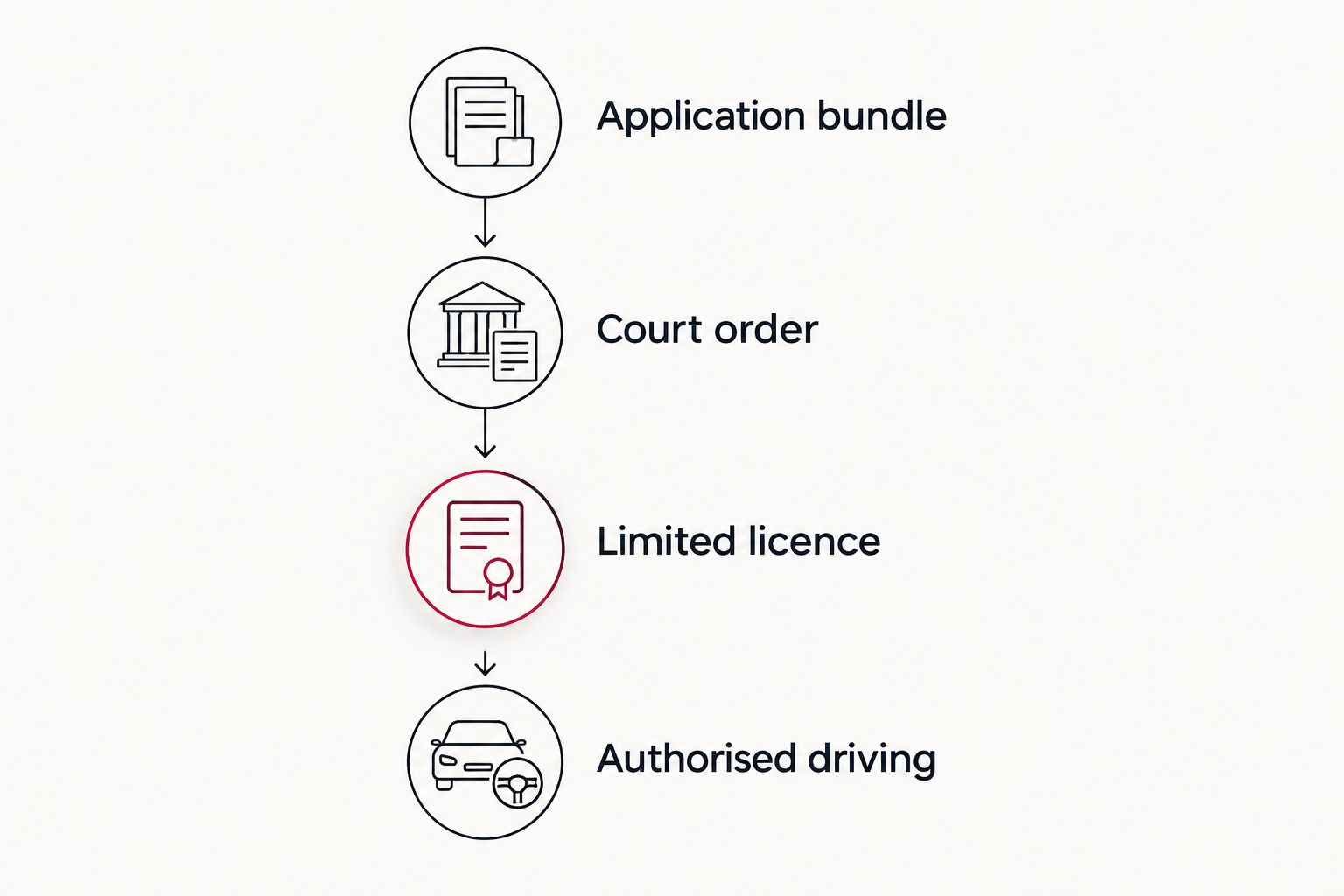
Keep document preparation, the court order and the issued limited licence separate in your thinking. A completed bundle is not permission to drive. Filing an application is not permission either.
Follow the Ministry of Justice’s official procedural information and NZTA’s instructions for obtaining the limited licence after a court order. Check the actual conditions before any driving begins. Do not treat a successful application as restoration of all previous driving privileges.
For your 2026 return-to-driving plan, also check the status of any passenger endorsement with NZTA. A limited licence does not itself restore or replace that endorsement, and it cannot authorise passenger-service driving.
- Confirm the court’s decision and read the order.
- Complete NZTA’s applicable licensing steps.
- Check the issued licence and its conditions.
- Keep passenger-service work outside the authorised driving.
- Resolve any uncertainty before starting a journey.
Compare your preparation options
Choose support for the problem you need solved. Clear facts and straightforward paperwork are different from uncertainty about whether the law permits the driving you want.
These options concern preparation and advice. None can promise court approval or remove the passenger-service restriction.
| Option | Best for | Main advantage | Key limitation |
|---|---|---|---|
| Prepare documents yourself | Drivers comfortable reading official requirements and organising evidence | You control the drafting and supporting material | You must identify inconsistencies and resolve legal questions separately |
| NZ Limited Licence document preparation | Drivers needing applications, affidavits and a complete document bundle | Fast, careful preparation for applications nationwide | Document preparation does not decide eligibility or guarantee approval |
| Local lawyer | Drivers needing legal advice about eligibility, objections or proposed driving | Advice tailored to the legal issues in your circumstances | Check the agreed scope; advice, drafting and representation are different tasks |
An orderly bundle cannot fix a request for driving that cannot be authorised. Equally, a clear legal position still needs accurate supporting documents. Settle the legal question first, then choose the preparation route.
Prepare your application documents
Get help preparing your application, affidavits and complete court document bundle.
Common mistakes passenger-service drivers make
Treating a passenger endorsement as permission to drive
A passenger endorsement is not a limited licence. Check the status of each authority separately with NZTA; holding an endorsement does not cancel a suspension or disqualification.
Asking to resume the same passenger duties
A letter saying you need to return to taxi, rideshare, shuttle or bus duties does not overcome the passenger-service restriction. Ask the employer to describe any genuine alternative duties accurately, without inventing a role to support an application.
Mixing lost income with the driving requested
Lost passenger-service income explains your circumstances, but it does not establish that the court can authorise that work. Connect the evidence to the specific eligible driving you are requesting.
Assuming preparation means approval
A signed affidavit, completed bundle or filed application does not give you driving authority. Keep the official court and licensing steps separate from the preparation service, and do not drive while relying on an application alone.
FAQ
Can I get a limited licence to drive a taxi in New Zealand?
A limited licence cannot authorise you to drive a passenger service vehicle. NZTA’s official limited-licence guidance states this restriction; needing taxi income does not remove it.
Can I use a limited licence for rideshare work?
A limited licence cannot authorise passenger-service driving, including carrying paying rideshare passengers. Do not assume that using your own car changes the nature of the work.
Can a bus driver apply for a limited licence for other driving?
Other proposed driving needs a separate eligibility assessment. Describe the non-passenger-service journeys accurately and get legal advice if the vehicle use or purpose is uncertain.
Does a limited licence restore my passenger endorsement?
A limited licence does not itself restore or replace a passenger endorsement. Check the endorsement’s status separately with NZTA, and remember that a limited licence cannot authorise passenger-service driving.
What should my employer’s letter explain?
The letter should accurately describe your duties, work pattern and the consequences of being unable to perform the proposed eligible driving. It should not describe commuting in one place and passenger-service duties in another.
Should I use a lawyer or a document-preparation service?
Use a lawyer when you need legal advice about eligibility or disputed driving restrictions. Use document preparation when you need help preparing the application, affidavits and supporting bundle after those questions are resolved.
Can I drive once my application documents are finished?
No. Completed documents are not driving authority. Follow the court process and NZTA’s applicable licensing requirements, then drive only within the issued limited licence’s conditions.
One last thing
Before signing your 2026 application, read the proposed driving description without looking at your job title. Does it clearly describe an eligible journey, or does it quietly ask to resume carrying customers?
Accurate wording matters, but changing the wording cannot change prohibited driving into permitted driving. Resolve the activity first. Prepare the documents second.