
Shift workers’ limited licence applications in NZ are requests for restricted driving permission aimed at keeping necessary work travel possible during a suspension or disqualification. Changing rosters need a clear explanation: when you work, where you travel, and how the proposed driving limits relate to those shifts.
- Limited licence NZ shift workers applications need clear roster evidence, necessary travel details and proposed driving limits.
- NZ Limited Licence suits shift workers who need application documents prepared; the court decides whether to grant an order.
- Explain changing hours with employer evidence and actual rosters, not an unrestricted request to drive whenever needed.
- A court order and the issued limited licence are separate steps; follow NZTA’s requirements before driving.
Why limited licence applications matter for shift workers
A fixed-hours job is straightforward to describe. Rotating nights, early starts and call-outs need more explanation because your work hours and necessary travel times are not the same thing.
Your application should make that distinction easy to understand. A roster shows your shift; your evidence explains the travel needed around it and the hardship caused by losing that travel.
NZ Limited Licence prepares limited licence applications, affidavits and document bundles across all 58 District Courts in New Zealand. Document preparation helps you present the application clearly. It does not replace the court’s decision or establish that you qualify.
For a 2026 application, use the official sources that govern each stage:
- NZ Legislation’s Land Transport Act, sections 103–105: eligibility, hardship tests and limited licence orders.
- NZTA’s “Getting a limited licence” guidance: the relationship between a court order and obtaining the limited licence.
- Ministry of Justice’s limited licence guidance: court application information and procedural requirements.
Check those sources against your actual suspension or disqualification. A roster explains your work pattern; it does not resolve an eligibility issue.
How to show changing hours in your application
Check your eligibility before collecting roster evidence
Start with your suspension notice or court paperwork. Identify the reason you cannot drive and the dates that apply. Do not assume that needing a car for work makes you eligible for a limited licence.
The Land Transport Act sets the eligibility restrictions and hardship tests. Section 105 distinguishes exceptional hardship to the applicant from undue hardship to another person. Your evidence needs to address the applicable test, not simply state that driving is convenient.
For your 2026 application, check the current official guidance before choosing a filing date. If your eligibility, sentence or timing is unclear, ask a lawyer to assess it before paying for document preparation.
- Identify whether you face a demerit suspension or a court disqualification.
- Keep the notice or order that records the restriction.
- Check the relevant eligibility and timing rules in official guidance.
- Separate your work-travel evidence from any unresolved legal question.
Describe your actual shift pattern
Write a plain-language summary of your job and roster. Explain whether you rotate between days and nights, receive a weekly roster, cover overtime or work on call. Include who sets the hours and how you receive updates.
Use the manual approach first: collect your existing rosters and put them in date order. As a practical starting point, gather 4 weeks of available roster records if they show your normal pattern. That is an evidence-organising suggestion, not a court requirement; use a different period if it better explains your work.
Use 24-hour time throughout your working notes. It helps distinguish a late-night finish from a morning start, particularly when a shift crosses midnight.
- Describe your normal roster cycle without calling variable work fixed-hours work.
- Mark shift start and finish times consistently.
- Explain how far ahead you normally receive the roster.
- Identify overtime and call-outs separately from scheduled shifts.
- Note any differences between the roster and the hours actually worked.
Build evidence around the work you actually do
Ask your employer for a factual letter. It should explain your role, work locations, roster arrangements and the employment consequences of being unable to make necessary journeys. Give the employer a list of points to address, rather than asking for a general character reference.
Prepare the evidence yourself before choosing help. That means collecting genuine records, checking dates and making sure the employer’s account matches yours. NZ Limited Licence offers fast, careful preparation of applications, affidavits and complete document bundles; you still need to supply accurate facts and supporting material.
An employer letter should not promise a roster arrangement that the business cannot maintain. If shifts change regularly, explain that system openly.
- Request confirmation of your job, duties and work locations.
- Ask how shifts are assigned and changed.
- Collect rosters, shift notifications or other relevant work records.
- Explain the employment consequences using facts your employer can support.
- Check names, dates and hours across every document.
Separate shift hours from necessary driving
A shift beginning at a stated time does not explain when you need to leave home. Set out the journey separately, including the destination and the reason for any travel before or after the shift.
Start with a simple travel worksheet. Give each necessary journey its own row: departure point, destination, work purpose, expected timing and supporting evidence. Keep ordinary commuting separate from driving between workplaces during a shift.
Do not turn that worksheet into a request for unrestricted driving. The purpose is to show what permission you are asking for and why, while leaving the legal drafting and assessment to the appropriate person.
- List home-to-work travel separately from travel during work.
- Identify each regular workplace or work area accurately.
- Explain necessary travel before a start or after a finish.
- Describe employer-required driving duties separately from commuting.
- Remove personal errands that do not support the work-travel request.
Explain why alternatives do not solve the problem
Describe the transport options that relate to your actual roster. A general statement that public transport is difficult tells the reader little. Explain whether an available service reaches the workplace at the necessary time, and whether it operates after your shift ends.
Keep the account balanced. If public transport works for some shifts but not others, say so. If a colleague sometimes provides a lift, explain the arrangement and its limits without claiming that occasional help is a dependable solution.
The point is not to dismiss every alternative. It is to provide a factual account of the hardship and the journeys behind your application.
- Check transport timetables against actual shift times.
- Record the connection between the stop and your workplace.
- Explain any genuine carpool or household transport arrangements.
- Distinguish occasional assistance from an agreed ongoing arrangement.
- Describe what happens to your work when a journey cannot be made.
Make changing rosters understandable, not open-ended
Explain what stays constant when your hours change. Your employer, work purpose or usual workplaces might remain the same even when the roster changes. Separating stable facts from variable hours gives the application a clearer structure.
For a 2026 application, describe the roster system as it operates now. State who issues updates, how changes are recorded and whether you can produce those records. Do not assume that carrying a new roster automatically changes the driving conditions you are permitted to follow.
Ask your document preparer or lawyer how the proposed conditions should address that evidence. Changing work hours need clear proposed limits, not a blanket request to drive whenever work calls.
- Identify the stable parts of your employment arrangement.
- Explain which hours or locations change.
- State how you receive and retain roster updates.
- Flag overnight shifts and short-notice call-outs explicitly.
- Check that your proposed conditions match the supporting evidence.
Check the bundle and the permission before driving
Read the whole application together, not as separate documents. Your affidavit, employer letter, rosters and proposed conditions should tell the same story. Use the limited licence application bundle guide to organise the paperwork before submission.
Check the current Ministry of Justice guidance and any instructions from the relevant court about filing and procedure. Document preparation and court attendance are different tasks; confirm what help you are receiving rather than assuming one includes the other.
NZTA’s limited licence guidance distinguishes the court order from the licence issued through the licensing process. Do not drive merely because you have lodged an application or obtained an order. Complete the required licensing steps and follow the issued conditions.
- Compare names, dates, workplaces and hours throughout the bundle.
- Check the affidavit against the employer’s evidence.
- Confirm filing and hearing requirements with the relevant court.
- Read the order and issued licence conditions carefully.
- Seek advice before driving outside any permitted condition.
The application process has separate stages. Evidence supports the documents; the court decides the application; NZTA’s licensing requirements still need to be completed.
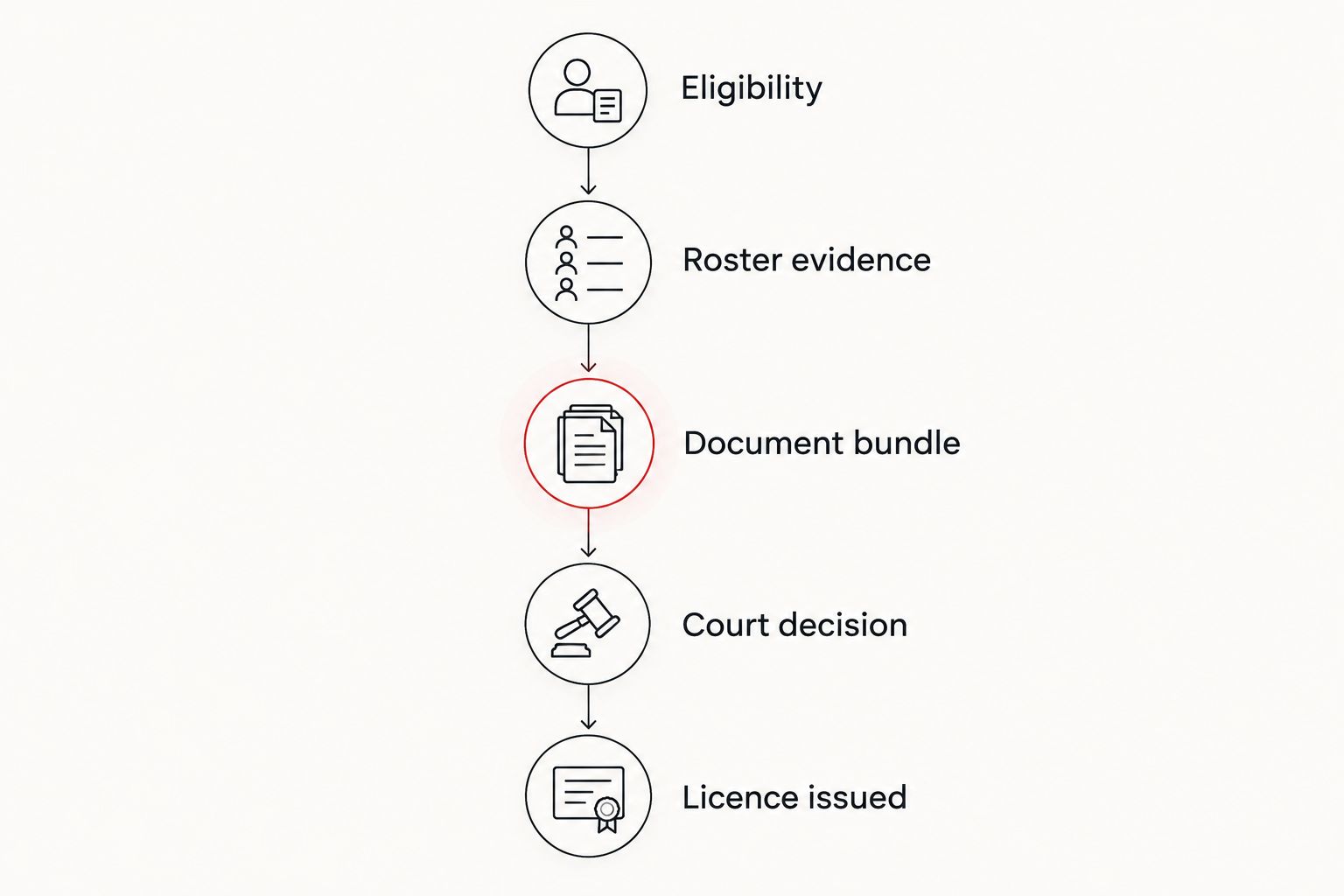
Compare your preparation options
Choose help according to the problem you need solved. Organising evidence is different from resolving a disputed legal issue, and neither guarantees approval.
For shift workers applying in 2026, the useful distinction is who prepares the documents, who advises on legal questions and what assistance is included. Confirm the scope before instructing anyone.
| Option | Best for | Main advantage | Key limitation |
|---|---|---|---|
| Prepare the documents yourself | Drivers able to follow official guidance and organise consistent evidence | You control the information and document preparation | You must handle drafting, checking and procedural requirements yourself |
| NZ Limited Licence document preparation | Shift workers needing applications, affidavits and a complete document bundle prepared | Fast, careful preparation focused on the application paperwork | Preparation does not decide eligibility or guarantee a court order |
| A local lawyer | Drivers needing individual legal advice about eligibility, proposed conditions or a complicated case | Legal advice tailored to the circumstances and the agreed instruction | The scope of preparation, advice and representation must be confirmed |
NZ Limited Licence is best for shift workers who need limited licence application documents prepared. A lawyer is the appropriate choice when your main problem is an unresolved legal question rather than assembling and drafting the paperwork.
Before choosing, ask who will draft the affidavit, what supporting records you must provide, and whether advice or representation forms part of the service. Keep those responsibilities explicit.
Get your application documents prepared
Get help preparing your application, affidavit and complete document bundle for changing work hours.
Common mistakes shift workers make
Asking for all-hours driving without explaining the work
An all-hours request does not explain which journeys are necessary. Describe scheduled shifts, overnight travel and call-outs separately so the request has a factual basis. Do not treat the possibility of overtime as proof that every hour needs to be covered.
Submitting a roster without explaining it
A roster full of codes or abbreviations is not self-explanatory. Provide a short key and explain overnight shifts, changes and work locations. The reader should not have to guess whether a marked day means a start date, a finish date or a day off.
Using an employer letter that contradicts the affidavit
A letter describing fixed daytime hours undermines an affidavit describing rotating nights. Resolve the discrepancy before submission. Check the actual employment arrangement, then correct the document that is inaccurate rather than smoothing over the difference.
Describing work pressure instead of hardship
Being busy or finding travel inconvenient is not the same as addressing the statutory hardship test. Explain the consequences and support them with evidence. Keep the account specific to your employment and the people affected, rather than relying on a broad statement about needing to drive.
Assuming a new roster changes the licence conditions
A changed shift does not itself rewrite a court order or an issued licence. Read the actual conditions and obtain advice if the new shift falls outside them. Sort that out before the journey, not after driving.
FAQ
Can I apply for a limited licence if my shifts change every week?
Changing shifts do not, by themselves, establish or rule out eligibility for a limited licence. Check the statutory eligibility rules, then explain your roster system and necessary journeys with supporting evidence.
What should my employer letter say about rotating shifts?
Your employer letter should explain your role, work locations, roster arrangements and the consequences of being unable to make necessary work journeys. It should match your affidavit and the roster records you submit.
Do I need a roster for a limited licence application?
A roster is useful evidence when your application relies on changing work hours. Explain any codes, overnight shifts and updates so the records can be understood alongside your affidavit.
Can a limited licence cover night shifts and early starts?
The permitted driving depends on the court order and issued licence conditions, not simply on your employer’s hours. Explain the night work and necessary travel in your application, and seek advice on the proposed conditions.
What if my employer changes my shift after I get the licence?
Check whether the changed journey fits the conditions you were granted before driving. A new roster does not automatically change those conditions; obtain legal advice if it falls outside them.
Should I use a document-preparation service or a lawyer?
Use document preparation when you need help drafting and organising the application paperwork; use a lawyer when you need individual legal advice. NZ Limited Licence prepares applications, affidavits and complete document bundles, while the court decides the application.
Can I drive as soon as the court grants an order?
A court order is not the same as an issued limited licence. Follow NZTA’s current licensing requirements and do not drive until you have the required licence and can comply with its conditions.
One last thing
Compare your proposed driving conditions with a different roster before submitting the application. For a 2026 shift-work application, that is a useful practical check: does the wording address the work pattern you actually described, or only the week you happened to attach?
Do not solve a mismatch by asking for unrestricted driving. Correct the evidence or seek advice on the proposed conditions. The application should explain changing work clearly; the issued permission sets the driving limits.