
Yes, you can use a company vehicle on a limited licence in New Zealand if your court order and issued licence allow that vehicle and the proposed driving. Company ownership does not give you permission to drive outside those conditions. Your employer’s permission, vehicle arrangements and work needs must fit the driving the court authorises.
- Limited licence NZ company vehicle driving depends on court-authorised conditions, not who owns the vehicle.
- Explain company vehicle access, work journeys and any vehicle changes before preparing your work licence application.
- Employer permission does not replace a limited licence or expand its conditions.
- NZ Limited Licence suits drivers seeking limited licence document preparation rather than legal representation.
Why this matters
A company vehicle can be essential to your job. But access to the keys and legal permission to drive are separate questions. A manager cannot override a suspension, disqualification or limited licence condition.
For a 2026 application, start with the driving you actually need: which vehicle, for what work, between which places and at what times. Those details belong in the application, not in an informal agreement made after the hearing.
NZ Limited Licence prepares limited licence applications, affidavits and document bundles across all 58 District Courts in New Zealand. Document preparation helps put your circumstances before the court; the court decides whether to authorise a limited licence and what conditions apply.
Official sources: The Land Transport Act, sections 103–105, sets out the application, court-order and licence-issue framework. NZ Transport Agency Waka Kotahi’s limited licence guidance explains the licensing process. Use the current legislation and official guidance for your 2026 application; neither an employer’s letter nor a prepared document bundle is permission to drive.
Limited licence NZ: can you use a company vehicle?
Yes—provided the company vehicle and each journey fall within your authorised conditions. Read the court order and issued limited licence together. If either restricts your driving to particular vehicles, purposes, areas or times, company ownership does not remove that restriction.
The practical question is not simply whether your employer owns the vehicle. It is whether your application explains the vehicle arrangement clearly and whether the resulting permission covers it.
| Vehicle arrangement | Best for | Practical advantage | Limitation to address |
|---|---|---|---|
| Assigned company vehicle | Workers who use the same vehicle for their duties | You can describe a clear, consistent vehicle arrangement | A replacement vehicle still needs to fit the authorised conditions |
| Company pool vehicles | Workers whose employer allocates different vehicles | The arrangement reflects how the workplace operates | Changing vehicles creates more detail to explain and check |
| Personally owned vehicle used for work | Workers who use their own vehicle for required work journeys | Vehicle access is separate from company fleet allocation | Personal ownership does not permit private driving outside the conditions |
Do not assume the court will approve every arrangement in the table. These are application scenarios, not different legal entitlements. The authorised conditions determine what you can actually drive.
If you already hold a limited licence, check its wording before accepting a different company vehicle. A work journey can still breach your conditions if the vehicle, time, purpose or destination is outside the permission granted.
Using an assigned company vehicle
An assigned vehicle gives you a straightforward starting point for your documents. Identify the vehicle you normally use and explain its role in your work. Include its registration details where relevant to the proposed conditions and application requirements.
Your description should connect the vehicle to actual duties. Explain whether you travel between job sites, carry tools, visit customers or perform another driving-dependent task. Use your real circumstances, not a generic statement that driving is convenient.
Separate vehicle access from hardship evidence. Being allocated a company vehicle explains what you drive; it does not, by itself, establish the hardship required for a limited licence. The application must also explain the consequences of being unable to undertake the necessary driving.
Discuss foreseeable changes before the documents are finalised. If the vehicle is regularly serviced, replaced or reassigned, say so. A predictable workplace arrangement is easier to explain accurately than an unexpected change after an order has been made.
Using company pool vehicles
Pool vehicles need a clear explanation because the vehicle allocated to you can change. Describe how allocation works and what your employer can confirm. Do not describe a fixed vehicle arrangement if that is not how your job operates.
Ask your employer whether the business can assign a consistent vehicle during the limited licence period. That is a practical question, not a legal requirement or a promise of approval. The answer helps you describe the arrangement truthfully.
If you need access to different vehicles, explain why. Distinguish a genuine operational need from a preference for unrestricted fleet access. Your proposed conditions should reflect the necessary work driving, while recognising that the court decides their final scope.
Do not assume permission for one company vehicle covers every vehicle in the fleet. Before taking another vehicle, check the actual court order and limited licence. Get advice where the wording does not clearly cover the change.
Using a company vehicle to travel to work
A company vehicle used for commuting raises a separate question from a vehicle used during your duties. Describe travel from home to work separately from travel between work locations. Do not combine both under a vague reference to business use.
Explain why you need the journey and what alternatives are available. If public transport does not match your work schedule, identify the actual mismatch. If a lift arrangement does not cover required travel, explain the gap rather than claiming no alternatives exist.
A company policy allowing you to take a vehicle home is not permission under a limited licence. Likewise, a court-authorised work journey does not automatically include shopping, family errands or other private stops.
For your 2026 application, make the distinction explicit: travel to work, driving during work and private travel are different purposes. Check each proposed purpose against the permission you seek and, later, the permission actually granted.
Why company vehicle permission varies
The court considers the application and sets the conditions. These practical differences affect what your documents need to explain:
- Vehicle allocation: A fixed vehicle and a changing pool arrangement need different descriptions.
- Driving purpose: Commuting and driving during work duties are not interchangeable explanations.
- Work schedule: Fixed shifts, changing rosters and after-hours duties require accurate evidence of the driving needed.
- Work locations: A regular workplace and changing customer or job sites create different travel requirements.
- Hardship evidence: The consequences of not driving must be explained, alongside the alternatives available.
- Existing restrictions: Your suspension or disqualification circumstances and any other applicable restrictions need to be checked before proposing driving conditions.
Describe the job you actually have, not the widest permission you would like. An application that matches your employment arrangements gives the court a clearer account of the request. It does not guarantee approval.
How do I prepare the company vehicle part of my application?
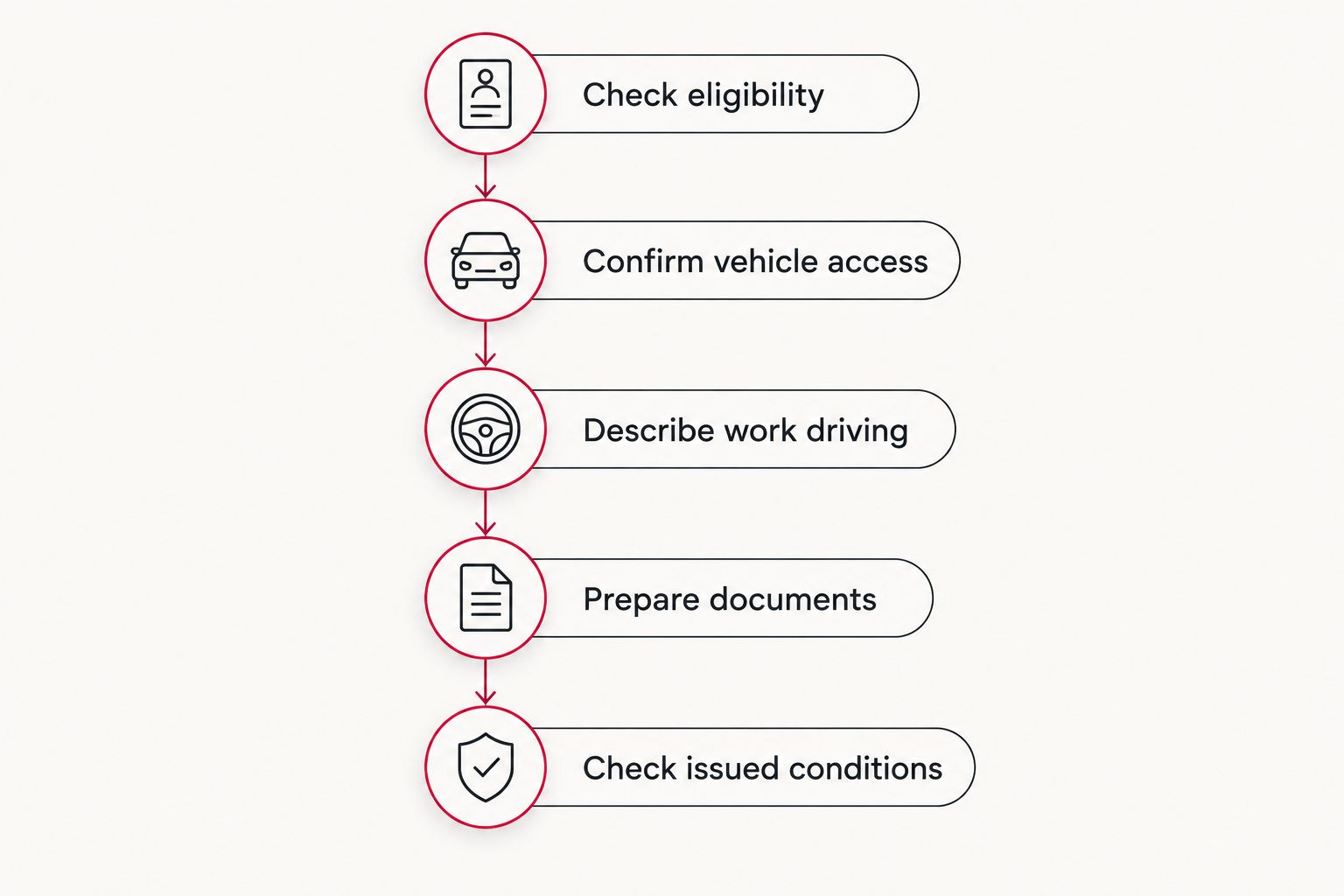
Use this sequence to organise your information before preparing the documents. The sequence separates workplace facts from the court’s decision and the later licensing step.
- Check eligibility. Confirm that your circumstances permit a limited licence application. NZTA guidance and the Land Transport Act are the starting points; get legal advice if another restriction or sentence affects your position.
- Confirm vehicle access. Establish whether you have an assigned vehicle, pool access or another arrangement. Ask what your employer can confirm in writing.
- Describe work driving. Set out the purposes, locations, schedule and vehicle details relevant to your request. Explain the hardship and available alternatives.
- Prepare documents. Make sure the application, affidavit and supporting material describe the same arrangement. Resolve contradictions before filing.
- Check issued conditions. After the court process, follow NZTA’s requirements for obtaining the limited licence. Read the permission before driving.
Your employer’s supporting information should match your own account. Check the job role, vehicle arrangement, hours and work locations against the affidavit. An employer describing flexible fleet use while your affidavit describes a permanently assigned vehicle creates a contradiction that needs correcting.
Use the limited licence application bundle guide to organise the supporting material. Keep vehicle details tied to the work and hardship you are explaining, rather than adding unrelated fleet information.
Should I prepare the documents myself or get help?
Choose the support that matches the problem you need solved. Preparing factual documents and advising on disputed legal issues are different tasks.
| Preparation option | Best for | Advantage | Limitation |
|---|---|---|---|
| Prepare documents yourself | Drivers comfortable checking requirements and organising evidence | You control the drafting and supporting material | You remain responsible for identifying requirements and resolving inconsistencies |
| Document-preparation service | Drivers who want help turning their circumstances into application documents | The service prepares the application material from your information | Document preparation is not the court’s decision or a substitute for legal advice |
| Local lawyer | Drivers needing legal advice about eligibility, disputed issues or conditions | A lawyer can advise on the legal issues within the agreed scope | Confirm whether document drafting and hearing representation are included |
NZ Limited Licence provides fast, careful preparation of court-ready applications, affidavits and complete document bundles nationwide. Choose document preparation for help with the paperwork; choose legal advice when you need a legal issue resolved. Neither choice guarantees a limited licence or permission to use a particular vehicle.
Get your application documents prepared
Prepare your limited licence application, affidavit and document bundle with your company vehicle details.
Can I change company vehicles after the court grants permission?
A replacement company vehicle must fit your existing authorised conditions. If the permission identifies a particular vehicle or otherwise limits vehicle use, do not assume an employer’s replacement arrangement changes that permission.
Check the court order and licence wording before driving the replacement. Get advice on the appropriate process if the conditions need changing; employer approval alone does not amend them.
Can I use the company vehicle for personal errands?
Personal errands are permitted only if they fall within the actual authorised conditions. Company ownership, an employer’s private-use policy and your ordinary entitlement to use the vehicle do not expand a limited licence.
Check the journey before making it. Do not treat a work-related destination as permission for unrelated driving along the way.
Can I drive as soon as the court approves my application?
Court approval alone is not the same as holding an issued limited licence. Follow NZTA’s current instructions for obtaining the licence after the order, and comply with any applicable timing restrictions.
For 2026, check the official process before arranging your return to driving. Your employer should not schedule you to drive on the assumption that a successful hearing completes every licensing step.
FAQ
Can I drive my employer’s vehicle on a limited licence in NZ?
Yes, if the company vehicle and journey fall within your court order and issued limited licence conditions. Employer permission does not replace those conditions.
Does a company vehicle have to be mentioned in my application?
Explain the company vehicle arrangement in your application so the proposed driving is clear. Identify relevant vehicle details and distinguish assigned vehicles from pool vehicles.
Can I use different pool vehicles for work?
You can use different pool vehicles only where your authorised conditions cover that arrangement. Explain the operational need before applying and check the final wording before changing vehicles.
Can I drive a company vehicle from home to work?
You can drive a company vehicle from home to work only if that journey is covered by your authorised conditions. Explain commuting separately from driving during work duties.
Is an employer letter enough to let me drive?
No, an employer letter is supporting information, not permission to drive. You must complete the applicable court and licensing process and comply with the resulting conditions.
Can NZ Limited Licence approve my company vehicle use?
No, NZ Limited Licence prepares application documents; the court decides whether to authorise a limited licence and sets the conditions. NZTA handles the licence-issue process under the statutory framework.
What should I check before my first company vehicle journey?
Check the vehicle, purpose, time and destination against your court order and issued limited licence. In 2026, use current NZTA guidance for the licensing steps before returning to driving.
One last thing
Ask your employer a specific question before drafting: what happens when the usual company vehicle is unavailable? The answer exposes a practical issue that a general statement about needing a work vehicle does not address.
Get the vehicle arrangement right before the application is finalised. That keeps your documents aligned with how your workplace actually operates, without assuming the court will allow unrestricted fleet access.