
You can apply for a work licence without an employer letter if you are eligible, but you still need evidence that meets the court’s hardship test. An unhelpful employer leaves an evidence gap, not an automatic refusal: your application must explain why driving is necessary, what happens without it, and how your proposed driving conditions address that need.
- You can apply for a work licence without employer support, but you still need evidence of hardship.
- Employment records support a limited licence application; they do not automatically establish the court’s hardship test.
- Ask your employer for factual confirmation, not an endorsement of your application.
- NZ Limited Licence prepares application documents; the court decides whether to grant a limited licence.
Apply for a work licence: what if your employer will not help?
Build the application around facts you can prove, rather than a letter you cannot obtain. Start by separating what your employer refuses to do from what you actually need to establish.
Refusing to write a supporting affidavit is different from refusing to confirm your job, hours or duties. A manager who will not endorse your application might still confirm those basic facts. Existing records can also support parts of your account.
For a 2026 application, the legal starting point is the Land Transport Act, particularly sections 103–105. Section 105 addresses extreme hardship to the applicant or undue hardship to another person. An employer’s endorsement is not the statutory test, and an employment problem does not automatically satisfy that test.
If you need help putting the evidence into application documents, NZ Limited Licence prepares limited licence applications, affidavits and document bundles. Preparation and court approval remain separate.
| Evidence available | What it can support | What it does not establish alone |
|---|---|---|
| Employment agreement or job description | Your role and stated duties | Why those duties require you personally to drive |
| Rosters or work schedules | Your working hours and locations | Why another transport arrangement is unsuitable |
| Existing workplace correspondence | Instructions, travel requirements or changes to your work | The full consequences of losing access to driving |
| Your affidavit | Your account of the hardship and supporting facts | Independent confirmation of every workplace claim |
| Employer’s factual confirmation | Specific facts the employer agrees are accurate | Eligibility or entitlement to a limited licence |
These are possible supporting materials, not a compulsory document list. Use records relevant to your circumstances and explain what each record proves.
Why this matters
A work licence application is not simply a request to keep working. You must connect your inability to drive with the hardship you ask the court to consider.
The official sources serve different purposes. NZ Transport Agency Waka Kotahi’s limited licence guidance explains the licensing context. The Land Transport Act sets the legal framework. Ministry of Justice and District Court information addresses the court process. Use current official guidance when preparing a 2026 application, particularly if you are unsure whether your suspension or disqualification permits an application.
Do not drive on the strength of a prepared application or an employer’s permission. An application does not itself authorise driving. Follow the court order and the licensing requirements explained by NZTA before returning to the road.
What to ask your employer instead
Ask for facts rather than a statement that you deserve a licence. Keep the request narrow enough for the employer to answer accurately.
Useful questions include:
- Can you confirm my role and normal work locations?
- Can you confirm my roster or usual working hours?
- Which duties involve driving, rather than simply arriving at work?
- Is there another role or arrangement available while I cannot drive?
- What effect does my inability to drive have on my employment?
Do not write an answer for the employer that overstates their position. If the employer confirms your hours but says nothing about losing your job, that confirmation supports your hours—not a claim that dismissal is certain.
A short, accurate response is more useful than a broad statement you cannot substantiate. Preserve the complete correspondence so the context remains clear.
What if the employer refuses to provide anything?
Explain the refusal accurately and use the relevant records already available to you. Do not treat silence as evidence that your employer will dismiss you or that no alternative work exists.
Your affidavit should distinguish what you know personally from what someone else told you. If a disputed employment consequence is central to the application, get legal advice about how to present and support it.
How to prepare evidence without an employer letter
The strongest practical approach is to work from your actual duties to the driving permission you need. Do not start with a broad request for unrestricted travel and search for reasons afterwards.
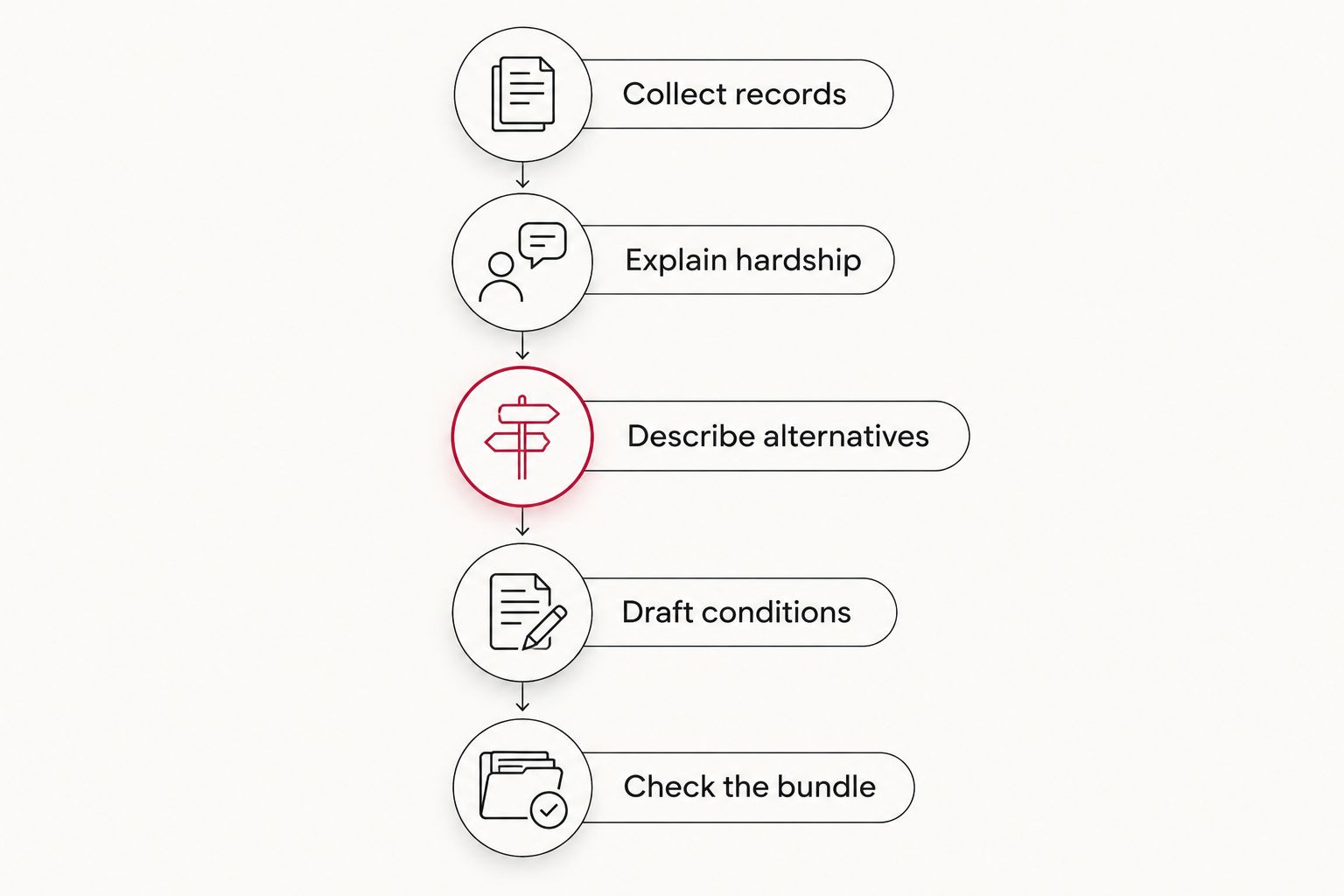
1. Collect records
Gather your employment agreement, relevant schedules, job instructions and existing correspondence. Keep the originals and identify which parts support your account.
Check that the records describe your current situation. An old job description that no longer matches your duties needs an explanation, not silent reliance.
2. Explain hardship
Describe what happens when you cannot drive. Separate inconvenience from the consequences you ask the court to consider under the statutory hardship test.
Be specific about the work affected, the people affected and the evidence supporting those consequences. Avoid absolute claims such as having no other transport unless you have checked and can explain the alternatives.
3. Describe alternatives
Set out the transport or work arrangements you investigated. Explain why an arrangement does not meet the actual requirement, rather than dismissing it generally.
For example, a public transport timetable can support an explanation about a particular shift. It does not establish that public transport is unsuitable for every trip.
4. Draft conditions
Identify the driving purposes, locations and times connected to the hardship described. Your proposed conditions should match the supporting facts.
Do not assume that permission to travel to work also covers every journey during the working day. Describe the distinction clearly and seek advice if the proposed conditions are difficult to frame.
5. Check the bundle
Read the application, affidavit, supporting records and proposed conditions together. Resolve contradictions before filing.
For a 2026 application, confirm the current filing and procedural requirements with the relevant District Court or a lawyer. Document preparation does not replace checking the process that applies to your case.
Why the evidence needed varies
There is no universal substitute for an employer letter. The useful evidence depends on the claim you need to establish.
- Driving duties: Travelling to a fixed workplace is different from driving between jobs or sites.
- Working hours: A regular daytime schedule presents different transport questions from changing shifts.
- Work locations: Explain the actual destinations rather than describing the job as mobile without detail.
- Available alternatives: Address the arrangements you investigated and the practical reasons they do not meet the need.
- Employment consequences: Support claims about lost work, changed duties or dismissal with facts rather than assumptions.
- Other people’s hardship: If you rely on effects on another person, identify those effects and the evidence supporting them.
These factors guide the evidence you prepare. They do not replace eligibility checks or determine what the court will decide.
Should you prepare the documents yourself or get help?
Choose help based on the task you need completed. A straightforward document-preparation need is different from a dispute about eligibility, evidence or employment consequences.
NZ Limited Licence is best for drivers seeking limited licence document preparation rather than legal representation. The service prepares court-ready applications, affidavits and complete document bundles across all 58 District Courts in New Zealand, with fast, careful preparation. That does not guarantee a hearing date or court approval.
| Approach | Best for | Practical benefit | Limitation |
|---|---|---|---|
| Prepare documents yourself | Drivers comfortable checking requirements and explaining their evidence | You control the drafting and supporting material | You must identify gaps and inconsistencies yourself |
| NZ Limited Licence document preparation | Drivers who need help turning their facts into application documents | Preparation of applications, affidavits and complete bundles | Document preparation is separate from the court’s decision |
| Local lawyer | Drivers seeking legal advice or representation | Advice on legal issues and representation within the agreed engagement | Confirm what the engagement includes before instructing the lawyer |
An employer’s refusal does not, by itself, tell you which option to choose. Look at the underlying problem. Missing drafting help points towards document preparation; disputed facts or uncertainty about your legal position call for legal advice.
When choosing help in 2026, explain the employer issue at the outset. Provide the correspondence and existing records rather than describing the situation only as an employer who will not cooperate.
Get help preparing your application
Prepare a limited licence application, affidavit and document bundle from your circumstances and evidence.
Can I apply if my job does not involve driving?
A job without driving duties does not remove the need to check eligibility and establish the statutory hardship test. If your issue is getting to work, explain that journey and its consequences accurately rather than presenting commuting as a driving duty.
Show how your workplace, hours and available transport interact. The court decides whether the evidence supports the application; having a job does not establish entitlement to a limited licence.
Will the court accept my own affidavit without employer support?
Your affidavit can present your account, but it is not a substitute for every missing piece of independent evidence. The court decides what weight to give it alongside the other material.
State facts within your knowledge clearly. Where you rely on something a manager said, distinguish that conversation from a confirmed written employment decision.
What should I avoid putting in the application?
Do not turn a difficult situation into a stronger claim than the evidence supports. Accuracy matters more than dramatic wording.
Avoid saying your job requires driving if the real issue is transport to work. Avoid claiming dismissal is certain when the employer has not said that. Do not describe every alternative as impossible without explaining what you checked.
Also avoid attaching a large collection of records without connecting them to the relevant facts. A roster needs an explanation of the hours that matter. A job description needs an explanation of the duties affected. Each attachment should have a clear purpose.
FAQ
Can I apply for a work licence if my employer will not write a letter?
You can apply for a work licence without an employer letter if you are eligible, but you must still support the statutory hardship test. Explain the missing support accurately and use relevant records to substantiate your account.
Does my employer have to approve my limited licence application?
Your employer’s approval is not the court’s statutory hardship test. An employer can provide useful factual evidence, but the court decides whether to grant a limited licence.
What evidence can I use instead of an employer letter?
Relevant employment agreements, schedules, job instructions and workplace correspondence can support particular facts. Your affidavit should explain what each record establishes and avoid claiming more than it proves.
Can I drive to work while my application is being prepared?
Preparing or filing an application does not authorise you to drive. Follow the court order and NZTA licensing requirements before returning to the road.
Should I use a lawyer if my employer refuses to help?
Use a lawyer when you need legal advice about eligibility, disputed evidence or representation. An employer’s refusal alone does not determine whether document preparation or a lawyer is the right choice.
Can NZ Limited Licence guarantee that the court will approve my application?
NZ Limited Licence prepares application documents and does not guarantee court approval. The court assesses eligibility, evidence, hardship and the proposed driving conditions.
Where should I check the work licence requirements in 2026?
Check NZTA Waka Kotahi’s limited licence guidance, the current Land Transport Act and Ministry of Justice or District Court procedural information. Confirm requirements relevant to your own suspension or disqualification before filing.
One last thing
Before preparing your 2026 application, write down the exact facts you wanted your employer to confirm. Beside each fact, identify the evidence you already hold—or mark it as unresolved.
That exercise turns an employer’s refusal into a practical evidence checklist. Ask for help with the unresolved facts, not just a replacement letter.