
For a work licence for drink driving in NZ, prepare a court application, a supporting affidavit and a proposed order setting out the driving permission you need. Add evidence that supports your hardship claim, such as an employer statement and details of journeys you cannot reasonably replace. Eligibility comes first: a complete document bundle does not make an excluded applicant eligible or guarantee court approval.
- A work licence for drink driving NZ application needs evidence of hardship, not just a statement that driving helps.
- NZ Limited Licence prepares limited licence applications, affidavits and document bundles; the court decides whether to grant permission.
- Check eligibility before preparing documents, especially if your sentence involves an alcohol interlock.
- Your proposed driving conditions must match the journeys and hardship explained in your affidavit.
Work licence for drink driving NZ: which documents do you need?
Build your application around the documents below. The application asks for permission, the affidavit supplies sworn evidence, and the proposed order describes the permission you want. Supporting documents should substantiate the facts rather than repeat them.
For a 2026 application, use NZ Transport Agency Waka Kotahi's limited licence guidance and the Ministry of Justice's limited licence application guidance to check the official requirements. Confirm filing arrangements with the relevant District Court before submitting your bundle.
NZ Limited Licence prepares court-ready applications, affidavits and complete document bundles across all 58 District Courts in New Zealand.
| Document | What it needs to explain | What to check |
|---|---|---|
| Court application | The order you are asking the court to make | Your identity, disqualification details and requested permission agree throughout |
| Supporting affidavit | The hardship caused by being unable to drive | Facts are specific, accurate and properly sworn or affirmed |
| Proposed order | The driving conditions you want authorised | The conditions match your demonstrated need |
| Employer evidence, where relevant | Your duties, required journeys and employment consequences | The employer explains the actual problem, not just general support |
| Other supporting evidence | Why the claimed hardship exists and alternatives do not resolve it | Each document supports a fact in your affidavit |
Prepare evidence of necessity, not a character reference dressed up as an application. An employer saying you are reliable does not explain which work journeys require driving.
Why this matters
A limited licence application is not simply a request to reverse a drink-driving disqualification. You must establish the relevant hardship and ask for restricted driving permission that addresses it.
The Land Transport Act's limited licence provisions distinguish between extreme hardship to you and undue hardship to another person. These are 2 hardship tests, not a requirement to prove both in every application. Your evidence needs to explain the ground you rely on.
That distinction changes what belongs in the bundle. A concern about your own employment needs a clear account of your circumstances. A claim about hardship to your employer or another person needs facts about their circumstances too.
The practical consequence is simple. More paperwork is not automatically better. A shorter, consistent bundle that explains the problem is more useful than a stack of unrelated documents.
Check eligibility before preparing the bundle
Start with your sentencing information and disqualification details. Do not assume that every drink-driving sentence allows an application for a limited licence.
NZTA's limited licence guidance identifies restrictions on eligibility, including alcohol interlock and zero-alcohol licence situations. Previous offending and the legal basis of your disqualification also matter. Check the actual sentence rather than relying on the offence's everyday name.
For an ordinary qualifying court disqualification, official guidance describes a 28-day waiting period before a limited licence can be granted. Preparing documents during that period does not give you permission to drive. The timing rule and your eligibility are separate checks.
For your 2026 application, give whoever prepares your documents the sentencing information you have. Include relevant previous disqualifications rather than deciding yourself that they are unrelated.
Get legal advice if the sentence, eligibility rules or previous offending leave you uncertain. Document preparation cannot resolve every legal question about whether you qualify.
Court application: identify the permission you need
The application should accurately identify you and the order you are seeking. Your name, address and disqualification information need to agree with the supporting documents.
Before drafting, gather your court or disqualification paperwork and write down what driving you actually need. Separate travel to work from driving during work. They are different requests and need different explanations.
For example, getting to a fixed workplace involves a different set of facts from travelling between changing job sites. Describe your actual arrangement. Do not copy someone else's application simply because they also lost their licence for drink driving.
Check the application against the affidavit and proposed order. If one document asks for work travel and another describes broader personal driving, resolve that difference before filing.
The application should ask for the permission your evidence supports—nothing broader. A vague request leaves the court to work out what you mean.
Supporting affidavit: explain the hardship in facts
An affidavit is your sworn or affirmed evidence. It needs a clear account of the hardship, the driving that would address it and why realistic alternatives do not solve the problem.
Use plain facts. Explain your job, where you work, when you must attend and which duties require driving. If your income or employment is at risk, describe the circumstances accurately and support them where possible.
A useful drafting checklist is:
- Your circumstances: Explain your employment and any other circumstances directly relevant to the hardship claim.
- Required journeys: Identify the journeys you need permission to make and their purpose.
- Consequences: Explain what happens without those journeys, rather than simply saying life becomes difficult.
- Alternatives: Address public transport, lifts, changed duties or other realistic arrangements.
- Supporting evidence: Identify documents that substantiate the important facts.
Do not dismiss an alternative without explaining why it does not work. If public transport is unsuitable, describe the actual timetable, location or connection problem. If another person cannot provide lifts, explain the relevant circumstances accurately.
Have the affidavit sworn or affirmed before an authorised person as required by the court's instructions. Do not treat an unsigned draft as completed evidence, and do not change sworn content casually after signing.
Employer evidence: show what the job requires
Employer evidence is relevant when your application relies on work-related hardship. It should explain your duties and the consequences of being unable to perform the necessary driving.
A useful employer statement addresses the actual work arrangement. It identifies where you work, the travel your duties involve and whether an alternative arrangement is available. It should distinguish facts the employer knows from assumptions about your personal circumstances.
Ask the employer to explain the consequence, not make a legal conclusion. A statement that you need a licence is less informative than a factual explanation of which duties you cannot perform without driving.
If you are self-employed, explain your work directly and support relevant claims with business records where appropriate. Do not invent an employer letter or assume self-employment removes the need for evidence.
Every supporting statement should agree with your affidavit. Resolve differences in working hours, locations or duties before submitting the bundle.
Proposed order: make the driving conditions specific
The proposed order sets out the restrictions you ask the court to authorise. It should follow from your hardship evidence rather than introduce journeys your affidavit never explains.
Describe the purpose of the driving and the relevant limits. Depending on your circumstances, those details include days, times, routes, areas or vehicles. Confirm the required wording against official guidance and the court's requirements.
Avoid treating flexibility as a reason to ask for unrestricted travel. If your work locations change, explain that work pattern accurately so the proposed conditions can address it.
The court decides the conditions. A prepared draft is a request, not permission, and the final order is not necessarily identical to the draft you submit.
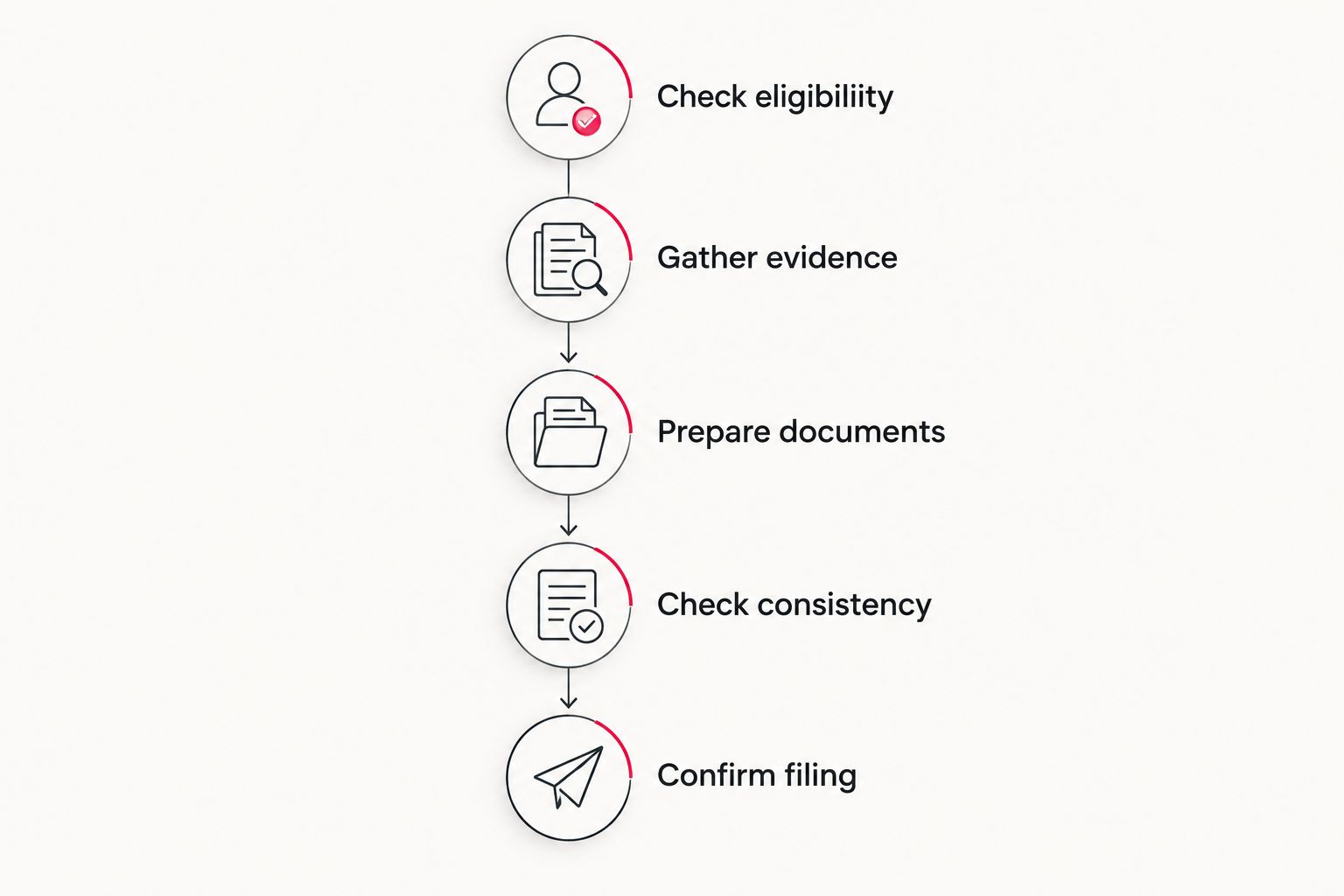
Prepare, check and submit your documents
Use this sequence to keep the work organised. It separates checking eligibility from drafting evidence and separates a court application from permission to drive.
- Check eligibility. Review your sentence against official limited licence guidance before committing to document preparation.
- Gather evidence. Collect sentencing information, employment details and evidence supporting the hardship and required journeys.
- Prepare documents. Draft the application, affidavit and proposed order so they describe the same circumstances.
- Check consistency. Compare names, dates, work details and requested driving conditions across the bundle.
- Confirm filing. Follow current court instructions, including any requirements concerning Police and the hearing process.
For a 2026 filing, confirm the practical requirements with the relevant District Court. Do not assume that completing a template also completes filing, service or hearing arrangements.
Keep a complete copy of what you submit. If information changes before the hearing, seek advice about how to correct or update it rather than leaving conflicting versions unexplained.
Why the documents vary between applicants
The core documents serve the same purposes, but the evidence and proposed conditions depend on your circumstances. Copying another driver's facts is not a shortcut.
- Your sentence: Eligibility must match the actual legal basis of your disqualification.
- The hardship claimed: Hardship to you needs different supporting facts from hardship to another person.
- Your employment: A fixed workplace and travelling duties require different explanations.
- Available alternatives: Transport options and workable changes affect the evidence you need.
- Requested driving: The proposed conditions must address your specific journeys.
- Court instructions: Filing and hearing preparation must follow the relevant court's requirements.
Do not add documents merely to make the bundle look substantial. Include them because they establish something relevant.
Should you prepare the documents yourself or get help?
Choose according to the work you need done. Preparing paperwork and obtaining advice about a difficult legal issue are different services.
| Option | Best for | Main advantage | Limitation |
|---|---|---|---|
| Prepare documents yourself | Applicants able to understand the requirements and organise their evidence | You control drafting and assembly directly | You must identify the requirements and check the documents yourself |
| Document-preparation service | Applicants seeking help drafting and assembling their bundle | Focused assistance with the application, affidavit and supporting paperwork | Document preparation is not the court's decision or a substitute for legal advice on disputed issues |
| Local lawyer | Applicants needing legal advice or representation | Advice can address eligibility, legal complications and court proceedings | Confirm whether the engagement includes drafting, filing and representation |
NZ Limited Licence's limited licence document preparation is best for drivers who need help preparing their court application, affidavit and complete bundle. The service focuses on fast, careful preparation; it does not guarantee approval.
NZ Limited Licence prepares documents nationwide across all 58 District Courts. You still need to supply accurate information and supporting evidence. Preparation cannot make an unsupported hardship claim true.
If you choose help for your 2026 application, clarify who handles drafting, signing arrangements, filing and any hearing attendance. Do not assume those tasks are included merely because someone prepares the documents.
Get help preparing your application
NZ Limited Licence prepares limited licence applications, affidavits and complete document bundles nationwide.
Do I need an employer letter for a drink-driving work licence?
Employer evidence is useful when your hardship claim depends on your employment. Ask for facts about your duties, required driving and the consequences of being unable to perform them—not a generic recommendation.
Can I drive after the court grants my application?
A court order authorising a limited licence is not itself the issued licence. NZTA's limited licence guidance explains the licensing step after the court order; complete that process before driving and follow the authorised conditions.
Does a complete bundle guarantee approval?
A complete bundle does not guarantee approval. The court decides whether the legal requirements are met and what driving conditions, if any, to authorise.
FAQ
What documents do I need for a work licence for drink driving in NZ?
Prepare a court application, supporting affidavit and proposed order, with evidence supporting your hardship claim. Check official guidance and the relevant District Court's filing requirements before submitting them.
Is a work licence the same as a limited licence?
Work licence is a common name for a limited licence sought for work-related driving. The permission is restricted by the conditions authorised through the court and licensing process.
Do I need to wait before getting a limited licence after drink driving?
A qualifying court disqualification ordinarily has a 28-day waiting period before a limited licence can be granted. Check NZTA guidance against your actual sentence because eligibility restrictions also apply.
Can I write my own limited licence affidavit?
You can prepare your own affidavit, but it must provide accurate evidence and be properly sworn or affirmed. Use official requirements rather than copying another driver's circumstances.
What should my employer say in a supporting letter?
Your employer should explain your duties, required driving and the consequences of being unable to drive. The statement should address realistic alternatives and agree with your affidavit.
Can NZ Limited Licence approve my work licence?
NZ Limited Licence prepares application documents; it does not approve limited licences. The court decides the application, and the licensing process must also be completed before you drive.
Should I use a lawyer or a document-preparation service?
Use document preparation when you need help drafting and assembling your application bundle. Seek a lawyer when you need legal advice about eligibility, complications or representation.
One last thing
Before submitting your 2026 application, compare the affidavit and proposed order side by side. For every driving permission requested, find the sentence explaining why you need it and the evidence supporting that explanation.
If the documents tell different stories, fix them before filing. That final check is more useful than adding another general statement that you need to drive.