
Yes, you can start preparing to apply for limited licence urgently, but urgency does not remove eligibility rules or any statutory waiting period. Fast document preparation and an early court hearing are separate matters. You must not drive until the court has granted the order and NZ Transport Agency Waka Kotahi has issued your limited licence.
- You can prepare to apply for limited licence urgently; court approval and licence issuance remain separate steps.
- A 28-day waiting period applies to certain disqualifications, not demerit-point suspensions.
- NZ Limited Licence suits eligible drivers needing fast, careful work licence document preparation.
- Explain the hardship, support it with evidence, and request only the driving you need.
Why this matters
Losing your licence can put your job or business under immediate pressure. That makes preparation urgent, but it does not create permission to drive. Your application needs to explain the hardship and the limited driving you want the court to authorise.
NZ Limited Licence prepares applications, affidavits and complete document bundles across all 58 District Courts in New Zealand. Preparation is separate from the court's decision. Treat your 2026 application as a sequence of legal and administrative steps, not a promise of an immediate return to driving.
Can you apply for a limited licence urgently?
You can act urgently on the paperwork. You cannot assume the court will grant an urgent hearing or waive a statutory restriction. Start by identifying whether you face a demerit-point suspension or a court-ordered disqualification. The reason you lost your licence affects the route available to you.
The official references are the Land Transport Act, particularly sections 103–105; the Ministry of Justice's limited licence guidance; and NZTA's limited licence and demerit-point guidance. Use the current official guidance when checking a 2026 application. A general explanation does not settle eligibility for your particular sentence or driving history.
Section 103 provides for limited licences where the statutory requirements are met, including exceptional hardship to the applicant or undue hardship to another person. Section 104 imposes a 28-day restriction on issuing a limited licence for the disqualifications it covers. That restriction does not apply to a demerit-point suspension.
An urgent application still needs a clear hardship case. Saying that you need your car is not the same as explaining why the loss of driving creates the hardship required by law.
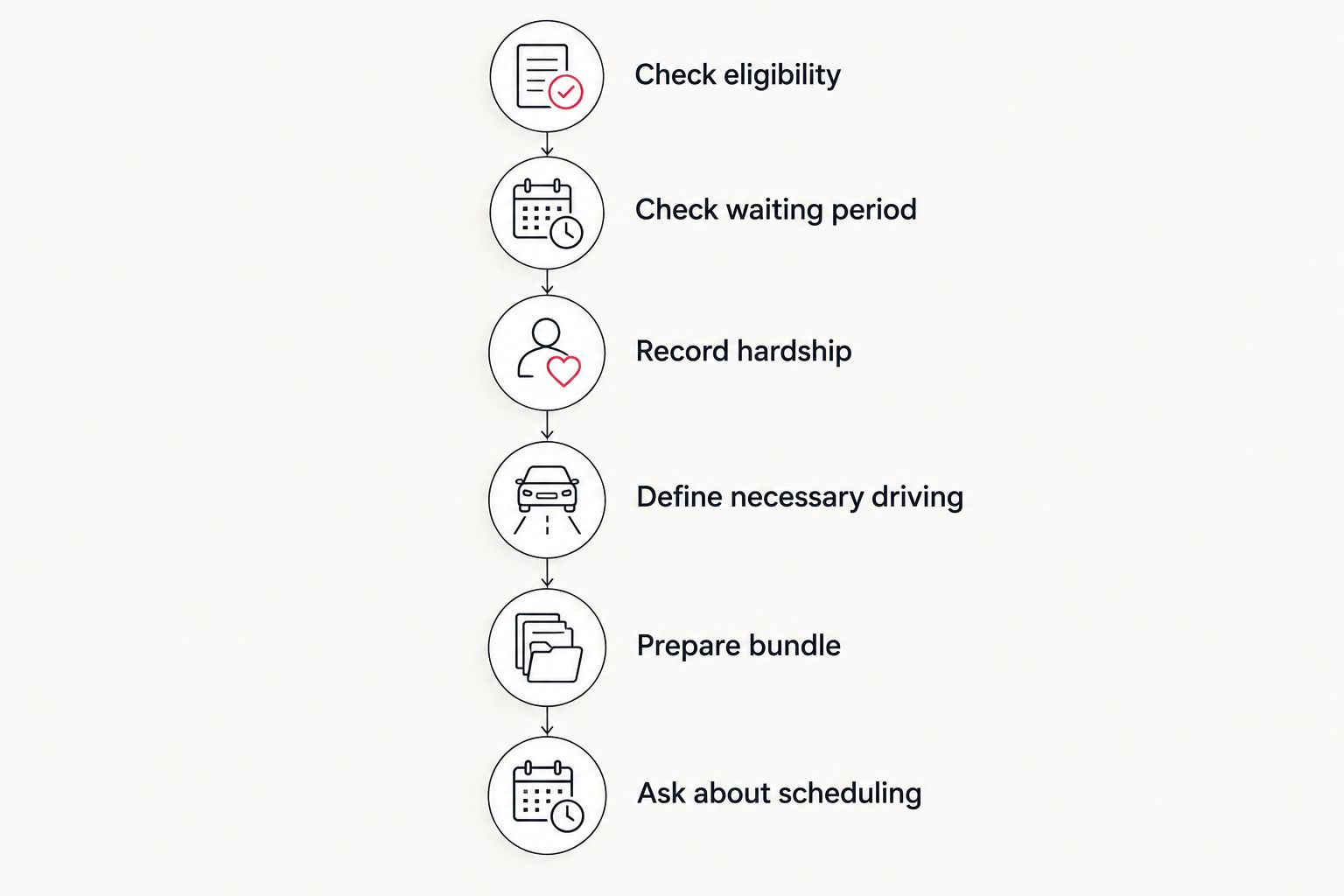
Follow these steps before requesting an early hearing
- Check eligibility. Read your suspension notice or court order. Identify the reason for the restriction, its start date and any sentence conditions. If the wording is unclear, get legal advice before treating yourself as eligible. An employer's need for a driver does not override an exclusion in the law.
- Check the waiting period. Establish whether section 104 applies to your disqualification. For a covered disqualification, the court cannot issue the limited licence during the first 28 days. Use that time to organise your evidence and documents rather than assuming an urgent request removes the restriction.
- Record the hardship. Write down what happens if you cannot drive. Explain your work duties, the travel involved, who else is affected and the alternatives you have considered. Separate facts you can support from predictions. Specific consequences make the application clearer than general statements about inconvenience.
- Define necessary driving. Identify the purposes, destinations, days and hours you need. Include the travel required to perform the work, not simply a broad request to drive whenever you choose. The proposed conditions should match the hardship described in your affidavit and supporting material.
- Prepare the bundle. Keep the application, affidavit, supporting evidence and proposed order consistent. Check names, dates, addresses and driving details across the documents. Follow the court's instructions for filing and any required service. Ask the registry about local requirements before assuming the bundle is ready to lodge.
- Ask about scheduling. Contact the relevant District Court registry about the filing process and available hearing arrangements. Explain any genuine deadline, such as a documented employment consequence. The registry can explain administration; it does not decide whether your hardship meets the legal test or guarantee approval.
Do not confuse lodging an application with receiving permission to drive. A filed bundle, a hearing date and a court order are different milestones. After an order is granted, follow NZTA's process for obtaining the limited licence before driving under it.
Demerit suspension: check eligibility before rushing the paperwork
NZTA's demerit-point guidance states that accumulating 100 or more active demerit points within 2 years results in a 3-month suspension. A limited licence application is a separate process; it does not cancel the suspension or restore unrestricted driving.
The 28-day restriction discussed above does not apply to demerit-point suspensions. That distinction matters when planning a 2026 application. It does not mean a court must hear your case immediately or that demonstrating hardship becomes optional.
Keep the suspension notice with your application material. Use the notice to check the dates rather than relying on memory. Then explain the actual work-related driving you need and why another arrangement does not address the hardship.
Drink-driving disqualification: check the sentence and waiting period
A drink-driving disqualification needs careful eligibility checking. Do not assume every drink-driving sentence allows the same limited licence route. Alcohol-interlock requirements and other sentence conditions need separate attention under the applicable rules.
For a disqualification covered by section 104, the 28-day restriction is a legal limit, not a document-preparation delay. Preparing the bundle quickly does not shorten it. Ask a lawyer if you are uncertain how the restriction applies to your sentence.
You can still organise evidence while you check the legal position. Collect your court paperwork, describe the necessary driving and ask your employer for accurate supporting information. Avoid promising a return-to-work driving date before the court and licensing steps are complete.
Which preparation option fits an urgent application?
NZ Limited Licence is best for eligible drivers who need limited licence application documents prepared quickly and carefully. Legal advice is the separate choice when you need an assessment of eligibility, contested issues or representation.
| Preparation option | Best for | Main advantage | Main limitation |
|---|---|---|---|
| Prepare the documents yourself | Drivers comfortable reading official guidance and managing court paperwork | You control the drafting and filing | You must identify requirements and resolve inconsistencies yourself |
| Use a document-preparation service | Drivers needing help assembling applications, affidavits and the document bundle | Practical help turning your information into prepared documents | Document preparation does not replace legal advice or the court's decision |
| Hire a local lawyer | Drivers needing legal advice, representation or help with a complicated case | Advice on your circumstances and the legal issues | You still need to provide accurate facts and supporting evidence |
Prepare the documents yourself
Self-preparation is a practical option if you can follow the official requirements and explain the hardship clearly. It gives you direct control over the wording. The responsibility for checking the documents also stays with you.
Before choosing this route, review what belongs in the bundle and how the court expects it to be filed. Do not let urgency push you into submitting an affidavit that leaves essential questions unanswered.
Use a document-preparation service
Document preparation fits a driver who needs help assembling the paperwork rather than advice on a disputed legal question. You provide the facts; the preparation service helps put the application material together. Accuracy still depends on the information you supply.
Review every statement before signing. A carefully prepared affidavit must describe your circumstances, not a generic hardship story. Check that the proposed driving conditions match your actual duties and schedule.
Hire a local lawyer
Choose legal advice when your eligibility is unclear, the sentence is complicated or you need representation. That is not the same service as preparing a document bundle. Tell the lawyer about previous relevant driving matters and provide the full court paperwork.
Ask what the engagement includes. Advice, drafting, filing and appearing at a hearing are distinct tasks. Knowing who handles each task prevents a gap when you are working towards a deadline.
Start your document preparation
Get help preparing your application, affidavit and complete court document bundle.
Why an urgent limited licence application takes different amounts of time
There is no single turnaround that covers preparation, court scheduling and licence issuance. For your 2026 application, keep these stages separate when discussing timing with an employer.
- Eligibility checks: The suspension notice, sentence and relevant driving history determine which legal questions need resolving first.
- Statutory restrictions: A waiting period cannot be removed by drafting the documents faster.
- Evidence readiness: Your affidavit needs accurate facts. Employer information and other supporting material must be available before you rely on them.
- Document consistency: Different dates, hours or destinations across the bundle create questions that need answering before filing.
- Court and licensing steps: Filing requirements, hearing arrangements and NZTA's licence-issuance process are separate from document preparation.
Ask for clarity about the stage being discussed. A statement that your documents are ready is not a statement that you can drive. Likewise, an available hearing date is not an indication of the outcome.
Can I apply before the waiting period ends?
For a covered disqualification, the 28-day restriction concerns when the limited licence can be issued. It does not require you to leave preparation until the restriction ends. Confirm filing and hearing arrangements with the registry rather than assuming an early application produces an early order.
Use the preparation time to make the bundle consistent. The guide to what belongs in a limited licence application bundle helps you focus on the documents rather than the hearing date alone.
Does an employer's letter make the application urgent?
An employer's letter supports the facts when it explains your duties, required travel and the consequences of being unable to drive. It does not itself create eligibility or guarantee an urgent hearing. Ask for concrete information, not a statement that you are a valued employee.
The letter should agree with your affidavit. If your employer describes different working hours or destinations, resolve the difference before filing. Do not submit contradictory accounts simply to meet a preferred date.
Can I drive once the court approves the application?
You must obtain the limited licence through NZTA before driving under the court order. Approval is not a substitute for completing the licensing step. Read the authorised conditions carefully and drive only within them.
For a 2026 application, make the final administrative step part of your plan. Do not arrange work driving on the assumption that leaving the hearing with an order is enough.
FAQ
Can I apply for limited licence urgently in New Zealand?
Yes, you can start preparing the application urgently, but eligibility rules, statutory restrictions and court arrangements still apply. Fast preparation does not guarantee an early hearing or approval.
Do I have to wait 28 days after a demerit suspension?
The 28-day restriction under section 104 does not apply to demerit-point suspensions. You still need to meet the limited licence requirements and complete the court and NZTA processes.
Does needing my licence for work guarantee approval?
No, needing your licence for work does not guarantee approval. The court considers the statutory requirements, including exceptional hardship to you or undue hardship to another person.
Can NZ Limited Licence decide whether the court approves me?
No, NZ Limited Licence prepares application documents; the court decides the application. Seek legal advice if your eligibility or sentence conditions are unclear.
Should I prepare the documents myself or use a lawyer?
Prepare them yourself if you can manage the requirements; use a document-preparation service for paperwork help or a lawyer for legal advice and representation. Choose according to the help your case needs, not urgency alone.
Can I drive while waiting for my limited licence hearing?
No, submitting a limited licence application does not authorise driving during your suspension or disqualification. You must complete the court and NZTA licensing steps before driving under a limited licence.
One last thing
Check the proposed driving conditions as carefully as the hardship evidence. A strong explanation of why you need to drive is only part of the application. You also need to describe what driving permission you are asking the court to grant.
Compare your affidavit, employer information and proposed order side by side. Check that the purposes, destinations and hours agree. If you cannot explain the requested driving clearly, fix the documents before filing rather than leaving the question for the hearing.