
Instead of repeatedly copying details from your charge sheet, build one checked case record, then use it to prepare your limited licence application, hardship evidence and proposed driving conditions. This 2026 workflow separates the charge from the court outcome, so you do not build an application around an allegation rather than your actual disqualification.
- A charge sheet limited licence application needs the court outcome and hardship evidence, not just the original charge.
- NZ Limited Licence suits drivers who need limited licence application documents prepared rather than preparing the bundle themselves.
- Check eligibility before drafting affidavits or proposing work licence driving conditions.
- Document preparation does not grant permission to drive; the court decision and licensing steps remain separate.
Why this matters
A charge sheet records the charge. It does not, by itself, establish the final sentence, your current licence status or your eligibility for a limited licence. Keep those questions separate from the start.
NZ Limited Licence is best for drivers who want limited licence application documents prepared for them. NZ Limited Licence prepares applications, affidavits and complete document bundles across all 58 District Courts in New Zealand, with fast, careful preparation rather than a promised court result.
For this 2026 workflow, the official reference points are the Land Transport Act, particularly sections 103–105 on limited licences, NZTA's limited licence guidance, and Ministry of Justice guidance on applying for a limited licence. Use those sources for eligibility, restrictions and procedure. Use your own court records for the facts of your case.
Before you start
- Gather the source records. Have your charge sheet, the court outcome or sentencing record, relevant suspension or disqualification notices, and your driver licence details. If something is missing, request it from the organisation that issued it.
- Gather the work evidence. Collect your roster, employment details, work locations and evidence explaining what happens without driving. Ask your employer to confirm facts, not just support the application generally.
- Check the stopping point. A charge sheet alone is not an eligibility check. Confirm the actual sentence, relevant exclusions and any waiting period before arranging sworn documents or expecting to drive.
Do not sign an affidavit in advance of the person authorised to take it. Keep the draft unsigned until the witnessing requirements are clear.
Case record
Start with a simple worksheet. The bold labels below are suggested worksheet headings, not fields from an official court form.
- Record the charge. Copy the offence wording and case reference accurately. Keep the complete charge sheet alongside the worksheet; do not replace it with a typed summary.
- Record the outcome. Add the conviction and sentence details from the court record. Identify the disqualification separately from any other part of the sentence.
- Record the dates. Write each date beside its source document. Separate the alleged offence date, hearing date and disqualification dates rather than treating them as interchangeable.
- Record licence status. Match your name and driver licence number across the records. Use NZTA information to resolve licensing questions rather than guessing from the charge sheet.
Expected result: one case record that distinguishes what you were charged with, what the court decided and what your current licence position is.
Keep a 1-page summary at the front of your working folder. This is an organising aid, not a substitute for the original records or a required court form.
If records disagree, mark the disputed detail and seek clarification from the issuer. Do not silently change an official document or choose whichever date makes the application easier.
Eligibility and hardship evidence
The next task is to establish whether a limited licence is available and explain the hardship. These are different questions. Strong work evidence does not remove a statutory exclusion.
- Check eligibility. Read the current official guidance against your exact suspension or disqualification. Ask a lawyer about uncertainty over exclusions, sentence wording or the legal effect of earlier orders.
- Describe your hardship. Section 103 of the Land Transport Act distinguishes extraordinary hardship to you from undue hardship to another person. Explain the actual consequences rather than relying on the statement that you need your car.
- Connect work to driving. List the tasks, locations and working hours that require travel. Separate commuting from driving during work.
- Document alternatives. Explain which public transport, lifts, changed hours or other arrangements you checked, and why they do not solve the particular problem.
- Match each statement to evidence. Use relevant rosters, employer information, contracts or other records. Explain any estimate and its basis; do not present it as a confirmed loss.
Expected result: an evidence set showing the hardship, the driving that addresses it and the facts supporting both.
For example, use a 7-day roster to show a full working week where that reflects your job. Label it with its actual dates. A representative roster should not be presented as a guaranteed future schedule.
For the supporting evidence stage, read the guide to proof of no alternative transport. A transport explanation should address your actual start times and destinations, not simply say that buses are inconvenient.
Application bundle
Turn the checked facts into consistent documents. Every part of the bundle should describe the same work, hardship and proposed driving needs.
- Draft the application. Use the current requirements applicable to your court and circumstances. Copy identifying details from the checked case record, not from memory.
- Draft the affidavits. Keep facts within each person's knowledge. Your employer should explain employment facts they can confirm; your own evidence should explain your circumstances accurately.
- Define the driving. Describe the work purposes, locations, days and hours you are asking the court to permit. Do not add unrelated personal travel to a work-based explanation.
- Check consistency. Compare names, dates, workplaces and requested driving conditions across the application, affidavits and supporting records.
- Arrange witnessing. Follow the applicable affidavit requirements and the authorised witness's instructions. Correct the draft before swearing or affirming it.
Expected result: a coherent draft bundle ready for the required signing and procedural checks, not a collection of documents that contradict one another.
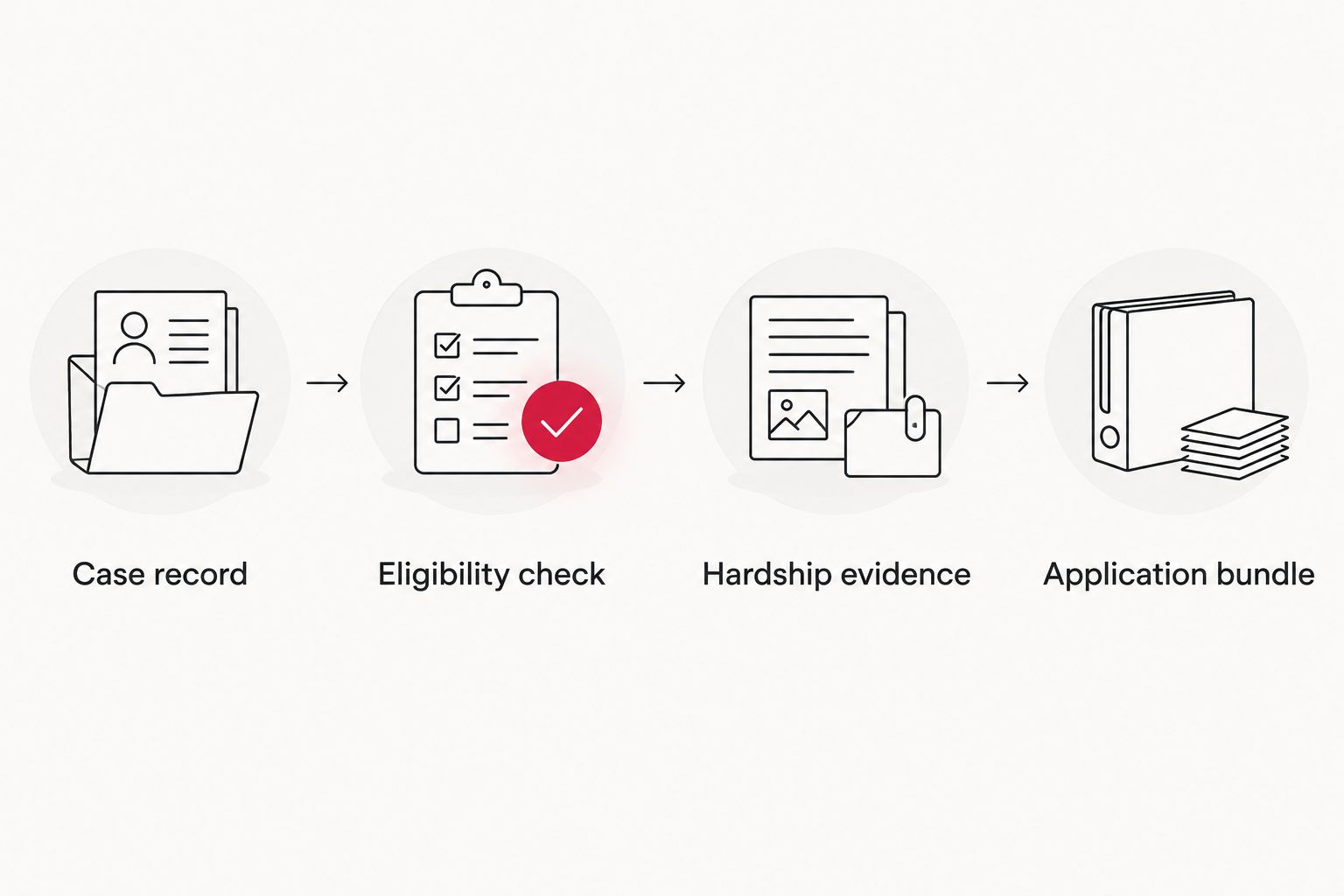
Use these four stages to organise the work: Case record, Eligibility check, Hardship evidence and Application bundle. Each stage answers a different question; completing one does not prove the next.
Choose how to prepare the documents
Choose the preparation route that matches the problem. Document drafting and legal advice are not interchangeable, and preparing everything yourself requires you to manage both the evidence and the procedural checks.
| Preparation route | Best for | Main benefit | Main limitation |
|---|---|---|---|
| Prepare it yourself | Drivers confident handling documents and checking official requirements | You control the drafting and evidence collection | You must identify gaps and resolve inconsistencies yourself |
| NZ Limited Licence | Drivers wanting limited licence applications, affidavits and document bundles prepared | Fast, careful preparation with nationwide coverage | Document preparation does not determine eligibility or secure court approval |
| Local lawyer | Drivers needing legal advice about eligibility, disputed facts or objections | Legal advice tailored to the issues in the case | You still need to supply accurate records and hardship evidence |
Do not choose a drafting service to avoid an unresolved legal question. Resolve that question first, then decide who should prepare the documents.
Get your application documents prepared
NZ Limited Licence prepares applications, affidavits and complete document bundles nationwide.
Filing and licensing checks
Preparation ends with a usable bundle. It does not end with permission to drive.
- Confirm the filing procedure. Check the relevant District Court's current requirements, including how documents must be lodged and what must be provided to Police. Use Ministry of Justice guidance and court instructions, not an old checklist alone.
- Keep the submitted version. Retain an identical copy of the documents you lodge. Keep later corrections separate so you can identify exactly what changed.
- Follow the court directions. Respond to requests for clarification and obtain advice about objections or legal issues. Do not assume that submitting documents means the application has succeeded.
- Complete the licensing steps. If the court grants an order, follow NZTA's requirements for obtaining the limited licence. Read the permitted conditions before driving.
Expected result: a clear record of what was submitted, what the court decided and which licensing steps remain.
For a 2026 application, check current instructions when you are ready to file. A saved form or an earlier application can help you organise information, but it is not confirmation of today's requirements.
If your starting document is a suspension notice
A demerit suspension workflow starts with the suspension notice rather than a criminal charge sheet. Do not create a charge-sheet section for a process that did not involve one.
Record the notice details, relevant dates and licence information. Then check the official limited licence eligibility guidance for that suspension before collecting hardship evidence and preparing the application documents.
The evidence workflow is similar; the legal starting point is different. Do not copy eligibility conclusions from a drink-driving disqualification into a demerit suspension application.
If your records refer to an alcohol interlock sentence, stop and check NZTA's alcohol interlock guidance and the statutory limited licence exclusions. Do not assume that needing to drive for work makes the ordinary limited licence route available.
Troubleshooting
You only have the charge sheet
Request the court outcome or sentencing record before treating the charge as the final position. Keep drafting factual work information, but leave eligibility and sentence details unresolved until you have the correct records.
Your employer's letter says only that driving is essential
Ask for the underlying facts: duties, locations, working hours and consequences if you cannot drive. A broad statement of support does not explain the transport problem or establish the claimed hardship.
Your requested hours do not match your roster
Identify why the difference exists. Separate working time from necessary travel time and explain changing shifts with actual records. Do not widen the requested hours simply to avoid describing the job accurately.
A fact changes after the affidavit is sworn
Tell the person preparing the documents before using the affidavit. Do not edit a sworn document yourself and submit it as though the witness saw the revised version. Confirm how the change must be documented.
You have an order but are unsure whether you can drive
Check the remaining licensing requirements with NZTA and read the order's conditions. A prepared application, a filed application and permission to drive are different stages. Do not treat one as proof of another.
Customize your workflow
Expand the evidence to match your work rather than stretching a generic affidavit. Multiple employers, changing shifts, self-employment and travel between sites need an explanation that reflects the actual arrangement.
For your 2026 working folder, use clear filenames such as employer-roster-2026 and court-outcome-2026 where those dates are accurate. Keep originals unchanged and place drafts in a separate folder.
Before sending documents for preparation, complete 2 checks: confirm that every key statement has a source, then confirm that every requested driving purpose matches the hardship explanation. This is a practical review method, not a court rule.
FAQ
Can I use a charge sheet for a limited licence application?
Use the charge sheet as a source record, not as proof of the final sentence or eligibility. Check it against the court outcome, current licence information and official limited licence requirements.
Can I start preparing documents before my court appearance?
You can organise factual records and work evidence before the outcome is known. Do not finalise sentence details or assume eligibility based only on the charge.
Does needing my car for work mean I qualify?
No. A limited licence application must meet the statutory requirements, including eligibility and the relevant hardship test. Work evidence must explain the actual consequences and why the requested driving addresses them.
Should I prepare the documents myself or use a service?
Prepare them yourself if you can check the requirements and manage accurate, consistent documents. Use document preparation for drafting support, and a lawyer when you need legal advice about eligibility, disputes or objections.
Can NZ Limited Licence guarantee court approval?
No. NZ Limited Licence prepares applications, affidavits and document bundles; the court decides the application. Fast preparation is not a guaranteed hearing date or permission to drive.
Do I sign my affidavit before taking it to a JP?
Keep the affidavit unsigned until the authorised witness gives you instructions. Check the applicable witnessing requirements and take the identification the witness requests.
Can I drive as soon as the application is filed?
No. Filing an application does not authorise driving. If the court grants an order, complete the required NZTA licensing steps and comply with the resulting conditions.
One last thing
Check the most important date twice. The charge sheet's offence date is not automatically the date your disqualification began. Match each date to its source before it enters an affidavit; copying a date consistently does not make it correct.