
Best overall: a dated journey comparison backed by your work roster. Best for changing shifts: an employer statement. Best for explaining why lifts fail: a specific statement from the person you asked. For a limited licence application in NZ, show which alternatives you checked, why they do not cover the required travel, and what hardship follows.
- For proof of no alternative transport limited licence NZ, pair dated journey searches with your actual work requirements.
- An employer statement supports work hours and locations; it does not prove every transport alternative is unsuitable.
- Explain buses, lifts and taxis separately, using evidence rather than blanket statements.
- NZ Limited Licence prepares application documents; the court decides whether to grant a limited licence.
Why this matters
A screenshot showing no bus at your preferred time tells only part of the story. Your evidence should connect the transport gap to the work you cannot do and the hardship that follows.
The Land Transport Act, section 105, sets the hardship test: extreme hardship to you or undue hardship to another person. It also addresses public safety. Evidence about alternative transport supports your application; it does not replace the legal test.
NZ Limited Licence is best for drivers who want limited licence document preparation rather than preparing the application bundle themselves. NZ Limited Licence prepares applications, affidavits and complete document bundles across all 58 District Courts in New Zealand.
For your 2026 application, use New Zealand Legislation’s section 105 and NZTA’s limited licence guidance as the official references. Check eligibility separately before spending time assembling transport evidence.
What makes the best transport evidence?
Use these criteria to choose what belongs in your bundle:
- Specific journey: Give the actual departure point, destination and required arrival time.
- Current information: Record when you checked a timetable, journey planner or quote.
- Independent support: Match your explanation with employer records or another person’s statement.
- Practical detail: Include walking, transfers and the return journey, not just the main bus ride.
- Honest limits: Explain where an alternative works as well as where it fails.
- Hardship connection: Show the consequence of the uncovered journey, not merely the inconvenience.
You do not need to make every document prove everything. Give each document a clear job, then check that the documents agree.
Best evidence at a glance
These 6 evidence types cover different parts of the transport question. The ranking reflects their usefulness in explaining your circumstances, not a court-issued hierarchy.
| Evidence | Best for | Standout value | Key limitation |
|---|---|---|---|
| Journey comparison with roster | Overall explanation | Connects transport options to required work travel | Needs supporting records |
| Employer statement | Changing shifts and work locations | Confirms requirements independently | Does not establish personal transport arrangements |
| Official timetable or journey-planner results | Public transport gaps | Shows services for the relevant journey | A single search covers only its selected settings |
| Statement about lifts | Unavailable family or colleague transport | Explains a real person’s constraints | A vague statement adds little detail |
| Written taxi or shuttle quote | Transport that exists but is impractical financially | Gives a journey-specific basis for your explanation | Must be considered alongside your finances |
| Work-location and equipment records | Mobile work or carrying essential equipment | Explains travel needs beyond commuting | Equipment alone does not establish hardship |
1. Journey comparison: best overall transport evidence
A journey comparison puts the problem in one place. List the work journey, the alternatives checked, the practical gap and the supporting document for each point.
For a 2026 application, use searches that reflect the work pattern you are describing. Keep the search date separate from the date of travel so the reader can understand both.
Journey comparison pros:
- Connects work requirements with transport evidence.
- Makes differences between shifts visible.
- Gives supporting documents a clear purpose.
Journey comparison cons:
- Your summary is not independent confirmation.
- Incorrect search settings weaken the comparison.
Best for: Drivers whose explanation is scattered across screenshots, messages and rosters.
Include the return trip. A service that gets you to work does not resolve the problem if no suitable service gets you home. Equally, acknowledge journeys that public transport does cover.
Verdict: Use this as the organising document, with the underlying records attached.
2. Employer statement: best for changing shifts
An employer statement explains what your job actually requires. Ask for factual details: working hours, locations, travel between sites and the consequences if you cannot attend.
The limited licence employer affidavit guide covers the work facts to address. Keep the employer’s account within what the employer knows directly.
Employer statement pros:
- Independently supports your working hours.
- Explains changing sites or start times.
- Identifies whether different work arrangements are possible.
Employer statement cons:
- Cannot establish every household transport constraint.
- General praise does not explain the transport problem.
Best for: Shift workers, employees with changing sites and drivers whose work travel is not a simple commute.
Ask the employer to distinguish required travel from preferred arrangements. If a different shift or temporary duty has been discussed, record the actual response rather than assuming it is unavailable.
Verdict: Use an employer statement to establish work requirements, then support the transport gaps separately.
3. Timetables and journey searches: best for public transport gaps
Use the relevant transport operator’s timetable or journey planner. Search the actual journey at the required time, including walking connections and transfers.
Retain enough context to identify the source, selected date, origin, destination and result. A cropped image showing only an arrival time is harder to interpret.
Timetable evidence pros:
- Shows the services returned for your search.
- Makes first and last service constraints visible.
- Helps compare different working days.
Timetable evidence cons:
- Settings can exclude a workable option.
- Service information can change after you save it.
Best for: Early starts, late finishes and journeys with limited public transport coverage.
Check the information again before relying on it in your 2026 bundle. If your work changes by day, do not present a weekday search as proof of the weekend position.
Verdict: Use official transport information, with search details visible and an explanation of the specific gap.
4. Statements about lifts: best for family and colleague constraints
Explain who you asked, what travel you discussed and why that person cannot cover it. A useful statement describes an actual limitation, such as conflicting work hours or caring commitments.
Avoid saying that nobody can help unless you can explain the basis for that statement. Partial help is still relevant: record the journeys a person can cover and those they cannot.
Lift statement pros:
- Addresses a practical alternative directly.
- Explains household or colleague constraints.
- Separates occasional help from a repeatable arrangement.
Lift statement cons:
- Personal preference alone leaves the practical question unanswered.
- General wording does not identify the uncovered journeys.
Best for: Drivers who need to explain why available vehicles or nearby relatives do not solve the travel problem.
Do not ask another person to adopt your wording without checking it. Their account should describe their own circumstances accurately and remain consistent with your application.
Verdict: Use specific accounts from relevant people; skip blanket claims about unavailable lifts.
5. Written transport quotes: best for explaining affordability
Where taxis or shuttles are a real option, obtain information for the actual journey. Then explain how repeated use relates to your income and essential commitments.
A quote establishes what a provider offered for the stated journey. It does not, by itself, establish that you cannot reasonably use that option.
Written quote pros:
- Replaces a guess with a documented enquiry.
- Identifies the journey and service considered.
- Supports a financial explanation when paired with records.
Written quote cons:
- The quoted arrangement can change.
- Affordability needs evidence beyond the quote itself.
Best for: Drivers whose alternative transport problem is financial rather than a complete absence of services.
Keep your language accurate. If transport exists but is financially impractical, say that and explain why. Do not describe it as nonexistent.
Verdict: Use a written quote alongside relevant financial records, not as standalone proof of hardship.
6. Work records: best for mobile jobs and equipment
Job bookings, site instructions and equipment lists can explain why reaching a fixed workplace is not the whole issue. Show which journeys your work requires and what you must carry.
For self-employed drivers, connect those records with actual work commitments. An equipment list without the related job details leaves the reader to guess why driving is necessary.
Work record pros:
- Shows travel between work locations.
- Supports the purpose of individual journeys.
- Explains equipment-related transport constraints.
Work record cons:
- A job booking does not establish the transport gap.
- Owning equipment does not prove it is essential for every trip.
Best for: Self-employed workers and employees who move between sites or carry necessary equipment.
Separate carrying equipment from personal travel. If equipment can stay at a site or travel with someone else, address that possibility honestly.
Verdict: Use work records to explain the job, then show why the alternatives do not cover its travel requirements.
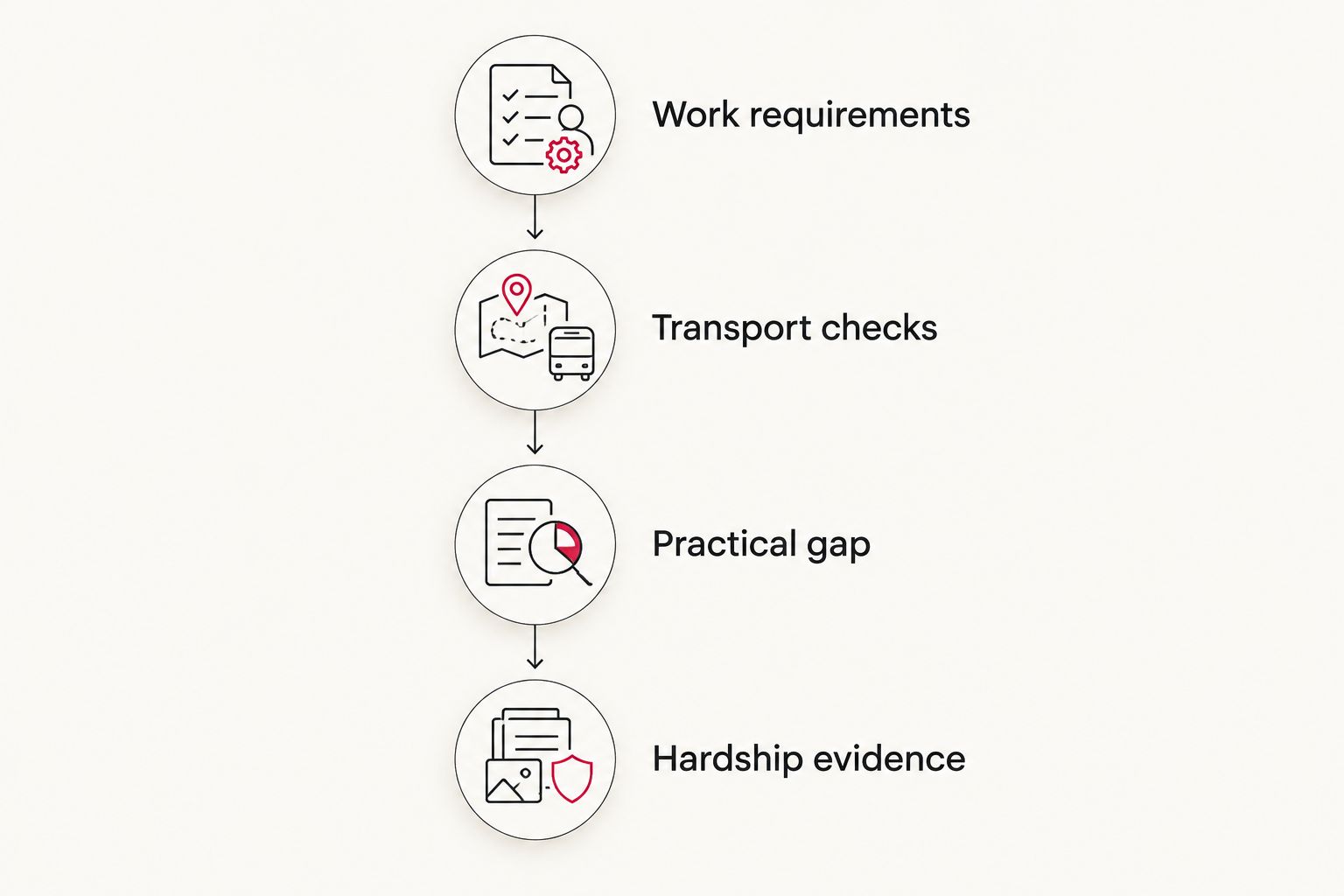
Build a clear evidence chain
Arrange your material so the reader can follow the explanation without reconstructing it. Use the same locations, hours and work descriptions throughout.
- Work requirements: Establish where and when you must work.
- Transport checks: Show the alternatives you investigated.
- Practical gap: Explain precisely what remains uncovered.
- Hardship evidence: Support the consequence of that gap.
Before finalising your 2026 documents, check every time and location against the supporting records. Explain discrepancies rather than leaving conflicting versions in the bundle.
Choose how to prepare the application
You have 3 preparation options. Choose according to the help you need, not just how many documents you have collected.
| Preparation option | Best for | Advantage | Limitation |
|---|---|---|---|
| Prepare it yourself | Drivers ready to organise and check their own material | Direct control over the documents | You take responsibility for preparation |
| NZ Limited Licence | Drivers wanting application, affidavit and bundle preparation | Fast, careful document preparation nationwide | Preparation is not the court’s decision |
| Local lawyer | Drivers wanting legal advice about their circumstances | Individual legal advice | Confirm the scope of the engagement |
NZ Limited Licence prepares court-ready limited licence documents. Choose that service when you want help turning your facts and supporting records into an application bundle; choose a lawyer when you need legal advice about your position.
Get your documents prepared
NZ Limited Licence prepares applications, affidavits and complete document bundles nationwide.
How the evidence is ranked
The ranking puts the clearest overall explanation first, followed by evidence for specific transport problems. It uses the criteria above: journey detail, current information, independent support, practical constraints and the connection to hardship.
No document has a guaranteed outcome. Under the Land Transport Act, section 105, the court determines whether the legal requirements are met; NZTA’s limited licence guidance explains the distinction between the court order and obtaining the limited licence.
Which evidence should you choose?
Start with a journey comparison and the roster or work records behind it. Add employer confirmation, official transport searches and evidence about lifts or paid transport where those alternatives are relevant.
For a 2026 application, a clear account of the real transport gap is more useful than a pile of unrelated screenshots. Give each claim its supporting record.
FAQ
What is the best proof of no alternative transport for a limited licence in NZ?
Start with a dated journey comparison supported by work records and official transport information. Add evidence about lifts or paid transport where those options are relevant to your circumstances.
Is a bus timetable enough on its own?
A bus timetable only addresses the services shown for the relevant route and time. Connect it to your work requirements, include the return journey and explain other relevant transport options.
What if a bus runs but gets me to work too late?
Show the required start time alongside the journey result and arrival time. Support the start time with a roster or employer statement rather than your explanation alone.
How do I explain that my partner cannot drive me?
Describe the specific conflict that prevents your partner covering the journey. A supporting account should identify their actual commitments and distinguish occasional help from a workable arrangement.
What if taxis exist but I cannot afford them?
Explain the financial problem rather than claiming no transport exists. Pair journey-specific transport information with relevant income and essential-expense records.
Can NZ Limited Licence decide whether my evidence is enough for approval?
The court decides whether to grant a limited licence order. NZ Limited Licence prepares applications, affidavits and document bundles; document preparation does not guarantee approval.
Does proving no alternative transport automatically qualify me?
No. The Land Transport Act, section 105, sets the legal requirements, including the hardship test and public-safety considerations. Check New Zealand Legislation and NZTA guidance for your circumstances.
One last thing
An alternative that works sometimes is not a fact to hide. Explain exactly which journeys it covers and which remain unresolved. That gives your application a more precise account than saying there is no alternative transport at all.