
A limited licence application employer affidavit should show your job, why it requires driving, the hours and places involved, and the actual consequences if you cannot drive. It should explain the alternatives your employer has considered and support factual claims with records—not simply say you need a licence for work.
- A limited licence application employer affidavit should connect driving duties to specific hardship, not general inconvenience.
- NZ Limited Licence prepares limited licence application documents; the court decides whether to grant the application.
- Use employment records, work schedules and factual explanations to support the employer’s evidence.
- Explain alternative transport and reassignment honestly, including arrangements that work for part of your job.
Why this matters
Having a job that involves driving is not the whole argument. Section 105 of the Land Transport Act distinguishes extreme hardship to the applicant from undue hardship to another person. Your employer’s evidence should explain the facts relevant to that distinction, rather than merely repeat those legal terms.
NZ Limited Licence prepares limited licence applications, affidavits and complete document bundles across all 58 District Courts in New Zealand. If you need help putting the evidence together, NZ Limited Licence provides document preparation—not the court’s decision.
For a 2026 application, use current employment facts. A letter describing an old role or a roster that no longer applies does not explain your present driving needs.
Limited licence employer affidavit: what facts should it show?
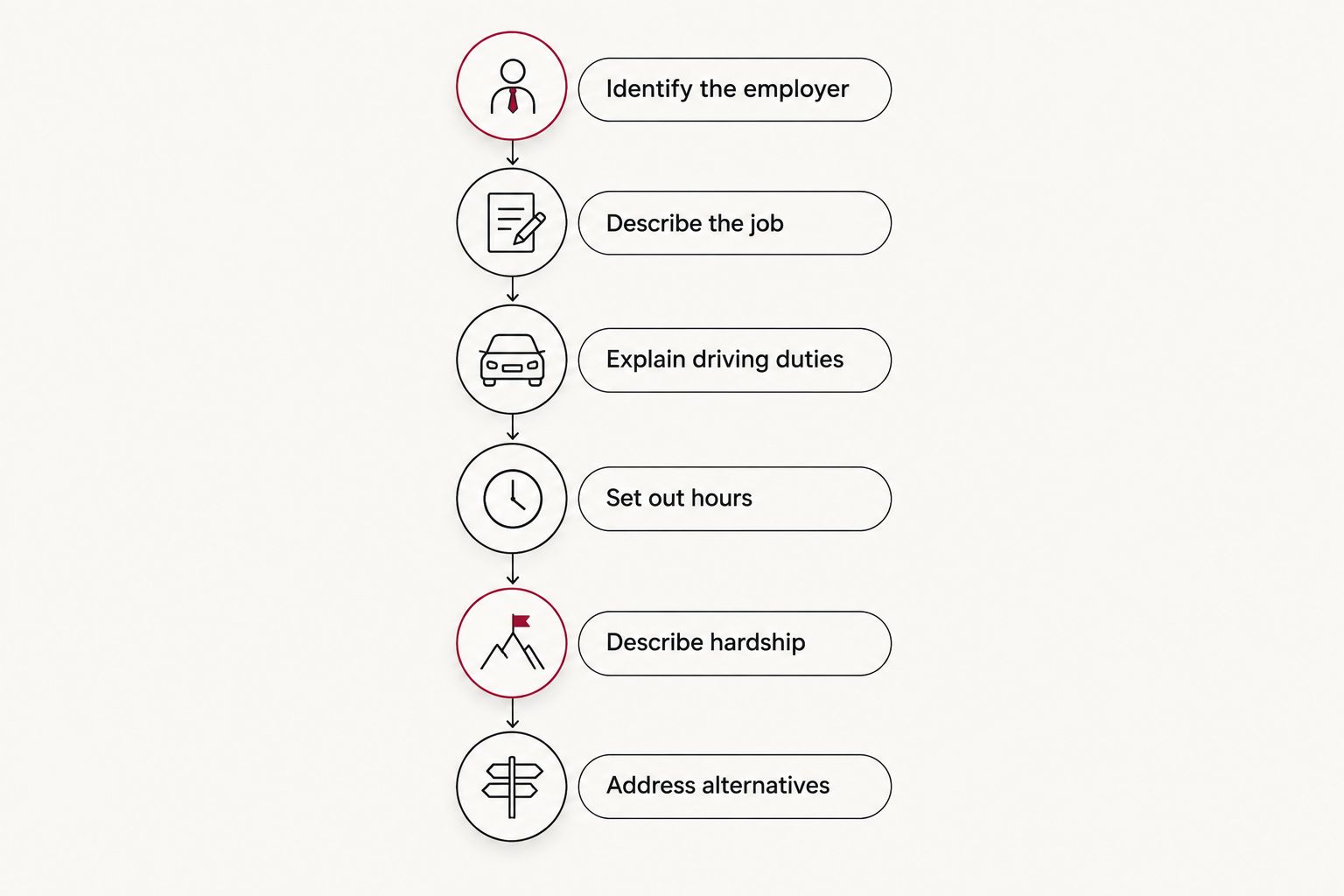
Build the affidavit around these 6 factual areas. Treat them as an evidence checklist, not a prescribed form or a guarantee of approval.
1. Identify the employer
State who is giving the evidence, their position, and how they know about your work. A direct manager can explain duties they supervise; a payroll contact can confirm employment information within their knowledge.
Include the business name and your role. Separate what the person knows directly from information they obtained from someone else, and identify the source where needed.
2. Describe the job
Explain what you actually do. A job title alone does not tell the court whether you drive between work sites, carry equipment, attend appointments or simply travel to a fixed workplace.
Separate commuting from driving during work. If both matter, explain each separately so the application does not treat different needs as interchangeable.
3. Explain driving duties
Describe the tasks that require travel and where those tasks take place. Identify relevant workplaces, operating areas and vehicle arrangements without asking for unrestricted driving simply because work sometimes changes.
If carrying tools or equipment affects transport options, describe what must travel with you. Avoid unsupported statements that public transport is impossible when the real problem is a particular route, connection or work task.
4. Set out hours
Give the working pattern that applies to your role. Explain fixed hours, rostered shifts, travel between jobs and any genuine variation.
Distinguish your working hours from the driving time requested. A long workday does not automatically explain a request to drive throughout that entire period.
5. Describe hardship
State what the employer expects to happen if you cannot perform the driving duties, and explain the basis for that expectation. Reduced duties, lost shifts or employment consequences should be described accurately, not escalated into certain dismissal unless that is the employer’s actual position.
Keep hardship to you separate from effects on the employer or other people. An employer can explain operational consequences, but should not guess about your household finances.
6. Address alternatives
Explain whether another worker can drive, duties can change, transport can be arranged or work can be rescheduled. Record what has been considered and why each relevant alternative does or does not meet the need.
An honest explanation of a partial solution is stronger than a blanket claim that nothing else works. If a colleague can cover some travel but not the whole role, describe that limit.
What evidence should support the employer’s account?
Choose records that help establish a disputed or important fact. More pages do not automatically make the explanation clearer.
- Employment records: Support your role, employment status and relevant duties. Check that the description matches your current work.
- Rosters or schedules: Show when work happens and explain any changing shifts. Identify whether a schedule is current or illustrative.
- Work locations: Support the travel described. Explain whether locations are fixed, recurring or assigned as jobs arise.
- Duty information: Show which tasks involve driving and which can be performed without it.
- Relevant correspondence: Support actual discussions about reassignment, transport or employment consequences, where appropriate.
Do not attach confidential customer or employee information without considering whether it is necessary. Ask the person preparing the documents how supporting records should be referred to and included.
For your 2026 application, check that dates and descriptions agree across the employer affidavit, your own evidence and the proposed driving conditions. The guide to what belongs in a limited licence application bundle helps you consider the documents together.
Why employer affidavit content varies
The useful detail depends on the work being explained. These factors shape the evidence—not a generic template filled with stronger adjectives.
- Commuting versus work travel: Getting to a workplace and travelling between jobs need separate explanations.
- Fixed versus changing hours: A regular timetable needs different supporting detail from a changing roster.
- Workplace locations: A fixed site is easier to describe than jobs assigned across different areas; explain the actual arrangement.
- Vehicle and equipment needs: Explain relevant transport requirements rather than assuming the court understands the role.
- Available alternatives: Shared driving, reassignment or other transport changes the explanation of hardship.
- Actual employment consequences: Distinguish an inconvenience, a temporary adjustment and an employment decision already communicated.
Your employer should describe the situation that exists. Do not make the affidavit sound more serious by removing facts that explain how the business is currently managing.
Can my employer just write that I need my licence?
An employer’s statement that you need your licence does not explain the underlying facts. It leaves unanswered what driving you do, why someone else cannot do it, and what happens if you remain unable to drive.
Ask your employer to replace conclusions with explanations. Rather than stating that your role requires flexibility, describe how work is allocated and what travel follows from that allocation.
A useful test is whether someone unfamiliar with your workplace can understand the account. If the reader needs to guess why driving matters, the explanation needs more detail—not more legal language.
Does an employer affidavit guarantee a limited licence?
An employer affidavit does not guarantee a limited licence. The court decides the application under the applicable law, taking account of the application as a whole.
The employer’s role is to give truthful evidence about matters within their knowledge. Your eligibility, your own hardship evidence and the driving conditions requested remain separate issues to address.
Before filing in 2026, check the current official position through New Zealand Legislation, section 105 of the Land Transport Act, and Ministry of Justice limited licence guidance. Use NZ Transport Agency Waka Kotahi guidance for the licensing steps that apply after a court order; an employer affidavit is not permission to drive.
Who should prepare the employer affidavit?
You have 3 preparation options: prepare the documents yourself, use a document-preparation service, or instruct a lawyer. Choose according to the help you need, not just whether someone can supply a template.
| Preparation option | Best for | Main benefit | Limit to understand |
|---|---|---|---|
| Prepare it yourself | Drivers comfortable organising evidence and checking official requirements | You control the drafting and collection of records | You must identify gaps, check consistency and confirm the required formalities |
| Document-preparation service | Drivers seeking help assembling applications, affidavits and supporting documents | Provides focused help with document preparation | Preparation does not determine eligibility or guarantee approval |
| Local lawyer | Drivers seeking legal advice or representation | Can advise on legal issues and the application strategy within the agreed work | Confirm whether drafting, filing and court attendance are included in the engagement |
NZ Limited Licence is best for drivers who want limited licence application documents prepared rather than drafting the bundle themselves. The service prepares court-ready applications, affidavits and complete document bundles, with fast, careful preparation as its focus.
Document preparation remains distinct from legal advice and the court’s decision. If you need advice about disputed facts, eligibility or how to respond to an objection, establish who will provide that advice before proceeding.
Get your application documents prepared
NZ Limited Licence prepares applications, affidavits and complete court document bundles nationwide.
Check the affidavit against the rest of the application
Read the employer affidavit alongside your own account and the driving conditions you intend to request. Each document should describe the same employment situation, even though each person gives evidence from a different perspective.
Check these points before arranging signing:
- Role: The job title and duties agree throughout the documents.
- Timing: The stated shifts explain the proposed driving times.
- Travel: The places and work areas match the travel described.
- Consequences: Statements about reduced work or employment risk do not contradict each other.
- Alternatives: Both accounts acknowledge arrangements already available.
- Records: Supporting documents relate to the employment situation being described.
A draft is not ready merely because every field contains text. Resolve contradictions with the employer rather than choosing whichever version sounds more persuasive.
Keep a clear final version for your 2026 application. If work arrangements change during preparation, tell the person handling the documents before the affidavit is finalised or relied on.
FAQ
What should a limited licence application employer affidavit include?
A limited licence application employer affidavit should explain employment, driving duties, working hours, locations, hardship and alternatives. The employer should distinguish direct knowledge from information obtained elsewhere and support important claims with relevant records.
Can my employer guarantee that the court will grant a work licence?
Your employer cannot guarantee that the court will grant a limited licence. The employer supplies evidence; the court decides the application under the applicable law.
Is an employer support letter the same as an affidavit?
An ordinary employer support letter is not the same as an affidavit. An affidavit is sworn or affirmed evidence; confirm the required document and signing formalities through current Ministry of Justice guidance or a lawyer.
Should my employer say I will lose my job?
Your employer should say you will lose your job only if that accurately states the employer’s position. If the consequence is uncertain, reduced duties or fewer shifts, describe that position instead of turning it into certain dismissal.
What if my work hours change every week?
Your employer should explain how changing hours are allocated and what records show the pattern. Distinguish the actual work arrangement from the driving conditions you intend to request.
Can a document-preparation service approve my employer affidavit?
A document-preparation service cannot approve your limited licence application on the court’s behalf. It can help prepare the documents, but the employer remains responsible for truthful evidence and the court decides the application.
One last thing
Ask your employer to read the draft for factual accuracy, not simply sign it as a favour. A careful account can acknowledge that some duties remain possible while explaining exactly where the driving problem starts.
For a 2026 application, the final check is straightforward: can every important statement be explained by the person making it? If not, clarify the statement or identify the appropriate source before signing.