
Instead of repeatedly explaining your transport problem at a Work and Income appointment, organise the appointment record, work evidence and proposed driving needs into a limited licence application brief. Work and Income does not grant a limited licence: use its records as supporting material, then keep document preparation, the court decision and NZTA licensing steps separate.
- A Work and Income limited licence enquiry starts with eligibility, not an assumption that an appointment proves hardship.
- NZ Limited Licence suits drivers who need limited licence application documents prepared, rather than preparing the bundle themselves.
- Use appointment records alongside specific work evidence and an honest account of alternative transport.
- A court order and the required NZTA licensing steps are separate from document preparation.
Why this matters
A Work and Income appointment records a conversation about your circumstances. It does not, by itself, establish eligibility for a limited licence or prove the legal hardship test.
For your 2026 application, separate what happened at the appointment from what you need permission to do. An appointment confirmation proves an appointment; an employer's letter can explain a job, its hours and why driving matters.
NZ Limited Licence is best for drivers who need limited licence application documents prepared rather than preparing the bundle themselves. NZ Limited Licence prepares applications, affidavits and document bundles across all 58 District Courts in New Zealand. Preparation does not determine the court's decision.
Before you start
- Collect your records: identification, your suspension or disqualification paperwork, appointment correspondence, employment documents and any written job offer. Keep originals separate from working copies.
- Get access to the facts: ask your employer, prospective employer or case manager for factual confirmation where relevant. Get permission before sharing another person's personal information.
- Check the legal gate first: a job opportunity or Work and Income referral does not establish eligibility. Check your licence status, the reason you cannot drive and any applicable exclusions or waiting period before commissioning documents.
For a 2026 eligibility check, use the official Land Transport Act, sections 103–105, alongside NZTA's limited licence guidance and the Ministry of Justice's limited licence application guidance. These sources cover the legal test and application process; confirm the current requirements for your circumstances before filing.
The central statutory distinction is between extreme hardship to you and undue hardship to another person. Do not reduce either test to a general statement that driving would make life easier.
Appointment record
Turn the conversation into usable evidence
- Write an appointment summary. Record the appointment date, its purpose, what you discussed and any agreed next action. Separate your recollection from statements confirmed in writing.
- Save the relevant correspondence. Keep appointment notices, messages about employment support and any documents connecting the appointment to a particular job opportunity.
- Ask for factual confirmation. Request confirmation of relevant facts, not a letter saying that you deserve a licence. A case manager should not be asked to verify an employer's roster or a driving route they do not know.
- Record unresolved points. Mark an unconfirmed start date or proposed shift as unconfirmed. Do not turn an expectation into a settled fact.
Expected result: you have a dated record showing what the appointment established and what still needs independent evidence.
For example, a discussion about finding work is different from a written offer requiring travel to a specified workplace. Keep that difference visible throughout the application.
Do not assume Work and Income will fund preparation, court-related expenses or licensing steps. Ask Work and Income directly about your circumstances before committing to an expense, and keep any decision in writing.
Work and transport evidence
Build a specific account of the driving need
- Identify the actual work. Record the employer, workplace, duties, confirmed hours and whether driving is part of the job or only the journey there.
- Describe the consequence of not driving. Explain the specific employment or household effect. Support it with records rather than repeating that you need a licence for work.
- Check alternative transport. Compare public transport with actual shift times. Explain lift arrangements honestly, including their limits, rather than claiming nobody can help without checking.
- Draft the proposed driving scope. List the purposes, places and times you want considered. Keep confirmed requirements separate from possible future work.
Expected result: another reader can connect the work requirement, transport problem and claimed hardship without filling in gaps.
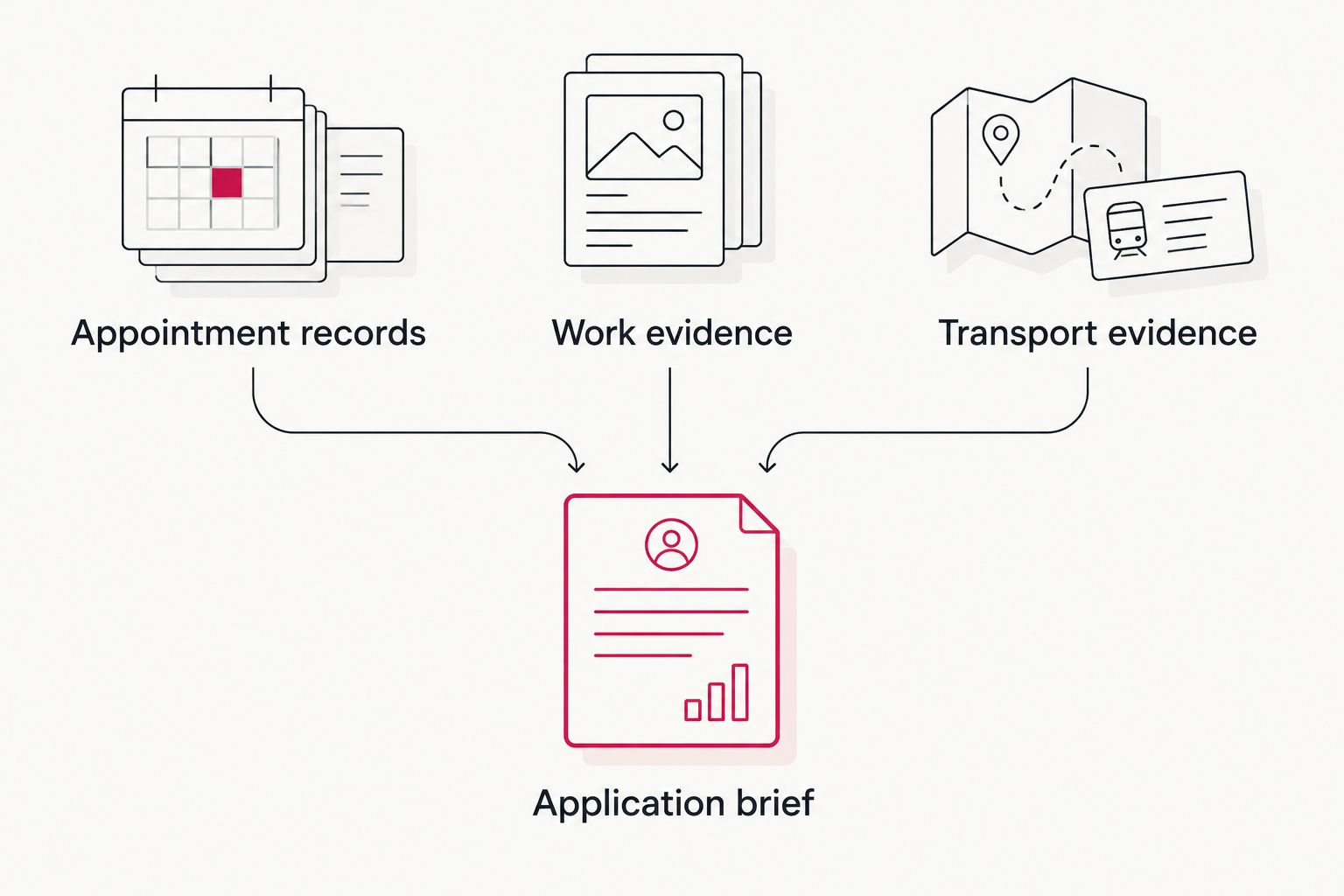
Use 3 document groups to keep this manageable: appointment records, work evidence and transport evidence. Those are organisational labels, not prescribed court forms.
Make the evidence agree
Check names, workplace addresses, shift descriptions and dates across the documents. If your statement describes an early start but the employer's letter gives different hours, resolve the difference before the affidavit is finalised.
For a 2026 application, use records that reflect the work you are actually seeking permission to undertake. Label an old roster as historical context, not proof of your current hours.
Keep financial evidence focused. Where lost income is part of your hardship account, show the connection between the transport restriction and that loss; a balance or bill alone does not explain the connection.
Application bundle
Choose who prepares the documents
There are 3 preparation routes: preparing the documents yourself, using a document-preparation service or instructing a lawyer. Choose according to the help you need, not an assumption that any route guarantees approval.
| Preparation route | Best for | Main advantage | Limit or trade-off |
|---|---|---|---|
| Preparing documents yourself | Drivers confident handling forms, evidence and official instructions | You manage the drafting and supporting records directly | You must identify gaps and check procedural requirements yourself |
| NZ Limited Licence document preparation | Drivers wanting applications, affidavits and a complete bundle prepared | Fast, careful preparation focused on the documents | Document preparation is not the court's decision or a substitute for legal advice on disputed issues |
| A local lawyer | Drivers needing legal advice about eligibility, disputed facts or objections | Legal advice can address issues beyond assembling records | Confirm whether the engagement includes drafting, filing and representation |
NZ Limited Licence prepares court-ready applications, affidavits and complete document bundles nationwide. Its role is document preparation; neither careful drafting nor a complete bundle guarantees court approval.
Prepare and check the bundle
- Confirm eligibility before drafting the final documents. Resolve uncertainty about the disqualification or suspension through the official guidance or legal advice. Do not rely on the appointment record to answer a legal question.
- Provide the evidence together. Supply the appointment summary, work records, transport explanation and relevant licence paperwork. Identify missing documents explicitly.
- Review every factual statement. Check the affidavit against your records. Correct inaccuracies before arranging the required witnessing or swearing process.
- Check the proposed order against the evidence. Requested driving should match the purposes, places and times your documents support. Avoid adding broad permissions just in case.
Expected result: the draft application tells one consistent story, with supporting documents for its material claims.
Use the limited licence application bundle guide to organise the material. A folder full of records is not the same as a clear application: each attachment needs an identifiable purpose.
Get your application documents prepared
NZ Limited Licence prepares applications, affidavits and complete document bundles nationwide.
Filing and licence checks
Keep preparation separate from permission
- Confirm the filing requirements. Use the Ministry of Justice's current instructions and check arrangements with the relevant District Court. Establish what must be filed and how any required service is handled.
- Keep a final copy. Retain the signed documents and the version actually submitted. Record any later request for clarification or additional material.
- Read the outcome carefully. If the court grants an order, check its conditions against the driving you intend to do. Do not substitute the permissions you requested for those actually granted.
- Complete the required licensing steps. NZTA's limited licence guidance distinguishes the court order from obtaining the limited licence. Do not drive merely because your documents are prepared, filed or approved by the court.
Expected result: you know the difference between a completed application, a court order and a limited licence that permits driving within its conditions.
For your 2026 handover, use 4 checkpoints: draft checked, filing confirmed, court outcome read and licensing completed. These checkpoints organise the process; they do not replace official instructions.
Permission comes from the legal process, not from the appointment or the document preparer. If anything about your authority to drive is unclear, resolve it before driving.
When a job offer or roster changes
A Work and Income appointment can happen before a job offer becomes definite. Build the initial brief around confirmed facts, then update it when the employer supplies the missing details.
- Keep the earlier version. Retain the original offer or roster so you can explain what changed.
- Get the change confirmed. Ask the employer for the revised workplace, duties, start date or hours in writing.
- Update the connected documents. Review the work description, transport explanation, affidavit and proposed driving scope together.
- Check the application's stage. If documents have already been filed, ask how to provide the update. If an order already exists, check the conditions and obtain advice about any required change before driving outside them.
Expected result: a changed job does not leave the application describing work you no longer expect to do.
For job interviews, distinguish a confirmed appointment from an open-ended request to travel wherever future opportunities arise. Whether particular driving can be authorised depends on eligibility, evidence and the court's decision; a referral does not settle it.
Troubleshooting
The case manager will not write a supporting letter
Use the appointment correspondence you hold and explain what it establishes. Ask employers to confirm employment facts and use transport records for transport facts. Do not attribute an opinion to Work and Income that it has not provided.
The employer's letter only says you need to drive
Ask for the missing facts: duties, workplace, hours and the consequence of being unable to drive. A conclusion without those details leaves the reader unable to assess the stated need.
Public transport exists but misses the shift
Show the actual mismatch using the relevant timetable and work hours. Explain the journey at the times you need it, including connections, rather than claiming there is no public transport at all.
The application asks for more driving than the records support
Narrow the request or obtain evidence for the additional need. Keep personal convenience separate from the hardship account, and seek legal advice where the proposed scope is disputed or unclear.
You have an alcohol-interlock requirement or unclear licence status
Stop treating the matter as an ordinary work-licence application. Check the official NZTA requirements and obtain legal advice about the correct pathway before preparing documents on the wrong basis.
Customize your workflow
Keep one evidence index and assign each document a purpose. When new information arrives, update the affected statement and attachment together instead of adding an unexplained document at the end.
For several employers, separate each employer's duties and hours. For changing shifts, explain how the roster is set. For hardship affecting another person, document that person's circumstances rather than assuming your employment records establish their position.
A useful 2026 brief is specific enough for a preparer to identify gaps quickly. Include a short list of unresolved questions so uncertainty is addressed, not hidden in confident wording.
FAQ
Can Work and Income give me a limited licence?
No. Work and Income does not grant a limited licence. The court application and NZTA licensing steps are separate from employment support or an appointment.
Does a Work and Income appointment prove hardship?
No. An appointment record establishes the appointment and any facts it actually records. Use specific work, transport and other relevant evidence to support the hardship account.
Will Work and Income pay for my limited licence application?
Do not assume Work and Income will pay. Ask directly about assistance in your circumstances and obtain a decision before relying on funding.
Can I apply for a limited licence before I have a job?
A job offer alone does not determine eligibility, and being unemployed does not answer the legal test. Check your licence status and circumstances against official guidance, and obtain legal advice where the position is unclear.
Is document preparation the same as hiring a lawyer?
No. Document preparation concerns preparing the application material; a lawyer can provide legal advice about eligibility, disputed issues and representation. Confirm the scope of the service you choose.
Can I drive once the court grants an order?
Do not drive on the court order alone. Follow NZTA's required steps to obtain the limited licence and comply with its conditions before driving.
What should I send a limited licence document preparer?
Send your licence-status paperwork, appointment records, relevant work evidence and transport explanation. Identify missing or unconfirmed facts rather than filling the gaps with assumptions.
One last thing
The most useful document is not always the most formal one. A factual employer confirmation can explain a driving need that an appointment notice cannot.
Before sending your brief, ask: which document supports each important statement? If the answer is none, obtain the evidence or correct the statement before it enters an affidavit.