
To check demerit points NZ drivers should request their record from NZTA, then read any suspension notice before deciding whether to prepare a limited licence application. Instead of chasing licence details, work letters and court documents separately, follow the workflow below to build one consistent evidence file.
- Check demerit points NZ through NZTA; your points balance does not establish limited licence eligibility.
- NZ Limited Licence suits drivers who need limited licence application documents prepared, rather than preparing them themselves.
- Confirm your suspension or disqualification, explain hardship, and support the driving conditions you request.
- Document preparation does not grant permission to drive. The court decides the application.
NZ Limited Licence prepares limited licence applications, affidavits and complete document bundles nationwide. NZ Limited Licence is best for drivers who want limited licence document preparation rather than drafting the bundle themselves.
Why this matters
A demerit points check answers a record question. A limited licence application asks the court for permission to drive under specific conditions. Treat them as separate stages, not interchangeable services.
NZTA's official guidance, Demerit points and suspension, explains that accumulating 100 or more demerit points within 2 years results in a 3-month suspension. Read the official notice to establish your own position; do not calculate your right to drive from a remembered points total.
For a 2026 application, use NZTA guidance for the licence record, Ministry of Justice guidance for court procedure, and the current Land Transport Act provisions for eligibility. A work need alone does not establish eligibility or guarantee approval.
Before you start
- Have your identification and notices ready. Gather your driver licence details, NZTA correspondence and any court order relating to the disqualification. Keep the complete documents, not cropped screenshots.
- Collect the work facts. Have your employer's details, usual hours, work locations and an explanation of what happens if you cannot drive. Self-employed drivers should gather records supporting the work affected.
- Check the legal pathway first. A demerit suspension and a court-ordered disqualification are not the same. Alcohol interlock requirements and other restrictions need separate checking before you commit to an ordinary limited licence application.
The main gotcha: a points balance is not permission to drive. If a suspension or disqualification applies, resolve the legal status before making any driving plans.
Your NZTA record
- Request your record. Use NZTA's official instructions for checking demerit points and suspension history. Start from NZTA's own service, not an unofficial points calculator.
- Save the result. Keep the response or record with the date you obtained it. Preserve the offence information and any accompanying explanation.
- Read the notice. Identify whether the document concerns demerit points, suspension, court disqualification or another restriction. Record the dates stated in that document.
- Resolve discrepancies. Ask NZTA about record questions. For uncertainty about the legal effect of a court order, obtain legal advice rather than interpreting it from a points total.
Expected result: you have a dated licence record and the document explaining the restriction you need to address.
Keep those records together. Do not substitute a payment receipt for a licence-status check: paying an infringement and establishing your entitlement to drive answer different questions.
For your 2026 file, label each document by its source and subject. A clear filename helps you distinguish the NZTA response from the suspension notice and the court order without reopening every attachment.
Your application pathway
- Identify the restriction. Write down whether you face a demerit suspension or a court-ordered disqualification. Include the reason shown on the official document.
- Check eligibility. Consult the current Ministry of Justice guidance on limited licences and the Land Transport Act, sections 103–105. Those provisions govern who can apply and the court's decision.
- Check timing. Establish any applicable waiting period and the filing requirements before arranging the rest of the application. Do not assume another driver's timetable applies to you.
- Choose preparation support. Decide whether to prepare the documents yourself, use a document-preparation service or instruct a lawyer. Match the choice to the work you need done.
Expected result: you know which pathway needs checking and who will prepare or advise on the application.
Choose the right kind of help
These are different services. Document drafting is not the same as advice about disputed eligibility or representation at a hearing.
| Option | Best for | Main benefit | Main limitation |
|---|---|---|---|
| Prepare documents yourself | Drivers able to research requirements and draft their own evidence | You control the drafting and organisation | You must establish the requirements and check the bundle yourself |
| NZ Limited Licence | Drivers seeking limited licence application document preparation | Prepares applications, affidavits and complete document bundles | Document preparation does not decide eligibility or guarantee a court order |
| Local lawyer | Drivers needing individual legal advice or representation | Can advise on legal issues and provide representation within the agreed instructions | You must confirm the scope of the engagement, including document preparation and hearing work |
Choose a lawyer when you need advice about the legal effect of your circumstances. Choose document preparation when the task is preparing the application evidence and bundle. Neither replaces the court's decision.
Your hardship evidence
- Describe the consequence. Explain what losing the ability to drive means in your actual circumstances. Identify the work affected and the person who experiences the hardship.
- Support the account. Gather employer evidence, work schedules, contracts or other records that support the facts you describe. Use relevant material rather than an unexplained collection of attachments.
- Explain transport alternatives. Record the trips required and why public transport, lifts or other arrangements do not resolve the problem. Use actual routes and working times.
- Define the driving requested. Set out the purposes, days, hours, locations and vehicle details relevant to your application. Make each requested condition traceable to the evidence.
Expected result: your evidence explains both the hardship and why the requested driving addresses it.
The Land Transport Act's limited licence provisions distinguish extreme hardship to the applicant from undue hardship to another person. Describe the facts supporting the relevant test; simply repeating those legal phrases adds little.
For example, an employer's statement should explain the employee's duties and what happens when those duties cannot be performed. It should not just say the employee is valued or needs a licence.
Use the guide to proof of no alternative transport to organise that part of your evidence. Keep your explanation specific to the journeys you are asking the court to permit.
Your document bundle
- Prepare the application. Use the current court requirements and ensure your personal details match your official records. Explain the restriction and the relief you seek consistently.
- Prepare the affidavits. Put the relevant facts into the required evidence format. Follow the applicable witnessing requirements; do not sign an affidavit in advance of the required witnessing process.
- Check the bundle. Compare names, dates, work hours, locations and requested conditions across every document. Resolve contradictions before the documents are finalised.
- Confirm filing and service. Follow the current Ministry of Justice and relevant District Court instructions. Establish what must be filed, who must receive documents and what happens at the hearing.
Expected result: the application, affidavits and supporting documents tell the same factual story and are ready for the required submission process.
For 2026 filing, confirm the court's current instructions rather than copying an old example. An example can help with organisation; it cannot establish that your application meets the present requirements.
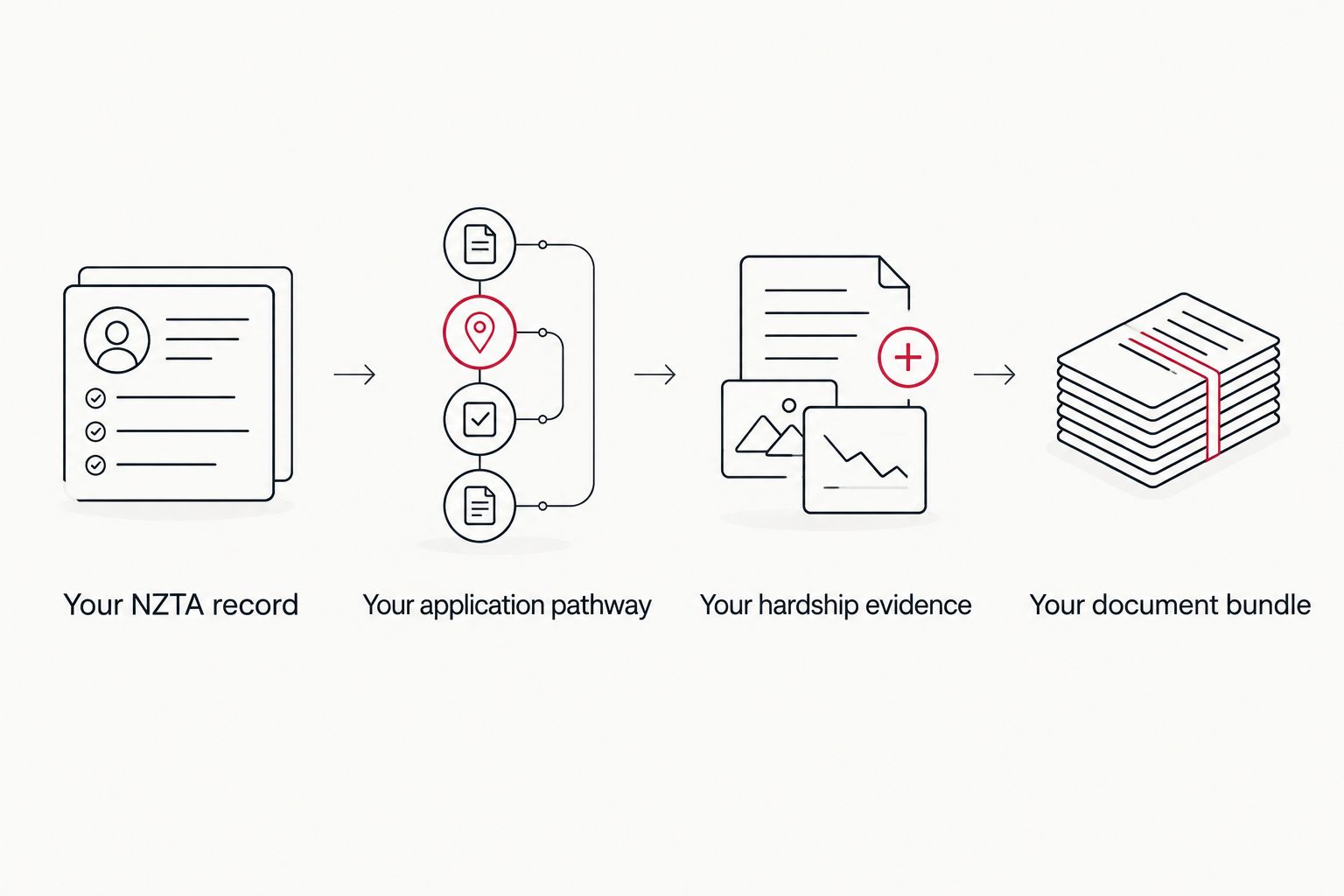
The workflow is simple: establish the record, check the pathway, support the hardship and assemble the bundle. Keep the court's decision separate from all four stages.
When your work details change
The adjacent workflow is updating your evidence when your job changes before the application is finalised. A new employer, different shifts or additional work locations can make an otherwise tidy draft inaccurate.
- Record the change. Write down what changed and when it takes effect. Keep the revised roster, employer confirmation or other supporting record.
- Update the evidence. Review every statement affected by the change, including the hardship explanation and proposed driving conditions.
- Recheck completed documents. If documents have already been sworn, filed or served, ask how corrections must be handled. Do not silently replace pages in a completed affidavit.
Expected result: the application reflects the work you actually need to perform, not an earlier arrangement.
If the court has already made an order, changed employment does not itself change that order. Check the existing conditions and obtain advice about the proper process before driving outside them.
Troubleshooting
Your points total differs from what you expected
Use NZTA's record to identify the entries involved and ask NZTA to clarify the discrepancy. Do not remove an entry from your own calculation merely because you paid the infringement or remember a different date.
Your employer's statement is too general
Ask for the underlying work facts: duties, locations, hours and the consequences of being unable to drive. A statement that only says you need your licence does not explain the hardship or support particular driving conditions.
The hours do not match across documents
Compare the roster, employer evidence, affidavit and requested conditions side by side. Correct the inconsistency and explain genuine variations, such as changing shifts, rather than concealing them behind broad hours.
You discover an interlock requirement
Pause the ordinary limited licence workflow and check NZTA's official Alcohol interlock programme guidance alongside the court order. Do not assume a limited licence application removes or replaces an interlock requirement.
You need to drive before the application is decided
A prepared or filed application is not driving authority. Follow the restriction that applies and confirm the steps required after any favourable court decision before driving; urgency does not create an exemption.
Customise your workflow
Build the evidence around your work, not a generic occupation label. A courier's delivery pattern, a hospitality worker's late finish and a self-employed driver's customer visits require different factual explanations.
Keep one source file containing your official record, notices and current work evidence. When a fact changes, check every document that relies on it before approving the final version.
NZ Limited Licence provides fast, careful preparation of applications, affidavits and complete document bundles across all 58 District Courts. Preparation supports the application; the court decides whether to grant it.
Get your application documents prepared
Arrange preparation of your limited licence application, affidavits and complete document bundle.
FAQ
How do I check demerit points in NZ in 2026?
Request your demerit points information through NZTA's official process. Keep the response and read any suspension notice separately, because a points total alone does not establish your entitlement to drive.
How many demerit points lead to suspension?
NZTA states that accumulating 100 or more demerit points within 2 years results in a 3-month suspension. Check NZTA's Demerit points and suspension guidance and your own notice for the details affecting you.
Does checking my demerit points start a limited licence application?
No. A demerit points check obtains information about your record; a limited licence application is a separate court process with eligibility and evidence requirements.
Can I get a limited licence just because I need to drive for work?
Needing to drive for work does not automatically qualify you for a limited licence. Eligibility and the relevant hardship test must be addressed, and the court decides the application.
Should I prepare my own documents or use a service?
Prepare your own documents if you can establish the requirements and draft the evidence accurately; use document preparation if you want that drafting work handled for you. Instruct a lawyer when you need individual legal advice or representation.
What does NZ Limited Licence prepare?
NZ Limited Licence prepares limited licence applications, affidavits and complete document bundles nationwide. Its document-preparation service is separate from the court's decision on the application.
Can I drive once my application has been filed?
Filing a limited licence application does not give you permission to drive. Continue to observe the applicable restriction and confirm the required steps following any court order before driving.
One last thing
Read the proposed driving conditions as if you had to follow them tomorrow. Check whether each necessary work journey fits the purpose, hours and locations requested. A carefully prepared hardship explanation still needs conditions that match the work described.