
Set your limited licence application driving hours around the work journeys you need, including travel before and after your shift, and support those hours with evidence. Separate your working hours from your requested driving hours so the court can see why each journey is necessary. Your proposed schedule is a request, not permission to drive: the court decides the conditions, and you must obtain the limited licence before driving under them.
- Limited licence application driving hours should reflect necessary journeys, not just the hours printed on your roster.
- Support requested driving hours with your roster, journey details and an explanation of the hardship.
- Changing shifts need a clear explanation; unrestricted hours are not a substitute for evidence.
- NZ Limited Licence suits drivers seeking limited licence document preparation; the court decides whether to grant the application.
Limited licence application: how do you set driving hours?
Start with the journeys, then work backwards to the hours you need. Under section 105 of the Land Transport Act 1998, the court considers the hardship grounds and can impose conditions on a limited licence. Your proposed hours should make the connection between those grounds and the driving request clear.
- List your working days. Include ordinary shifts and any changing work pattern you need to explain.
- Identify necessary journeys. Separate travel to work, travel home and driving required during work.
- Allow for travel. Explain why driving must start before work or finish after it.
- Match the evidence. Keep the roster, supporting statements and proposed conditions consistent.
- Check the wording. Make sure the requested schedule is understandable without a further explanation from you.
For paid document preparation, NZ Limited Licence prepares applications, affidavits and complete document bundles nationwide. Preparation is separate from the court's decision.
Why this matters
A work roster describes when you work. It does not necessarily describe when you need to drive. If your proposed driving permission starts when your shift starts, it leaves the journey to work unexplained.
The reverse problem matters too. A wide driving window needs a reason. Asking for hours that extend beyond the journeys described in your evidence makes the request harder to understand.
For a 2026 application, explain each requested window through a real work need and the hardship it addresses. Do not treat a limited licence as a replacement for unrestricted driving.
Fixed shifts: include the journey, not just the shift
For a fixed work pattern, show the relationship between your shift and the travel on either side. State where you start, where you need to go and when you must arrive. Then explain the return journey.
Keep work time and driving time distinct. You might spend the working day at a single workplace without needing to drive during it. If so, explain the commuting need rather than suggesting that the whole shift requires driving.
Where driving forms part of the job, describe that separately. Travelling between work locations is different from travelling to a workplace and staying there. The application should make that distinction visible.
Useful supporting material includes:
- A roster or statement confirming your normal work pattern.
- The location where you report for work.
- An explanation of the travel required before and after work.
- Details of any driving tasks during the shift.
- An explanation of why the available alternatives do not resolve the hardship.
Request the hours your evidence explains. Do not copy a colleague's proposed schedule simply because you do similar work. Your journeys and circumstances need their own explanation.
Changing shifts: explain the pattern and its limits
A changing roster needs more detail than a fixed start and finish time. Describe how shifts are allocated, which days they cover and what changes from one roster to the next. Distinguish an established work pattern from a possibility that has not been confirmed.
If you receive rosters in advance, include material showing the pattern. If your employer changes shifts at short notice, explain that arrangement and seek supporting confirmation. Avoid claiming that every hour is necessary when the evidence only shows occasional variation.
A useful explanation answers these questions:
- Which shifts do you actually work?
- How do you find out your start and finish times?
- Which journeys change when the shift changes?
- What limits can you describe accurately?
- What evidence confirms the arrangement?
A 2026 application should describe your current work arrangements, not an old pattern that no longer applies. Check the proposed schedule against the documents you submit.
Do not assume a future roster overrides the licence conditions. Once permission is granted, the conditions control your driving. If work changes beyond those conditions, get advice about the proper next step before driving outside them.
Overnight work: make the day change clear
A shift that crosses midnight needs wording that makes the calendar days clear. State which day you leave for work and which day you return. Do not leave the reader to infer whether the return journey falls within the requested permission.
The same issue arises when you finish late and travel home after midnight. Your work record and your proposed driving schedule should tell the same story, even though the journey ends on a different day.
Check weekend references carefully. A shift starting on a weekend can finish on the following day, and a return journey can fall outside wording that only names the starting day. Clear drafting prevents that ambiguity; it does not expand the permission the court grants.
Read the proposed condition as a standalone instruction. Someone who has not seen your roster should still understand which days and periods it covers.
Work driving: explain the tasks as well as the hours
If you need to drive during work, name the tasks that require it. Explain whether you travel between sites, transport work equipment or undertake another driving duty. Include only duties that genuinely form part of your work.
Hours are only part of the request. The purpose of the journey, the places involved and the relevant vehicle or licence requirements also need attention. Broad hours do not resolve an unclear work-driving purpose.
Separate routine duties from exceptional requests. If an employer occasionally asks you to cover another location, explain the actual arrangement rather than presenting every possible destination as a regular requirement.
An employer's supporting statement is most useful when it describes your role in practical terms. It should help the court understand what you need to do, why driving matters and what happens if you cannot do it.
Why requested driving hours vary
There is no single schedule that fits every limited licence application. The appropriate request depends on the necessary journeys and the evidence supporting the hardship grounds.
These factors shape the proposed hours:
- Shift pattern. Fixed shifts and changing rosters need different explanations.
- Travel time. The journey before and after work must fit the requested schedule.
- Workplace location. A fixed workplace differs from work across several locations.
- Driving duties. Commuting differs from driving as part of the job.
- Roster notice. Advance scheduling differs from confirmed short-notice changes.
- Available alternatives. Explain why other transport or work arrangements do not address the hardship.
Traffic delays need an honest explanation, not an arbitrary extension. State the journey conditions relevant to your work and explain the allowance you request. Avoid presenting an unusually difficult journey as your normal daily pattern unless that is accurate.
A wider window needs a clearer explanation, not stronger adjectives. Words such as essential and urgent do not replace details about the journey and its consequences.
Make the affidavit and proposed conditions agree
Your affidavit should explain the facts behind the driving request. The proposed conditions should express the permission you are asking the court to grant. They serve different purposes, but they must agree.
If the affidavit describes weekday work at one location while the proposed schedule includes weekends and other destinations, explain the difference or correct it. Do not expect the court to reconstruct your intended request from inconsistent documents.
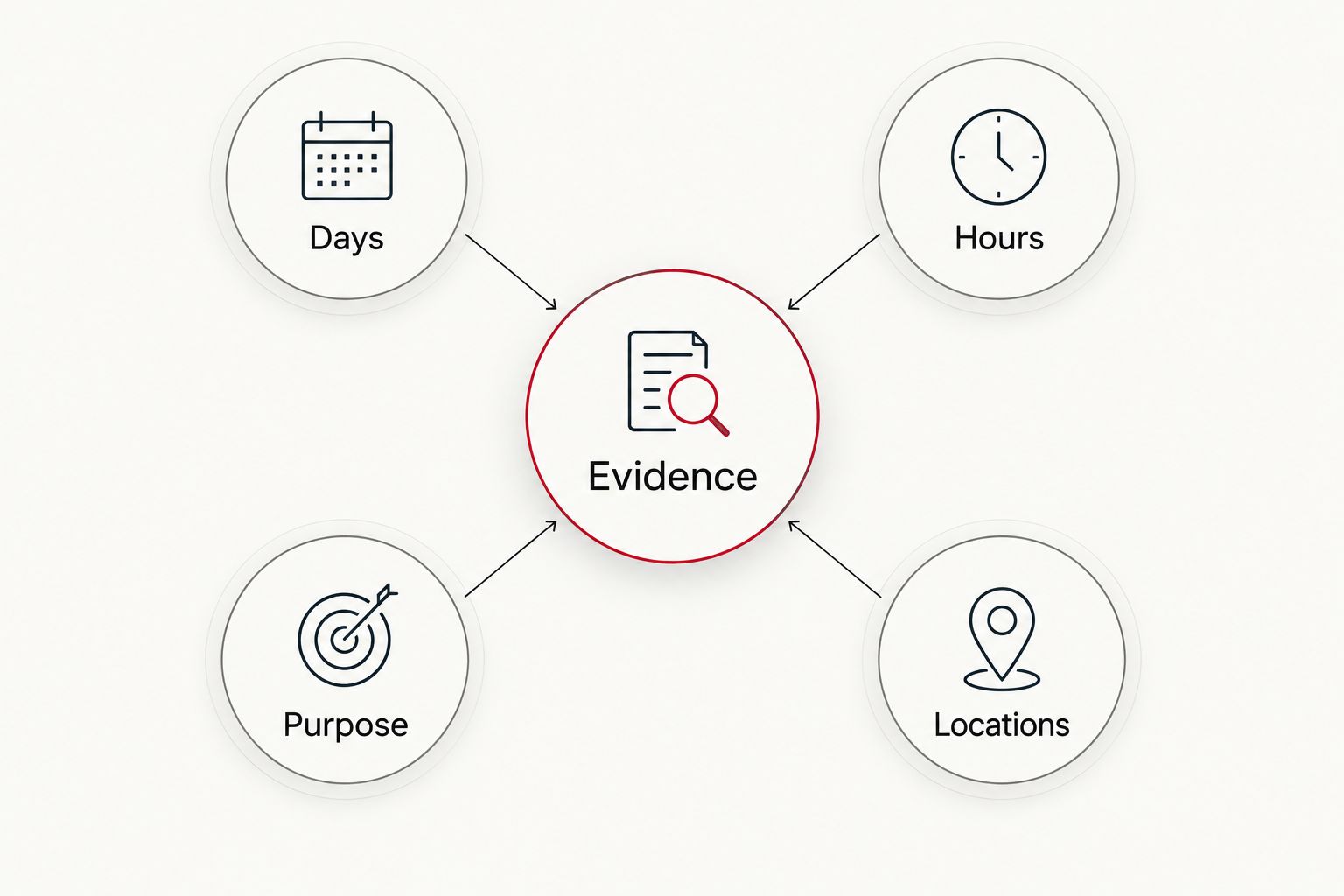
For your 2026 bundle, check:
- Days: the work pattern matches the days requested.
- Hours: travel before and after work is accounted for.
- Purpose: each requested journey has an explanation.
- Locations: the described journeys match the proposed scope.
- Evidence: supporting material confirms the arrangements you describe.
Use plain language. A precise explanation of a work journey is more useful than a long statement saying you need your licence back.
Before signing, read every factual statement carefully. Document preparation does not remove your responsibility to provide accurate information. Raise contradictions before the bundle is finalised.
Should you prepare the hours yourself or get help?
You can approach document preparation in different ways. Choose according to the clarity of your circumstances and whether you need legal advice as well as help drafting the bundle.
| Approach | Best for | Practical advantage | Limitation |
|---|---|---|---|
| Prepare documents yourself | Drivers able to understand the requirements and explain their circumstances clearly | You control the drafting and gather the evidence directly | You must identify inconsistencies and check the requirements yourself |
| NZ Limited Licence document preparation | Drivers seeking help preparing applications, affidavits and complete bundles | Fast, careful preparation focused on the application documents | Document preparation does not decide eligibility or guarantee approval |
| A local lawyer | Drivers who need legal advice about eligibility, disputed issues or proposed conditions | You can seek advice tailored to the legal questions in your case | Confirm the scope of the lawyer's work and any representation arrangement |
NZ Limited Licence prepares limited licence documents for applications across all 58 District Courts in New Zealand. That nationwide preparation service does not change the legal test or the court's control over the conditions.
For a 2026 application, get legal advice where you are unsure whether you can apply or whether your circumstances meet the test. A well-presented schedule cannot solve an eligibility problem.
Get your application documents prepared
Prepare your application, affidavit and complete bundle around the driving you need to explain.
What official rules should you check?
Use the Land Transport Act 1998, particularly sections 103 to 105, and NZ Transport Agency Waka Kotahi's official limited licence guidance when checking the legal framework. Those sources cover matters beyond the wording of your hours, including restrictions on obtaining a limited licence and the court's powers.
Section 105 distinguishes extreme hardship to the applicant from undue hardship to another person. Your evidence needs to address the relevant ground; employment alone is not a substitute for explaining the hardship.
For a 2026 application, check the current legislation and official guidance rather than relying on an old template. These references identify the legal framework, not a guarantee that your proposed conditions will be accepted.
NZTA's licensing process is separate from preparing the court documents. If the court grants an order, follow the official steps to obtain the limited licence before driving. Then comply with its conditions.
Can I request driving hours beyond my normal shift?
You can request hours that cover necessary travel before and after your shift, but explain why those periods are needed. Your work start time and your driving start time are not necessarily the same.
If you also need to drive during work, describe those duties separately. The requested window should follow the journeys, not simply duplicate the roster.
Can my employer's roster change my approved driving hours?
An employer's roster does not override the conditions of your limited licence. Check each work arrangement against the permission actually granted, not the wider schedule you originally requested.
If a changed roster requires driving outside the conditions, seek advice before making that journey. Do not treat employer approval as legal permission to drive.
FAQ
How do I set limited licence application driving hours?
Set the requested hours around necessary journeys and support them with your work pattern, travel details and hardship evidence. Separate shift times from driving times, and explain any driving required during work.
Do I include travel time to and from work?
Include the travel you need before and after work in the proposed schedule and explain it. A shift starting at your workplace does not account for the journey needed to get there.
Can I ask for unrestricted driving hours because my shifts change?
Changing shifts do not establish a need for unrestricted driving hours. Explain the actual pattern, provide supporting evidence and seek advice on conditions that address your circumstances.
How do I explain an overnight shift in my application?
Explain the departure and return days separately when a shift crosses midnight. Make sure the requested wording accounts for the return journey on the following calendar day.
Does my employer's letter decide the hours I can drive?
An employer's letter supports the facts behind your request; the court decides the conditions. The letter should describe your actual duties, work pattern and driving need.
Can I drive as soon as my court documents are prepared?
Prepared court documents do not give you permission to drive. You must obtain the limited licence through the required process and comply with its conditions.
Can NZ Limited Licence guarantee the court will approve my hours?
NZ Limited Licence prepares application documents; it does not guarantee approval of your requested hours. The court decides whether to grant the application and what conditions to impose.
One last thing
Check the journey home as carefully as the journey to work. It is easy to focus on arriving for a shift and leave the return trip unclear, especially when work finishes after midnight.
Before submitting, compare a real workday with the proposed wording from departure to return. Check the days, purpose and locations as well as the hours. The whole necessary journey should be explained, not just the point at which you clock in.