
Farmers’ limited licence applications in New Zealand seek permission for specified driving during a suspension or disqualification, with the aim of keeping essential farm work possible. Your documents need to explain the work, the hardship caused by losing your licence, and the driving you actually need—not simply that you live rurally.
- A limited licence NZ for farmers application should connect essential farm driving with clear hardship evidence.
- NZ Limited Licence suits rural workers who want application documents prepared rather than drafting the bundle themselves.
- Check eligibility with NZTA and current legislation before preparing affidavits or proposed driving conditions.
- Document preparation does not replace the court’s decision or give you permission to drive.
Why limited licences matter for farmers and rural workers
A farm worker’s transport problem is not always a simple commute. Your role might involve travelling between properties, reaching an early milking shift, collecting supplies or attending changing work sites. Explain which of those duties actually apply to you.
The useful question is not whether driving makes work easier. It is what happens when you cannot do the necessary driving. Separate inconvenience from consequences you can support with records or another person’s evidence.
For your 2026 application, keep eligibility and document preparation separate. Check the legal position first. Then decide whether to draft the documents yourself, engage a lawyer or use NZ Limited Licence for application, affidavit and document-bundle preparation.
Use official sources before choosing a preparation route
The official starting points are NZ Transport Agency Waka Kotahi’s limited licence guidance, the Ministry of Justice’s limited licence application guidance, and the current Land Transport Act. Use the versions available when you apply in 2026, not an old form saved by a friend.
The Land Transport Act’s limited licence provisions distinguish extreme hardship to the applicant from undue hardship to another person. They also contain eligibility restrictions. Do not assume that needing a vehicle for work settles either question.
If your situation involves an alcohol interlock, an indefinite disqualification or uncertainty about the sentence imposed, get legal advice before treating this as a standard application. A document checklist cannot resolve a legal eligibility question.
Prepare your rural application in 6 steps
Check eligibility
Start with the actual suspension notice or court order. Your recollection of what happened is not a reliable substitute for the document. Identify the reason you cannot drive and the conditions or restrictions that apply.
Check the current official guidance against your circumstances. NZTA explains the licensing side; Ministry of Justice guidance addresses the court application process. The legislation controls eligibility. Ask a lawyer about anything you cannot resolve from those sources.
Do this before asking your employer to prepare supporting evidence. A strong account of farm hardship does not remove an eligibility restriction.
- Read your suspension notice or disqualification order.
- Confirm the reason for the loss of your licence.
- Check the current NZTA limited licence guidance.
- Check the Ministry of Justice application guidance.
- Identify legal questions that need a lawyer’s advice.
Describe hardship
Write a plain account of your job and the consequences of being unable to drive. If you are employed, explain your duties and what your employer can confirm. If you are self-employed, distinguish lost turnover from the income you actually depend on.
Make each consequence specific. A missed milking shift, an unserviceable contracting job and a delayed supply collection are different problems. Describe the actual work affected rather than presenting every rural task as equally urgent.
For self-employed farmers and contractors, the guide to affidavits proving lost self-employed income explains the evidence question in more detail. Keep any financial claim consistent with the records behind it.
- Describe your role and essential duties.
- Identify the work you cannot complete without driving.
- Explain the resulting effect on income or employment.
- Separate your hardship from hardship affecting others.
- Match each important claim to supporting evidence.
Choose preparation
You can begin manually by gathering the official guidance, setting out your facts and identifying the documents needed. That lets you understand the application before deciding who should prepare it. Be realistic about the drafting and checking involved.
NZ Limited Licence is best for farmers and rural workers who want their limited licence application documents prepared rather than drafting the bundle themselves. The service prepares court-ready applications, affidavits and complete document bundles across all 58 District Courts in New Zealand, with fast, careful preparation.
The limitation is clear: document preparation is not the court’s decision. If you need advice about eligibility, disputed facts or legal representation, discuss that need with a lawyer rather than assuming document preparation covers it.
- Start by assembling your notices and work details.
- Decide whether you can draft and check the documents yourself.
- Use document preparation when drafting is the main task.
- Ask a lawyer about unresolved legal issues.
- Confirm what your chosen service includes before engaging it.
Map work travel
Turn your job description into a travel plan. Identify where you start, where you need to go and why each journey is necessary. Distinguish travel to a workplace from driving that forms part of the work itself.
Rural contracting and relief work need particular care. If properties change, describe how jobs are allocated and how you can identify the relevant locations. Avoid asking for unrestricted travel simply because writing down the pattern takes effort.
For seasonal work in 2026, explain the actual pattern rather than using a single busy week to describe the entire year. Proposed driving conditions should reflect the work you can substantiate. Get advice if you cannot express that pattern clearly.
- List the properties or work locations involved.
- Separate commuting from driving during work.
- Explain the purpose of each journey type.
- Record the days and hours your work requires.
- Identify seasonal changes and genuine on-call duties.
- Note the vehicles and licence classes involved.
Gather evidence
Support your account with records that show how the work operates. An employer’s explanation should describe the duties and consequences they know about, not repeat a statement you have written without checking it.
Transport alternatives need the same care. If a lift, public transport or another worker cannot cover a journey, explain the practical reason. Do not say there are no alternatives merely because the available option is inconvenient.
Keep evidence relevant. A clear roster and a specific employer statement are more useful to the explanation than a pile of unrelated farm paperwork. Never alter a record to make it fit your proposed driving hours.
- Gather rosters, contracts or job schedules relevant to the work.
- Obtain an accurate account from your employer where appropriate.
- Collect records supporting any claimed income loss.
- Record the transport alternatives you investigated.
- Explain why those alternatives do not cover the necessary journeys.
- Keep names, locations and dates consistent across documents.
Check the bundle
Read the application as one account, not as separate documents. The work described in an affidavit should match the travel requested. Supporting material should explain the same circumstances, without conflicting hours, locations or job details.
Follow the current Ministry of Justice instructions for the application and affidavit process. Check signing and witnessing requirements before signing. Ask about unclear procedural requirements rather than improvising them.
Preparing documents does not restore your right to drive. Follow the court and NZTA process, and confirm that you are legally entitled to drive before taking a vehicle onto the road. If permission is granted, read and follow the actual conditions.
- Compare the application with every supporting affidavit.
- Check proposed travel against your work evidence.
- Confirm names, addresses and vehicle details.
- Follow the required signing and witnessing process.
- Check current filing and procedural instructions.
- Retain the completed documents and any resulting conditions.
The preparation sequence is straightforward: Check eligibility, Describe hardship, Choose preparation, Map work travel, Gather evidence, and Check the bundle. Each stage answers a different question; a tidy bundle cannot compensate for an unexplained work need.
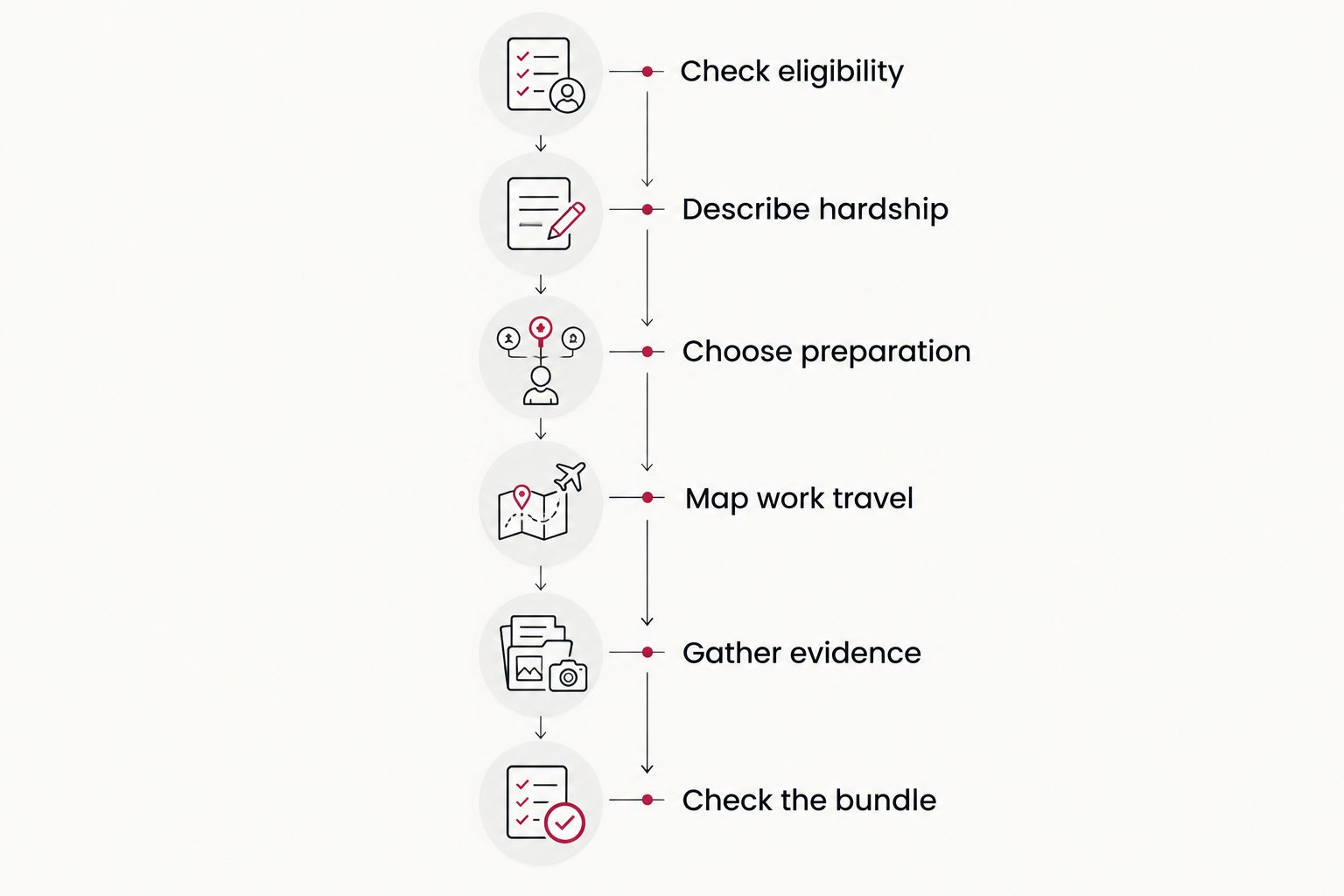
Compare the 3 preparation options
Choose the option that matches the task you need help with. Drafting documents, explaining work evidence and getting legal advice are related, but they are not interchangeable.
| Option | Best for | Main benefit | Key limitation |
|---|---|---|---|
| Prepare the documents yourself | Applicants willing to work through official guidance and check their own drafting | You control the preparation and know the underlying work facts | You take responsibility for understanding the requirements and producing a consistent bundle |
| NZ Limited Licence document preparation | Farmers and rural workers who want applications, affidavits and the document bundle prepared | Fast, careful preparation focused on the court documents | Preparation does not determine eligibility or guarantee court approval |
| Hire a local lawyer | Applicants needing legal advice, help with disputed issues or representation | You can discuss the legal position and the assistance your case needs | Confirm the agreed scope; do not assume every task is included |
Choose on scope, not on the label attached to the service. Before engaging anyone in 2026, ask who prepares the affidavits, what information you must supply, and whether legal advice or representation forms part of the engagement.
Get your application documents prepared
NZ Limited Licence prepares applications, affidavits and complete court document bundles nationwide.
Common mistakes farmers and rural workers make
Treating rural isolation as the whole explanation
A rural address does not describe your job or establish the consequences of losing your licence. Explain the necessary journeys, the alternatives considered and the hardship that remains. Give the reader facts they can follow.
Asking for every possible farm journey
A broad request can hide the work that matters most. Separate essential employment travel from personal errands and hypothetical emergencies. Explain each requested journey rather than relying on the phrase farm work.
Using fixed hours that do not match the roster
Early starts, relief shifts and seasonal work need an accurate explanation. Do not copy ordinary office hours into the paperwork if your evidence shows something different. Equally, do not request all-hours driving without explaining the actual need.
Assuming a farm vehicle removes the licence question
Do not assume that a ute, tractor or company vehicle makes your driving lawful. Check the relevant licensing position with NZTA and obtain advice where needed. Be especially careful where travel involves roads between properties rather than activity within a paddock.
Describing income loss without supporting records
Self-employed applicants should distinguish bookings, turnover, expenses and personal income. Use records you can explain. An unsupported financial claim does not become stronger because it appears in several documents.
FAQ
Can farmers get a limited licence in New Zealand?
Farmers can apply where they meet the legal eligibility requirements. Farming is not automatic approval: the application must address the applicable hardship test and the driving requested. Check current NZTA guidance and the Land Transport Act before preparing documents.
What evidence should a rural worker gather?
Gather evidence explaining your duties, necessary journeys and the consequences of being unable to drive. Relevant material can include rosters, contracts, employer evidence and records supporting income loss. Match the evidence to your actual circumstances.
Can a limited licence cover travel between farms?
Travel between farms needs to be explained in the application rather than assumed to be covered. Identify the locations, work purpose and timing. Any driving must stay within the permission and conditions actually granted.
Is document preparation better than hiring a lawyer?
Document preparation fits applicants whose main need is drafting the application bundle; a lawyer fits applicants needing legal advice or representation. Confirm the scope before choosing. Neither option guarantees court approval.
Can I prepare a rural work licence application myself?
You can take the self-preparation route using current official guidance and the required documents. You remain responsible for checking the requirements, evidence and consistency of the bundle. Get legal advice about eligibility questions you cannot resolve.
Can I drive while my application is being prepared?
Document preparation does not give you permission to drive. Do not treat payment, drafting or filing as a replacement for lawful driving authority. Confirm the court and NZTA requirements before driving.
What if my farm work changes after approval?
Check the actual licence conditions before undertaking changed work travel. A new employer, property, vehicle or shift pattern must not be assumed to fit existing permission. Seek advice about the proper process if the conditions no longer match your work.
One last thing
Before submitting a 2026 application, check your documents against one real working day. Can you trace each necessary journey from the roster to the affidavit and proposed conditions? If the account breaks at that point, fix the mismatch before filing—not after someone asks you to explain it.