
Healthcare workers’ limited licence applications seek permission for specified driving during a suspension or disqualification, aiming to protect employment or prevent hardship to others. This 2026 guide explains how to document shifts, patient visits and transport gaps without confusing document preparation with the court’s decision.
- Limited licence NZ for healthcare workers applications need specific evidence of work journeys, roster requirements and hardship.
- NZ Limited Licence suits healthcare workers seeking paid preparation of applications, affidavits and court document bundles.
- Check eligibility before preparing documents; healthcare employment does not automatically qualify you.
- Separate commuting, patient visits and on-call work so the requested driving matches the evidence.
Why limited licences matter for healthcare workers
Losing the ability to drive affects healthcare roles differently. A hospital employee travelling to a fixed workplace has a different transport problem from a community nurse visiting patients or a support worker covering several homes.
Your application needs to explain that difference. A job title does not show when you travel, why driving matters or what happens when you cannot make a journey.
For changing start and finish times, the guide to showing changing hours for shift workers helps you organise the roster evidence before drafting your account.
Build the application around necessary journeys and documented consequences, not the importance of healthcare in general. Describe your actual work. Do not claim patient harm unless someone with direct knowledge can support it.
Check the official rules before preparing documents
For a 2026 application, use NZ Transport Agency Waka Kotahi’s official limited licence guidance, the Ministry of Justice’s limited licence application guidance and the current Land Transport Act on New Zealand Legislation. These are the official references for eligibility, procedure and the legal test.
The Act distinguishes extreme hardship to the applicant from undue hardship to another person. Ordinary inconvenience is not the same thing. Explain the consequences accurately rather than copying those legal terms into every paragraph.
Working in healthcare does not create automatic eligibility or guarantee approval. Your suspension or disqualification circumstances matter. Check the applicable rules before paying for preparation, and seek legal advice when your eligibility or legal position is unclear.
Document preparation helps present your evidence. It does not decide whether the legal test is met, replace required procedural steps or authorise driving.
Build your healthcare worker application
1. Confirm your licence position
Start with the actual notice or court order. Do not rely on your recollection of what was said or a colleague’s experience with a different offence.
Write down whether you face a demerit suspension or a court-ordered disqualification. Record the relevant dates and any other licence restrictions. If alcohol interlock requirements are involved, check the official guidance for that situation rather than assuming a standard work licence application is the right route.
A document preparer needs accurate starting information. A lawyer is the appropriate choice when you need advice about how the law applies to disputed or complicated circumstances.
- Read the suspension notice or disqualification order.
- Record the dates exactly as written.
- Identify any other licence conditions or orders.
- Check the official eligibility guidance.
- Resolve uncertainty before drafting the application.
2. Map the driving your role actually requires
Separate travel to work from driving during work. A fixed hospital commute, travel between clinics and home-based patient visits serve different purposes and need different explanations.
For each journey type, record its origin, destination, timing and frequency. Use your real roster or appointment schedule. Describe an operating area where visits vary, but do not substitute a broad region for a clear account of the work.
As a planning exercise, map 3 representative journeys: a routine journey, a difficult shift journey and a work-related journey between locations, where relevant. This is an organising suggestion, not a court requirement.
- Identify your usual workplace or work base.
- Separate commuting from work-time travel.
- List recurring clinics, facilities or service areas.
- Explain which journeys change with the roster.
- Exclude personal trips from the work-driving explanation.
3. Choose who will prepare the documents
You can start manually by gathering your records and reading the official application guidance. That work remains useful whether you prepare the documents yourself, use a preparation service or instruct a lawyer.
NZ Limited Licence is best for healthcare workers seeking paid preparation of limited licence applications, affidavits and complete court document bundles. The service prepares documents for disqualified drivers across all 58 District Courts in New Zealand, with fast, careful preparation as its focus.
Use NZ Limited Licence when you want preparation support rather than drafting the bundle yourself. Choose a lawyer when you need legal advice or representation. Neither route transfers responsibility for truthful information away from you.
- Decide whether you need drafting, legal advice or both.
- Gather your licence records before requesting preparation.
- Explain your employment and driving arrangements accurately.
- Confirm what the chosen service includes.
- Keep document preparation separate from court approval.
4. Gather employment evidence that explains the hardship
Ask your employer for facts, not praise. A statement that you are valued does not explain why you need to drive or what happens without the proposed journeys.
Useful supporting information describes your role, workplaces, roster and driving duties. If your employer says alternative duties are unavailable, ask for the factual reason. Do not turn a temporary difficulty into a claim that dismissal is certain unless that is genuinely supported.
For rotating shifts, collect 2 roster cycles as a starting point if they show the relevant variation. That is a practical evidence-gathering suggestion, not a prescribed minimum.
- Obtain your job title and a description of relevant duties.
- Gather dated rosters or work schedules.
- Identify who can confirm the employment facts.
- Explain available alternative duties or their limits.
- Describe employment consequences without exaggeration.
5. Test the transport alternatives against each journey
Saying there is no public transport is less useful than showing what transport exists and why it does not cover the necessary journey. Match the evidence to the actual shift, destination and day.
For a 2026 application, use current timetable information rather than an old screenshot. Check the journey home as well as the journey to work. A service that reaches the hospital before a shift starts does not answer how you return after it finishes.
Consider lifts, employer arrangements and other practical alternatives honestly. If an option works for some journeys, say so. Then explain the remaining gap.
- Check transport for the actual start and finish times.
- Save dated timetable or journey-planner results.
- Record the walking connections where relevant.
- Explain why available lifts do not cover particular shifts.
- Separate inconvenience from an evidenced transport barrier.
6. Explain patient and service impacts without exposing private details
If you rely on hardship to someone else, identify the consequence and who can confirm it. Do not assume that every missed shift proves patient hardship.
A manager can explain staffing arrangements, reassignment options or the effect of losing coverage. A community healthcare worker can describe the visit pattern and why transport alternatives do not meet the role. Keep each statement within the writer’s direct knowledge.
Protect patient information while preparing your evidence. Use general descriptions where they explain the point, and obtain appropriate advice before including identifiable clinical material. More private detail does not automatically make a stronger application.
- Describe the affected service or work arrangement.
- Identify a person who knows the relevant facts.
- Explain replacement or reassignment options honestly.
- Avoid unsupported predictions about patient outcomes.
- Leave unnecessary patient identifiers out of working drafts.
7. Reconcile the documents before submission
Read the application, affidavits and proposed driving details together. They should tell the same story. A roster showing weekend work needs an explanation if the proposed driving only addresses weekdays.
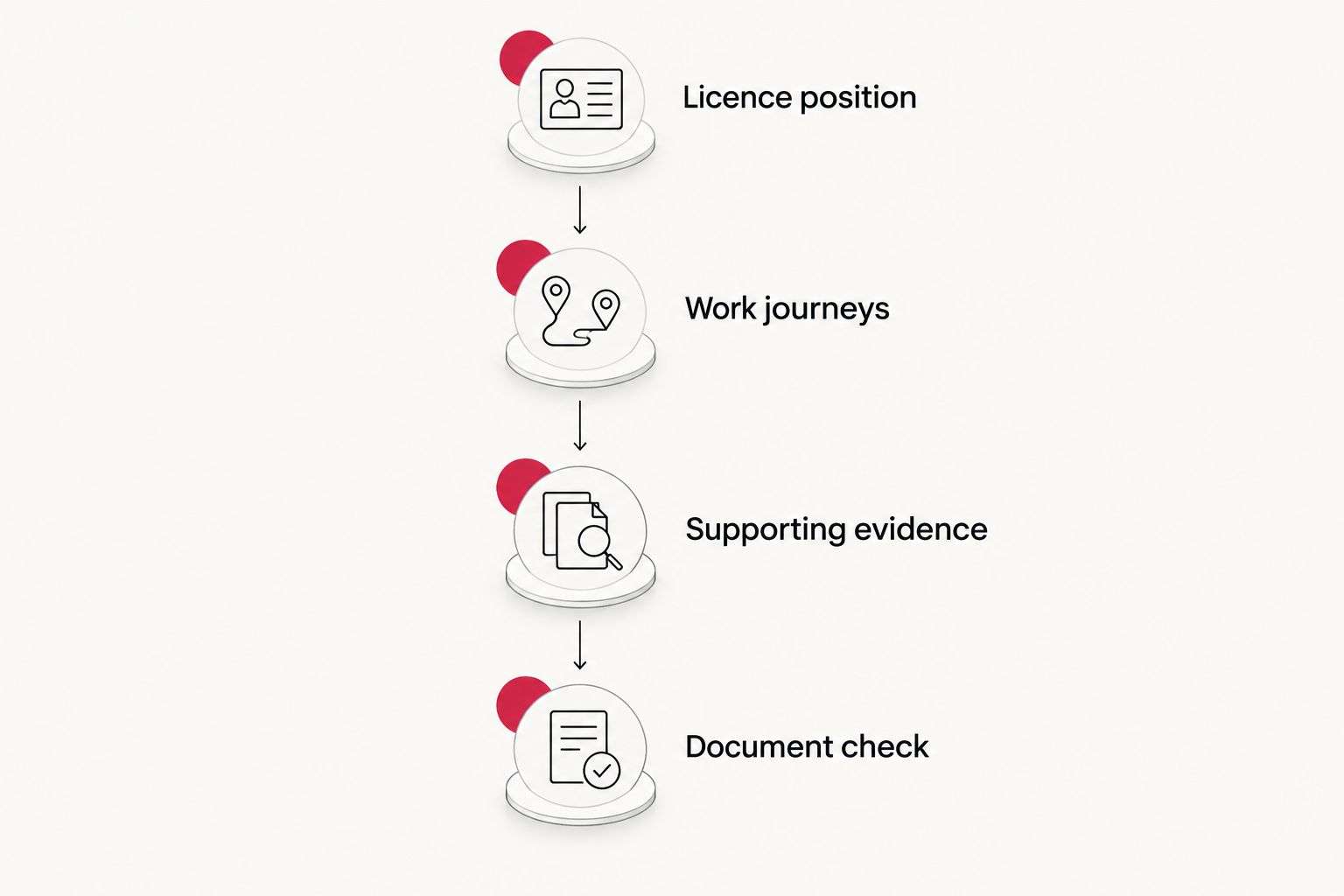
Use a simple sequence: Licence position, Work journeys, Supporting evidence, Document check. Resolve differences before the bundle is finalised rather than expecting the reader to infer what you meant.
Check the Ministry of Justice’s current procedural guidance for your 2026 application, including the applicable filing and affidavit requirements. Follow the required process for signing or swearing documents; an unsigned draft is not a completed affidavit.
- Match names, dates and employer details throughout.
- Compare requested driving with the roster evidence.
- Check that supporting statements describe the same duties.
- Follow the applicable affidavit witnessing requirements.
- Keep a complete copy of the final documents.
Compare your document preparation options
Choose according to the work you need done. Document drafting and legal representation are different services. Ask about scope before you commit, particularly if you need someone to address a disputed legal issue.
| Option | Best for | Main advantage | Key limitation |
|---|---|---|---|
| Prepare documents yourself | Drivers confident reading official guidance and drafting their evidence | You control the drafting and understand every supporting record | You must organise the documents and check the applicable requirements yourself |
| NZ Limited Licence document preparation | Healthcare workers wanting applications, affidavits and a complete document bundle prepared | Fast, careful preparation focused on the application documents | Preparation is not the court’s decision; confirm any support beyond the documents |
| Hire a local lawyer | Drivers needing legal advice, representation or help with a complicated legal position | You can obtain advice on your circumstances and agree a representation scope | You still need to supply accurate employment, roster and hardship evidence |
Pick the service that solves your actual problem. If you cannot explain your work journeys, hiring someone does not remove the need to establish those facts. If your difficulty is legal eligibility, better formatting alone does not resolve it.
Get your application documents prepared
NZ Limited Licence prepares applications, affidavits and court document bundles nationwide.
Common mistakes healthcare workers make
Treating a healthcare job as proof of eligibility
Being a nurse, caregiver or allied health worker explains your occupation. It does not establish your legal eligibility or prove hardship. Check the legal starting point first, then show the consequences of losing the specific driving your work requires.
Asking for unrestricted on-call driving
An on-call label does not explain when you are rostered, where you travel or who confirms the arrangement. Describe the actual call-out system and its limits. Do not ask the reader to infer that your role requires driving everywhere at any time.
Using an employer statement that contradicts the roster
A statement describing weekday duties conflicts with evidence showing rotating night and weekend shifts unless the difference is explained. Review the documents together. If the roster has changed, identify which schedule applies and why the older record is included.
Claiming there are no alternatives without checking
A transport claim loses clarity when it ignores an option that works for some shifts. Be precise. Explain which journeys are covered, which remain uncovered and what practical checks support that distinction.
Including patient details instead of useful operational evidence
A list of patient names does not explain why replacement staff or different travel arrangements are unsuitable. Focus on duties, timing, service areas and confirmed consequences. Ask for appropriate advice before submitting sensitive material.
FAQ
Can healthcare workers get a limited licence in NZ?
Healthcare workers can seek a limited licence if their circumstances meet the applicable eligibility rules and legal test. Healthcare employment alone does not qualify you; check NZTA guidance, Ministry of Justice guidance and the current Land Transport Act.
Is a work licence different from a limited licence?
Work licence is a common informal term for a limited licence sought for work-related driving. Do not treat the informal name as permission to drive for every work purpose; the authorised conditions matter.
What evidence should a nurse gather for an application?
Start with your licence notice or court order, role details, rosters, required journeys and transport checks. Add factual employer evidence explaining the consequences of losing the driving you seek.
Can my application cover night shifts and on-call work?
Explain night shifts and on-call journeys specifically when requesting driving conditions. Provide evidence of the arrangement; the court decides what conditions, if any, to approve.
Do I need a lawyer or a document-preparation service?
Choose a lawyer when you need legal advice or representation, and a document-preparation service when you need help preparing the application bundle. Confirm the scope before choosing either option.
Does having my documents prepared mean I can drive?
No. Document preparation does not authorise driving. Follow the official court and NZTA process and do not drive unless you hold the required authority and meet its conditions.
Should I include patient names in my affidavit?
Do not include patient identifiers merely to make the application look more detailed. Explain the operational hardship with appropriate supporting evidence and obtain advice before including sensitive clinical information.
One last thing
Check the journey home. An early shift start often gets attention, while the late finish is left unexplained. For your 2026 application, test both ends of each necessary journey against the roster and transport evidence.
The strongest preparation starts with an accurate account of the driving you need—not the broadest request you can write. Keep a separate list of unresolved facts and settle them before the documents are finalised.