
A tradie’s limited licence in NZ is permission to drive under specific conditions during an eligible suspension or disqualification, with the aim of protecting work where the legal hardship test is met. Carrying tools, reaching changing job sites and collecting materials make your evidence different from a standard commute-only application.
- Limited licence NZ for tradies: explain the work journeys, hardship and transport alternatives, not just your occupation.
- NZ Limited Licence prepares work licence applications, affidavits and document bundles; the court decides whether to grant permission.
- Choose document preparation for drafting support; choose a lawyer when you need legal advice or representation.
- Do not drive just because your application has been prepared, filed or heard.
Why limited licences matter for tradies
Your application needs to explain what stops working when you cannot drive. A job title alone does not show the consequences. Describe the tools you carry, the sites you attend and what happens to your employment or business without those journeys.
An employed apprentice and a self-employed electrician need different supporting evidence. An employer can explain roster requirements and available alternative duties. A sole trader needs records connecting booked work, necessary travel and the income at risk.
For self-employed applicants, the guide to affidavits proving lost self-employed income explains the evidence issue in more detail. Keep the focus on records that support your own circumstances.
Use official sources for your 2026 application
The legal starting point is the Land Transport Act, particularly sections 103 and 104. These provisions address limited licence applications, exclusions, hardship and the court’s decision. The hardship test distinguishes exceptional hardship to you from undue hardship to another person.
For a 2026 application, check NZ Transport Agency Waka Kotahi’s official limited licence guidance for the licensing process and the Ministry of Justice’s limited licence application guidance for court procedure. Confirm eligibility and any applicable waiting period before choosing a filing date. A need to keep working does not, by itself, establish eligibility.
How to prepare your tradie limited licence application
Check eligibility
Start with your actual suspension notice or court order. Do not rely on a description such as lost licence or drink-driving ban: the legal basis matters. Different circumstances require different checks, and some exclusions prevent a limited licence application.
Read NZTA’s limited licence guidance alongside your notice. If your paperwork mentions an alcohol interlock requirement, an indefinite disqualification or another complication, get advice about that specific position rather than assuming an ordinary work licence application fits.
Create a short case summary before drafting anything. Separate confirmed facts from questions that need an answer.
- Record the reason for the suspension or disqualification.
- Copy the start date and duration from the official document.
- Keep the notice or order with your application records.
- Check eligibility, exclusions and any applicable waiting period.
- Ask a lawyer about unclear legal issues before paying for drafting.
Map work travel
Build a travel record yourself using your diary, job bookings and work messages. Cover 1 working week as a starting exercise, then add recurring duties that the week does not capture. This is a preparation method, not a court-prescribed evidence period.
Split travel into getting to work, travelling between sites, collecting necessary materials and returning equipment. Explain why each journey requires you to drive. A supplier visit needs a different explanation from driving to the same workshop each morning.
Changing sites need clear boundaries. Describe the actual work area and scheduling pattern rather than asking for unrestricted travel wherever a job appears.
- List your usual starting point and destinations.
- Identify tools or materials that need transport.
- Separate regular journeys from occasional call-outs.
- Record who assigns jobs and confirms site locations.
- Note journeys that someone else can reasonably cover.
Choose preparation support
You can organise your records and prepare documents yourself. That route gives you control, but it also leaves you responsible for understanding the requirements, drafting accurately and following the filing process. Use official guidance rather than copying another driver’s circumstances.
NZ Limited Licence is best for tradies who need limited licence documents prepared rather than legal representation. The service prepares court applications, affidavits and complete document bundles nationwide, with fast, careful preparation as its focus. Preparation does not determine eligibility or guarantee approval.
You can use NZ Limited Licence once you have gathered your notices and work evidence. Choose a lawyer instead when you need advice about a disputed issue, an objection or representation.
- Decide whether you need drafting, advice or representation.
- Ask what the preparation service includes.
- Confirm who handles filing and procedural follow-up.
- Explain any known objection or unusual licence history.
- Keep responsibility for checking the accuracy of your facts.
Build hardship evidence
Start with documents you already hold. For an employee, these include rosters, job instructions and employment correspondence. For a sole trader, use booking records, contracts, invoices and other records that connect the claimed hardship to real work.
Keep 2 evidence lists: one for hardship affecting you, and one for hardship affecting other people. The distinction helps you organise facts around the statutory test. It does not replace legal advice about whether those facts meet that test.
Affidavits should explain what the person making the statement actually knows. An employer should describe the work requirements and consequences, not repeat an unsupported conclusion that you must receive a licence.
- Match each claimed consequence to supporting records.
- Explain whether alternative duties are available.
- Distinguish booked work from hoped-for future work.
- Identify who can confirm the facts directly.
- Keep income figures consistent across supporting documents.
Set workable conditions
Draft the driving you actually need, not the broadest permission you would prefer. The court decides the conditions. Your preparation should give the court a clear account of the proposed work purpose, hours, locations and relevant vehicles.
Test the proposal against 3 practical checks: an ordinary workday, a changing-site day and an on-call situation if that genuinely forms part of your work. These are planning examples, not automatic categories of permitted driving.
A narrow proposal that omits essential duties is not useful either. Explain necessary flexibility with evidence, rather than hiding it inside vague wording such as work purposes at all times.
- Describe normal work hours and genuine variations.
- Explain the geographical area your jobs require.
- Identify relevant vehicles and existing licence classes.
- Separate supplier trips from private errands.
- Check that proposed conditions match the supporting affidavits.
Check the bundle
Read the application, affidavits and attachments together. Names, dates, employment details and proposed driving arrangements should agree. Correct discrepancies before signing or filing rather than expecting someone else to reconcile them.
For your 2026 filing, follow current Ministry of Justice guidance and confirm procedural requirements with the relevant court. Check how affidavits must be sworn or affirmed, what needs filing and what notification or service steps apply. Do not sign a draft affidavit casually before checking the witnessing requirements.
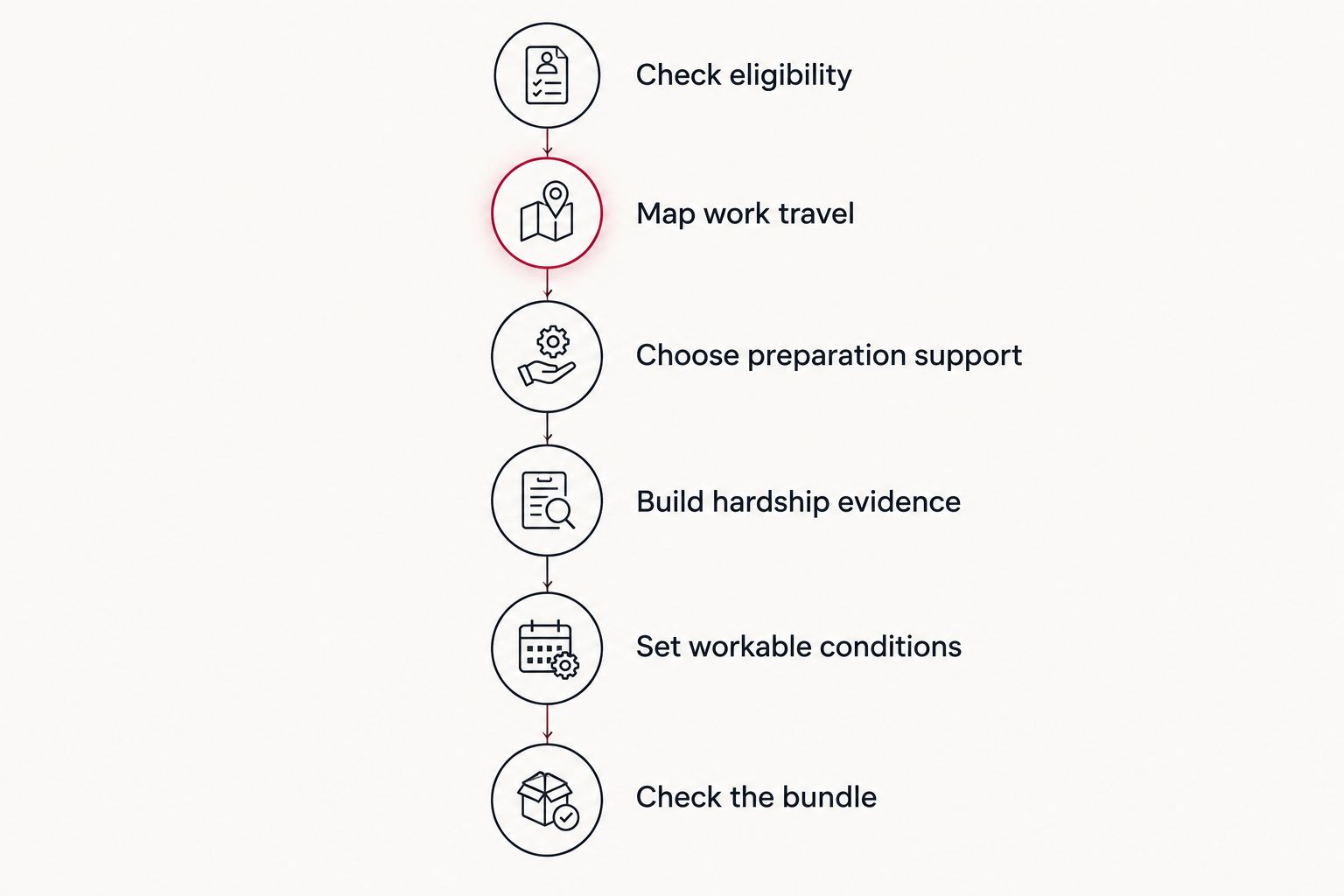
Use the preparation sequence as a final review. Each stage should support the next, from eligibility through to a consistent document bundle.
- Check eligibility.
- Map work travel.
- Choose preparation support.
- Build hardship evidence.
- Set workable conditions.
- Check the bundle.
Compare your preparation options
Choose support according to the task you need done. Document drafting and legal representation are different services. Neither removes the need for accurate evidence from you, your employer or other people supporting the application.
| Option | Best for | Main advantage | Key limitation |
|---|---|---|---|
| Prepare it yourself | Applicants able to understand the requirements and draft their own evidence | Direct control over the documents and factual detail | You handle drafting, consistency checks and procedural requirements yourself |
| NZ Limited Licence document preparation | Tradies wanting applications, affidavits and a complete bundle prepared | Fast, careful document preparation across New Zealand | The court decides the application; preparation is not legal representation |
| A local lawyer | Applicants needing legal advice, help with objections or representation | Advice and representation within the agreed engagement | Confirm the scope; do not assume every task is included |
For a straightforward document-preparation need, gather your evidence before approaching a provider. For a legal uncertainty, resolve that uncertainty first. Paying for polished paperwork does not answer a disputed eligibility question.
Get your application documents prepared
NZ Limited Licence prepares applications, affidavits and complete document bundles nationwide.
Common mistakes tradies make
Treating a ute as proof of hardship
Saying your tools live in the ute does not explain why another arrangement fails. Describe the equipment, where it needs to go and the practical transport options you investigated. Keep the explanation factual; do not claim alternatives are impossible without checking them.
Claiming turnover as lost personal income
Business revenue and your own income are not interchangeable. Explain what your records show and how the inability to drive affects the business and you. For a 2026 application, use records relevant to the work and income currently at risk, not an unrelated busy period.
Asking for every possible driving hour
Broad hours without supporting work evidence leave the proposed arrangement unclear. Use rosters, bookings and an explanation of genuine call-outs. If jobs change regularly, explain how they are assigned and why a fixed daily schedule does not describe the work accurately.
Ignoring other available drivers
A workmate, employee or family member is an obvious transport question. Address it directly. Explain availability, conflicting duties and the journeys that person can actually cover; acknowledge alternatives that work instead of claiming every trip requires you behind the wheel.
Driving before the process is complete
Prepared documents are not permission to drive. Neither is a belief that the application should succeed. NZTA’s limited licence guidance distinguishes the court process from obtaining the limited licence; follow the required steps and confirm you are legally entitled to drive before making any work journey.
FAQ
Can I get a limited licence in NZ because I need my ute for work?
Needing your ute for work does not automatically qualify you for a limited licence. You must be eligible and satisfy the applicable legal test; explain the necessary journeys, transport alternatives and resulting hardship with evidence.
What should my employer put in a supporting affidavit?
Your employer should explain the work facts they know directly, including your duties, necessary driving and the consequences if you cannot drive. The statement should address available alternatives and agree with the rest of your application.
Can a self-employed tradie apply without an employer letter?
Self-employment does not give you an employer who can provide that letter, so organise evidence of your own work and hardship. Booking records, contracts and financial records can support the factual account, but eligibility and the legal test still need checking.
Can a limited licence cover changing building sites?
Changing sites need to be explained in the application and addressed in any conditions the court grants. Describe the work area, scheduling process and necessary travel rather than assuming all future site visits will be covered.
Is document preparation the same as hiring a lawyer?
Document preparation is not the same as legal advice or representation. Choose drafting support when you need application documents prepared, and seek a lawyer when you need advice on legal issues or representation.
Can I drive as soon as the court approves my application?
Do not assume court approval alone completes the licensing process. Follow NZTA’s official instructions for obtaining the limited licence and confirm that every required step is complete before driving.
What should I check before applying for a limited licence in 2026?
Check your suspension or disqualification documents, eligibility, any applicable waiting period and the current application procedure. Use official NZTA and Ministry of Justice guidance, and get legal advice where your circumstances are unclear.
One last thing
Write down a normal workday before writing your hardship statement. Include the first destination, tools carried, site changes and return journey. Then ask someone unfamiliar with your trade to read it: if they cannot tell why you need to drive, add the missing facts before turning that account into formal evidence.