
A limited licence and a work licence in NZ are the same thing. "Work licence" is the everyday name; "limited licence" is the legal term for the licence a District Court can grant to a disqualified or suspended driver. The real choice in 2026 is not which licence to get. It is how you prepare the application: yourself, through a document service, or with a local lawyer.
- Limited licence and work licence NZ describe one licence. Only the name differs.
- The District Court decides every application. No service or lawyer can promise approval.
- Choose NZ Limited Licence if you want a court-ready bundle prepared fast, without paying for full legal representation.
- Choose a local lawyer if your case is contested or legally complex.
- Doing it yourself works only if you can build the evidence and affidavits without gaps.
Why this matters
Searching "nz limited licence vs work licence nz" usually means one of two things. You think there are two licences and want the right one. Or you have seen both terms on different sites and are not sure you are reading about the same thing.
You are. The confusion costs people time. Some wait for a "work licence" form that does not exist, because the application is made to the court, with a supporting affidavit and evidence.
NZ Limited Licence prepares those court applications, affidavits and document bundles for disqualified drivers across all 58 District Courts in New Zealand. Everything below is written to help you decide, including when someone else is the better choice.
At a glance: limited licence vs work licence
| Dimension | Limited licence | Work licence |
|---|---|---|
| Best for | The legal and official term | The everyday, search-friendly term |
| Who grants it | The District Court | The District Court (same licence) |
| Application route | Court application with supporting evidence | Court application with supporting evidence |
| Typical purpose | Driving for work, and other needs the court accepts | Driving for work |
| Conditions | Set by the court | Set by the court |
| Standout feature | Official wording used by NZTA and the courts | Plain wording drivers actually search |
No row has a different answer in the two columns. That is the finding.
Both names mean the same licence: a tie
There is no legal difference to weigh. Official sources say limited licence. Drivers, employers and most websites say work licence, because work is the most common reason people apply.
The court can attach conditions to the licence it grants, such as when, where and for what purpose you may drive. Those conditions are why the evidence you supply matters. The licence is only as useful as the hours and routes you can justify.
Verdict: use either term in conversation. Use "limited licence" when you read NZTA or court material, so you find the right page.
The word "work" is narrower than the licence
This is the one place the names pull apart. "Work licence" suggests the licence is only about a job. What the court will accept as a reason to drive depends on your circumstances and the evidence you give it. If your need is not a standard job, say a second job, caregiving or shift patterns, the application needs more careful framing.
If your situation involves several employers or on-call hours, the supporting documents change. For example, this guide covers what happens to your work licence if you change employer after you have one.
Verdict: "limited licence" is the more accurate name. "Work licence" is fine as shorthand.
The real comparison: how you prepare the application
Once the naming question is gone, the question that matters is who builds the application. There are three routes. None is wrong for everyone.
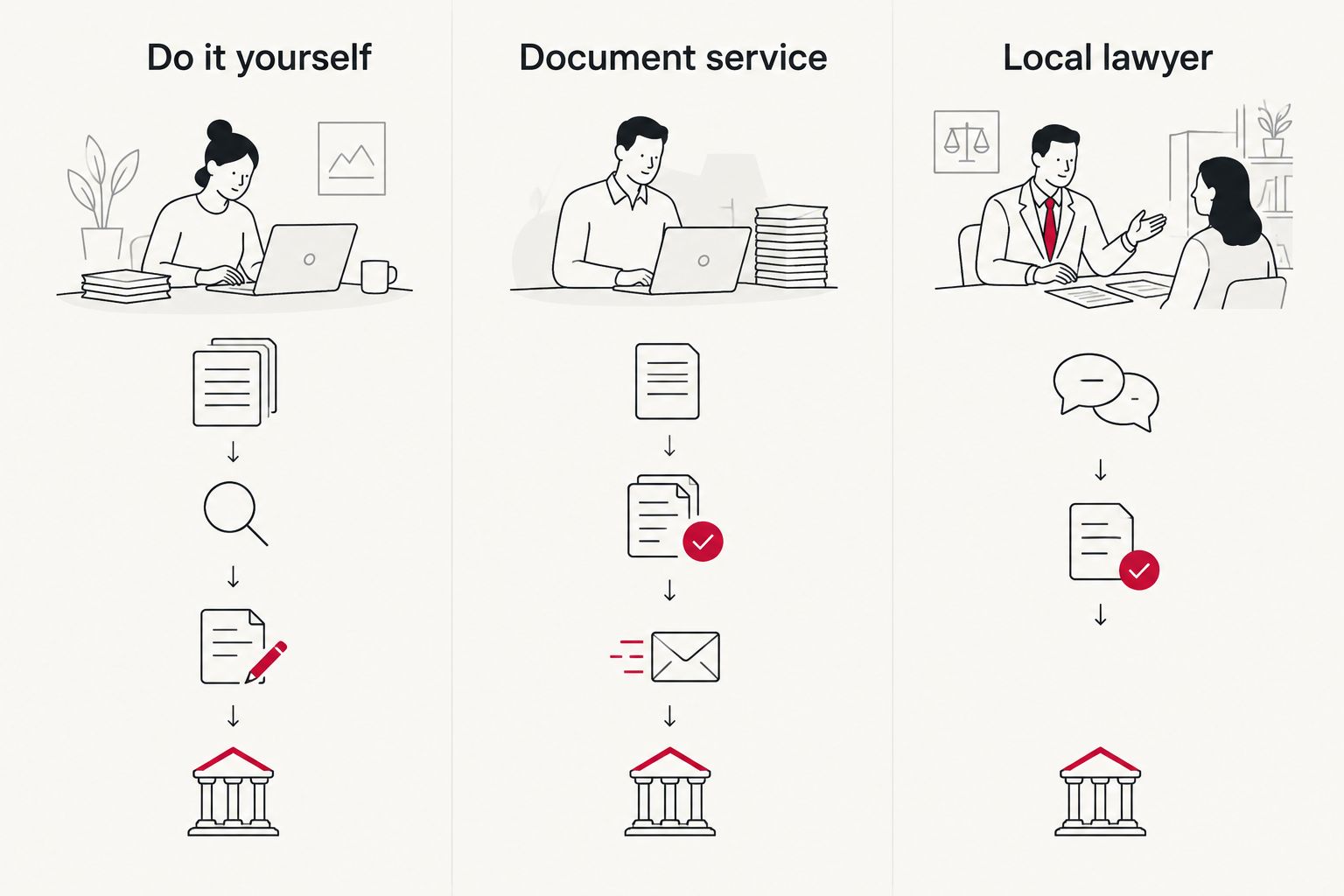
| Dimension | Do it yourself | NZ Limited Licence | Local lawyer |
|---|---|---|---|
| Best for | Simple, well-documented cases | Drivers who want a court-ready bundle prepared fast | Contested or legally complex cases |
| What you do | Research, draft, assemble | Provide your details and evidence | Instruct and attend |
| Court representation | None | Document preparation only | Available |
| Main risk | Gaps and mistakes you cannot see | You still file and present the case | Cost and local availability |
| Standout feature | You control everything | Nationwide, built for this one application | Legal advice on your wider case |
Do it yourself: possible, but unforgiving
You can prepare the application yourself. The court does not require a professional. What it requires is a complete, consistent set of documents.
The problem is not the form. It is knowing what the court expects in the affidavit, how to describe your driving, and which evidence backs each claim. People often discover the gaps only after a refusal. This guide explains whether you can prepare work licence documents yourself and where it tends to go wrong.
Verdict: a reasonable choice if your case is simple and you have time. Risky if you are close to a deadline or your work pattern is complicated.
Document preparation: the faster middle route
A document-preparation service builds the application for you: the affidavit, the supporting evidence and the assembled bundle. NZ Limited Licence works this way for drink-driving disqualifications and demerit suspensions.
The case for this route is speed and completeness. Preparation is fast, and the bundle is built around what the court looks for. The case against it is just as plain. A service prepares documents. It does not decide the outcome and it does not stand in court for you.
Verdict: the best fit if you want a careful, complete application without paying for a lawyer to run your whole case.
A local lawyer: the right call when the case is hard
A lawyer gives you legal advice and can represent you. That matters if police are likely to object, your history is complicated, or you need advice on the underlying charge.
The tradeoffs are cost and access. A local lawyer may not be near you, and not every lawyer does this work often. For a side-by-side look at this decision, read lawyer or document preparation service.
Verdict: worth it for contested cases. Often more than a straightforward application needs.
Get your application prepared
Court-ready affidavits and document bundles for all 58 District Courts.
What none of the three routes can promise
The District Court makes the decision. No service, lawyer or template changes that. Approval depends on your circumstances, your evidence and the court's view of your case.
What preparation can do is remove avoidable problems: missing documents, inconsistent details, vague driving descriptions. That is a real gain. It is not a guarantee.
Check current eligibility rules on the official NZTA and Ministry of Justice sites before you apply. Rules and forms change, and the official pages are the source for eligibility and procedure.
Pricing: models, not numbers
The three routes charge in different ways, and that shapes the decision more than any single figure.
- Do it yourself: the cost is your time and the risk of a refused application.
- Document preparation: a defined piece of work, so the cost is more predictable.
- Lawyer: often priced on time and complexity, which gives flexibility but less certainty up front.
Current pricing sits on each provider's site. For a breakdown of what drivers typically ask about, see the guide on how much a limited licence costs in NZ.
Final verdict
Choose NZ Limited Licence if you are a disqualified or suspended driver who needs to keep working, your case is not contested, and you want a complete court-ready bundle prepared fast.
Choose a local lawyer if police may object, your record is complicated, or you want legal advice beyond the application itself.
Choose to do it yourself if your case is simple, your evidence is organised and you have time to get it right.
“A limited licence and a work licence are the same licence. The only choice that matters is who prepares your application.”
Scorecard
| Dimension | Winner |
|---|---|
| Name accuracy | Limited licence |
| Everyday searchability | Work licence |
| Legal difference between the two | Tie: there is none |
| Speed of preparation | NZ Limited Licence |
| Court representation | Local lawyer |
| Lowest outlay for a simple case | Do it yourself |
| Guaranteed outcome | Nobody: the court decides |
FAQ
Is a work licence the same as a limited licence in NZ?
Yes. Work licence is the everyday name for a limited licence. Both refer to the licence a District Court can grant to a disqualified or suspended driver, with conditions.
Who grants a limited licence in NZ?
The District Court grants it. You apply with supporting evidence and an affidavit, and the court decides. Check the Ministry of Justice and NZTA for current procedure.
Can I get a limited licence only for work?
Work is the most common reason, but the licence is not defined by the word work. The court looks at your circumstances and the evidence you provide for the driving you need.
Do I need a lawyer to apply for a limited licence?
No. A lawyer is optional. You can apply yourself or use a document-preparation service. A lawyer helps most when your case is contested or complicated.
What does NZ Limited Licence actually do?
NZ Limited Licence prepares limited licence applications, affidavits and document bundles for disqualified drivers across all 58 District Courts. It prepares documents. The court makes the decision.
Can a document service guarantee my limited licence?
No. Only the District Court decides. Good preparation reduces avoidable mistakes, but no service can promise approval, and you should be wary of any that does.
What if my application is refused?
A refusal is not always the end. You can look at why it failed and reapply with stronger evidence. Common refusal reasons are covered in the related guides below.
One last thing
Most refused applications fail on evidence, not on the licence name. A driver who explains exactly when, where and why they drive, and proves it, is in a stronger position than one who simply asks. Decide who will build that evidence before you decide anything else in 2026.