
If your limited licence application is refused, you do not gain permission to drive: your existing suspension or disqualification still applies. Get the court’s reasons, identify whether the problem concerns eligibility, evidence or the driving permission requested, and seek legal advice before trying to challenge the decision or apply again. A refused application is not permission to drive while you sort out the next step.
- Limited licence application refused? Keep off the road and obtain the court’s reasons before choosing your next step.
- NZ Limited Licence prepares applications, affidavits and document bundles; the court decides whether to grant permission.
- A Police objection is not a court refusal. Check what the judge actually decided.
- Get legal advice before challenging a refusal or submitting another application.
What happens if your limited licence application is refused?
A refusal leaves you without the limited driving permission you requested. It does not cancel, shorten or pause the suspension or disqualification already affecting your licence.
NZ Limited Licence prepares limited licence applications, affidavits and document bundles. That preparation is separate from the judge’s decision and from advice about challenging a refusal.
Take these steps in order:
- Do not drive. Work commitments and a pending next step do not replace lawful permission.
- Get the decision. Ask the court registry how to obtain the order and any available reasons.
- Identify the actual outcome. Check whether the application was refused, adjourned or left awaiting further information.
- Match each reason to the issue. Separate eligibility, hardship evidence, public safety and proposed driving conditions.
- Get advice on your options. A lawyer can assess whether there is a lawful basis to challenge the decision or make a further application.
For a decision made in 2026, check the current official requirements before taking another procedural step. The relevant starting points are New Zealand Legislation’s Land Transport Act, particularly section 103, NZ Transport Agency Waka Kotahi’s limited licence guidance, and Ministry of Justice guidance on applying for a limited licence.
Refused, adjourned or opposed: what is the difference?
These outcomes are not interchangeable. Read the court’s direction rather than relying on a conversation outside the courtroom.
| Position | What it means | What you should do |
|---|---|---|
| Court refusal | The court has declined the application | Obtain the reasons and seek advice about available next steps |
| Adjournment | The court has postponed dealing with the application | Follow the directions and confirm what must happen before the next hearing |
| Police objection | Police oppose the application or an aspect of it | Identify the objection and prepare a response; the court makes the decision |
None of these positions, by itself, gives you permission to drive. Even after a favourable court order, follow NZTA’s requirements for obtaining the limited licence before driving.
Why this matters
The next step depends on why the application failed. More paperwork will not resolve a legal eligibility problem, and a stronger statement of need will not necessarily answer a public-safety concern.
For your 2026 application, keep the legal test separate from the practical inconvenience of losing your licence. Section 103 of the Land Transport Act identifies extreme hardship to you or undue hardship to another person, alongside the requirement concerning public safety. Read the current provision in full rather than treating those phrases as a checklist that guarantees approval.
That distinction changes how you prepare. Explain the consequences of not driving, support them with evidence, and show why the particular driving permission requested is justified.
How do you work out why the application was refused?
Start with the judge’s reasons, not a guess about what went wrong. Write down each reason separately and record what evidence the court had on that point.
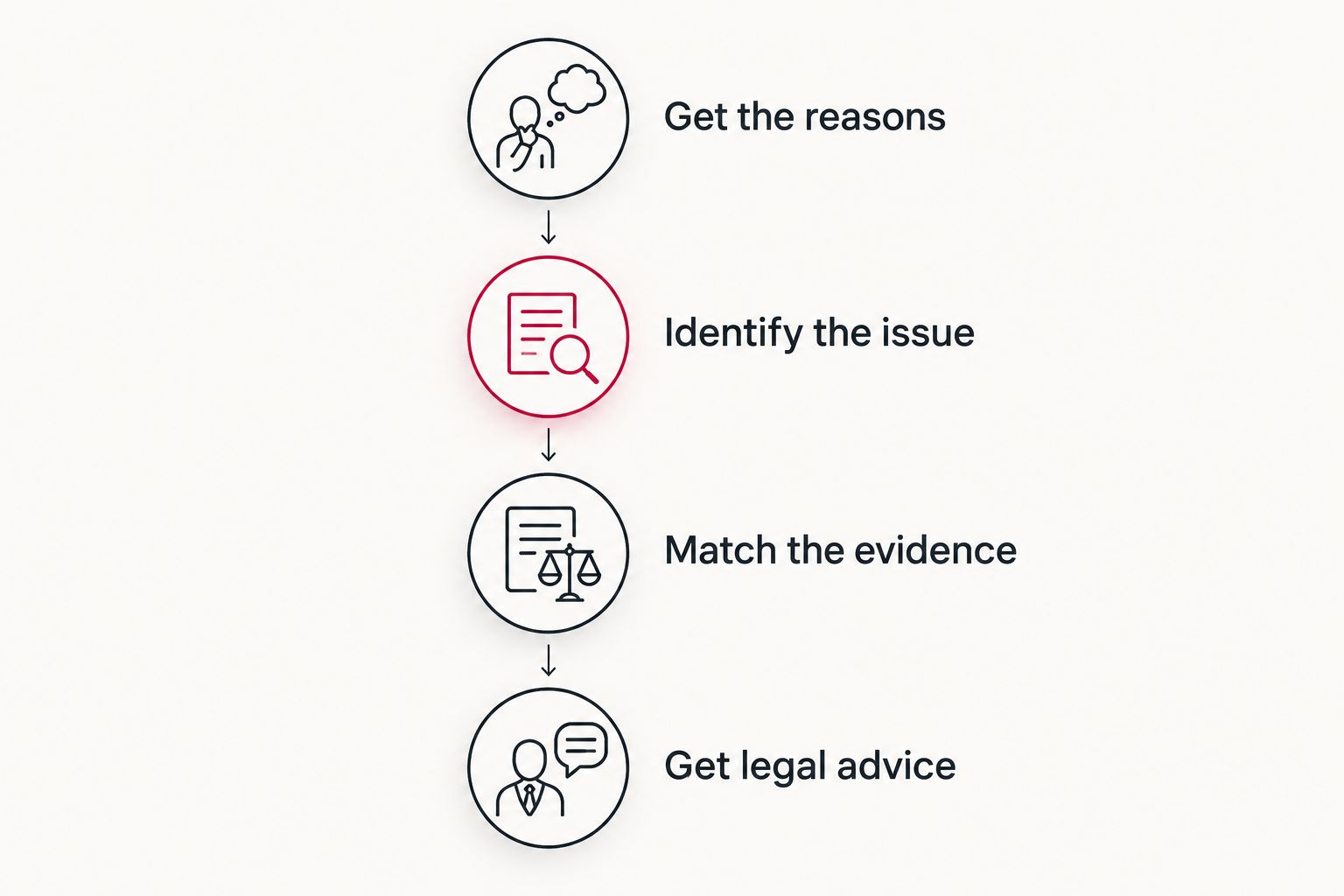
Use the following review sequence before commissioning another document bundle.
Get the reasons
Ask the registry what record of the decision is available and how to obtain it. If the decision was explained orally, ask how you can access the relevant record rather than relying entirely on memory.
Keep the application, affidavits, supporting material and court correspondence together. A lawyer assessing the refusal needs to understand what was actually before the judge, not just what you intended to explain.
Identify the issue
Distinguish a legal barrier from an evidence problem. A finding about eligibility calls for a different response from a finding that the affidavit did not establish hardship.
Also check whether the concern involved the proposed driving conditions. A request covering broad hours or purposes needs an explanation of why that scope is necessary; changing the wording alone does not answer the underlying concern.
Match the evidence
For each factual issue, identify the supporting document or witness evidence already provided. Then check whether it actually addresses the reason given.
An employer’s statement that you are valued does not explain the same thing as evidence about driving duties, available alternatives and the consequences of being unable to perform the work. Keep the evidence relevant and accurate.
Get legal advice
Ask a lawyer what options the decision leaves open, what deadlines apply and what further material would matter. Do this promptly rather than spending time preparing another application first.
Do not assume that submitting a revised bundle is an available substitute for challenging a court decision. The appropriate procedure depends on the decision and your circumstances.
Why limited licence decisions vary
A refusal is not explained by a single rule about needing a car for work. The court applies the legal requirements to the circumstances and evidence in the application.
For a 2026 review of your documents, focus on these factors:
- Eligibility: whether the applicable suspension or disqualification permits a limited licence application under the current law.
- Hardship: whether the evidence addresses extreme hardship to you or undue hardship to another person.
- Public safety: whether the proposed grant meets the statutory public-safety requirement.
- Driving scope: whether the requested purposes, hours and routes are explained by the evidence.
- Evidence consistency: whether the affidavit, supporting statements and proposed conditions describe the same practical need.
These are points to examine, not a prediction of what the judge decided in your case. Use the actual reasons to determine which points matter.
Official sources for the legal requirements are the current Land Transport Act on New Zealand Legislation and NZTA’s limited licence guidance. Ministry of Justice guidance explains the court application process; it does not replace advice about a particular refusal.
Can you apply again after a limited licence refusal?
Do not assume you can simply apply again with a rewritten affidavit. Get advice on whether a further application is available and whether your circumstances or evidence provide a proper basis for it.
Tell the lawyer about the earlier refusal and provide the complete decision. Starting with a blank form while leaving out the previous application prevents a useful assessment of the next step.
If further preparation is appropriate, address the identified problem directly. Repeating the same account in stronger language is not the same as supplying relevant evidence.
Can you appeal a refused limited licence application?
Get legal advice promptly about whether the refusal can be challenged and what procedure applies. Do not assume that disagreement with the outcome establishes grounds for an appeal or that an appeal gives you permission to drive.
Ask the lawyer to explain the available route, the applicable deadline and the realistic purpose of taking that step. The court registry can help you access court records, but it does not choose your legal strategy.
Does a Police objection mean your application has been refused?
A Police objection is not a court refusal. The judge decides the application, and an objection needs to be understood on its own terms.
Check whether Police dispute eligibility, evidence, public safety or particular driving conditions. Respond to the actual point rather than treating all opposition as a request for another employer letter.
Should you prepare the documents yourself or get help?
Choose help according to the problem, not just the size of the document bundle. After a refusal, the first question is whether you need legal advice about the decision or practical help preparing documents for an appropriate next step.
| Option | Best for | Advantage | Limitation |
|---|---|---|---|
| Prepare documents yourself | Drivers able to understand the requirements and organise their evidence | You control the preparation and know the underlying facts | You must identify the required documents and keep the evidence consistent |
| NZ Limited Licence document preparation | Drivers seeking prepared applications, affidavits and complete bundles | Fast, careful preparation focused on court documents | Document preparation does not determine eligibility or secure court approval |
| Local lawyer | Drivers needing advice about a refusal, legal eligibility or a possible challenge | Legal advice can address the decision and available procedures | Clarify whether the engagement includes document preparation and court representation |
NZ Limited Licence is best for drivers seeking prepared limited licence applications, affidavits and document bundles. The service prepares documents nationwide across all 58 District Courts in New Zealand; the court remains responsible for the decision.
If your 2026 application has already been refused, establish the correct next step before paying for replacement paperwork. Once that step is clear, document preparation can focus on the evidence and documents actually needed.
Get your application documents prepared
Preparation of limited licence applications, affidavits and complete court document bundles.
What should you gather before asking for help?
Give the person advising you a clear record. Keep original documents and distinguish material filed with the court from material you have only collected since the hearing.
Prepare:
- The decision: the court order, available reasons and any directions.
- The filed bundle: the application, affidavits, supporting statements and proposed conditions.
- The licence position: documents identifying the suspension or disqualification affecting you.
- Any Police response: objections, correspondence or proposed changes to conditions.
- Relevant updates: changes in employment, care responsibilities or transport arrangements since the hearing.
Describe updates precisely. Explain what changed, when it changed and what supports the account; do not rewrite earlier events to make the application sound stronger.
FAQ
Can I drive to work after my limited licence application is refused?
No. A refused application gives you no limited driving permission, and your existing suspension or disqualification still applies. Work commitments do not create an exception.
What is the first thing I should do after a limited licence refusal?
Obtain the court’s decision and any available reasons. Keep the filed application bundle with it so a lawyer can assess the decision and your next steps.
Can I submit another limited licence application straight away?
Do not assume another application is available straight away. Get legal advice about the refusal, the appropriate procedure and whether further evidence or changed circumstances matter.
Does an employer letter guarantee a limited licence?
No. An employer letter is supporting evidence, not a guarantee of approval. The court must apply the legal requirements to the application as a whole.
Is a Police objection the same as a refusal?
No. Police can oppose an application, but the court decides it. Identify the particular objection before preparing your response.
Can NZ Limited Licence overturn the judge’s decision?
Document preparation does not overturn a court decision. NZ Limited Licence prepares applications, affidavits and document bundles; seek legal advice about challenging a refusal.
Can I drive as soon as the court later grants an order?
Do not treat the court order alone as permission to start driving. Follow NZTA’s requirements for obtaining the limited licence, then comply with its conditions.
One last thing
The most useful next document is often the court’s reasons, not another support letter. A refusal tells you which issue needs attention; collecting more material without that direction risks answering the wrong question.
For any next step in 2026, take the decision, the filed bundle and a short factual account of what has changed to your adviser. Keep driving arrangements separate: until you have lawful permission, arrange transport that does not require you to drive.