
For your limited licence application vehicle details, prepare the registration plate, make and model, vehicle type, and a clear explanation of whose vehicle you need to drive and why. If your work involves several vehicles, describe that arrangement rather than listing only your usual car. These details help define the driving permission you are asking for; they do not replace the court order or authorise you to drive.
- Limited licence application vehicle details should identify the vehicle and explain its connection to the driving you need.
- Company vehicles and changing fleets need a clear explanation, not a guessed registration list.
- NZ Limited Licence suits drivers who need work licence application documents prepared rather than drafting them themselves.
- The court decides the conditions; document preparation does not guarantee approval.
Why this matters
Identify the vehicle before you finalise the driving request. Your application needs to explain the driving you need, not just the vehicle you own. A personal car used to reach work and a company vehicle driven during work describe different needs.
NZ Limited Licence prepares limited licence applications, affidavits and complete document bundles across all 58 District Courts in New Zealand. Its limited licence document preparation is relevant when you want fast, careful preparation instead of drafting the bundle yourself. The court still decides your application.
The legal starting point is section 105 of the Land Transport Act 1998, which deals with limited licence orders and their conditions. NZ Transport Agency Waka Kotahi's official limited licence guidance explains the court-order and licence process. For your 2026 application, use those official sources to check the process, and make sure the vehicle description matches the permission you seek.
Limited licence application: which vehicle details are needed?
Prepare enough information to identify the proposed vehicle and explain its role. The checklist below is a practical preparation list, not a claim that every application requires the same fields or supporting documents.
| Detail to prepare | What to record | Why it helps |
|---|---|---|
| Registration plate | The plate exactly as displayed | Identifies a particular vehicle without relying on a general description |
| Make and model | The vehicle's actual make and model | Provides another check that you have identified the intended vehicle |
| Vehicle type | A plain description, such as car, van or truck | Explains the kind of driving involved |
| Ownership or access | Whether it is your vehicle, an employer's vehicle or another arrangement | Explains how the vehicle is connected to your request |
| Intended use | Travel to work, driving during work or another stated need | Connects the vehicle to the purpose of the application |
| Multiple vehicles | Which vehicles change, and how they are assigned | Helps avoid a request that describes only part of your actual work |
Start with information you can check directly. Read the registration plate from the vehicle or a reliable vehicle record. Confirm the make and model rather than copying an old message or relying on memory.
Then explain the arrangement in ordinary language. Who provides the vehicle? What journey or work task requires it? What changes between working days? These answers make the vehicle details useful rather than leaving them as an isolated list.
Do not treat vehicle ownership as the same thing as permission to drive. The relevant question is what the limited licence authorises, subject to the court order and the licensing process.
Your own vehicle: identify it and explain the journey
For a personal vehicle, gather the registration plate, make and model, and describe the travel you need. Keep the vehicle description separate from the explanation of hardship. Owning a car does not, by itself, explain why a limited licence is needed.
If the request concerns getting to work, explain the connection between the vehicle and that journey. If the request also concerns driving while working, say so clearly. Do not describe work travel as commuting when your duties involve driving between places during the day.
For a 2026 application, check the details against the vehicle you actually intend to use. An old registration entry or a description copied from a previous application is not a substitute for checking the current arrangement.
Before sending the information for preparation, ask yourself:
- Have I identified the correct vehicle?
- Have I explained what I need to use it for?
- Does the vehicle description agree with the rest of my application?
- Have I explained any planned change of vehicle?
These checks concern accuracy and clarity. They are not an additional legal eligibility test.
A company vehicle: explain access and work duties
For an employer's vehicle, record the details available to you and explain how the employer assigns it. A vehicle permanently assigned to you is different from a vehicle selected from a shared fleet each day. Your account should reflect the actual arrangement.
Employer information can help explain that arrangement. Ask for factual confirmation of the vehicle you use, the driving duties involved and whether the allocation changes. Keep any statement consistent with your own account; do not ask an employer to describe duties you do not perform.
If you know the registration plate, supply it. If the allocation changes, explain the change rather than presenting one plate as though it covers every vehicle you need.
An employer's permission to use a vehicle does not expand a limited licence. Once the order and licence are issued, the authorised driving conditions remain the boundary. Work instructions do not replace them.
Several vehicles: describe the allocation clearly
A changing fleet needs a clear explanation of how vehicles are assigned. Simply writing that you need to drive any work vehicle leaves the reader without the practical detail needed to understand your request.
Explain the vehicle types involved and why a single vehicle description does not match the work. Distinguish a genuine rotating allocation from a preference to have extra choices. Keep the request tied to the driving need you can explain.
| Vehicle arrangement | Best preparation approach | Main limitation to address |
|---|---|---|
| One known personal vehicle | Identify the vehicle and its intended use | The description does not explain other vehicles |
| One assigned company vehicle | Identify the vehicle and explain the work arrangement | A later replacement needs attention |
| A rotating employer fleet | Explain vehicle types and the allocation process | A single registration plate does not describe the whole arrangement |
| A planned replacement | Explain the intended change before finalising the request | The proposed wording must not leave the change unexplained |
This table compares ways to describe your circumstances. It does not establish which vehicle wording a court will approve. Section 105 of the Land Transport Act 1998 is the official legal reference for the court's limited licence order and conditions.
How do you check the vehicle details before applying?
Use a simple sequence to keep the vehicle information connected to the rest of the bundle. This is a preparation workflow, not a replacement for official filing instructions.
- Identify vehicles. Record the known plates, makes, models and vehicle types. Explain any changing allocation.
- Explain access. State who provides each vehicle and how you use it. Separate personal access from employer allocation.
- Connect duties. Describe the journeys or work tasks that require driving. Keep them consistent with your supporting account.
- Check consistency. Read the application, affidavit and supporting information together. Resolve conflicting vehicle descriptions before finalising them.
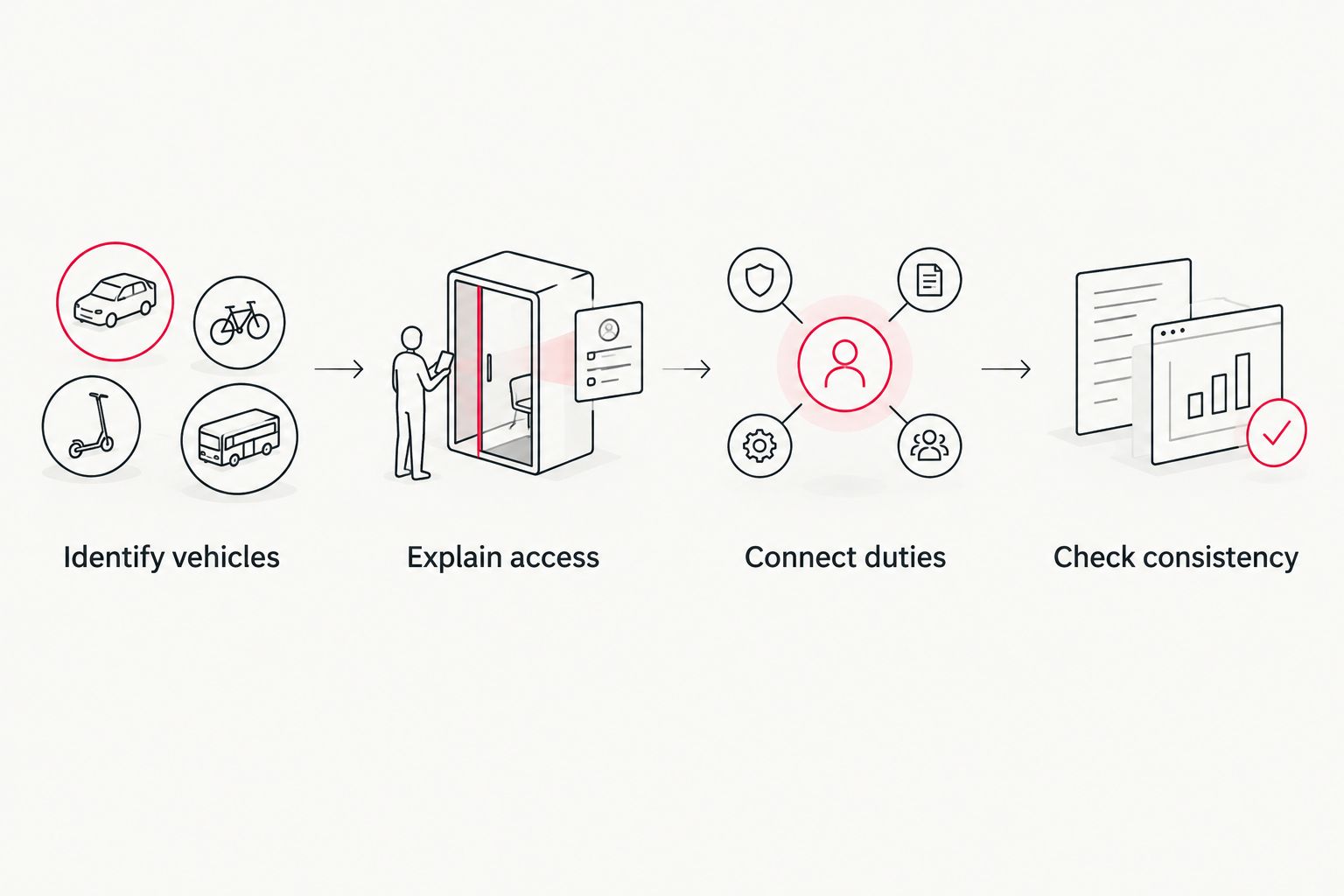
For your 2026 preparation, focus on consistency rather than adding more pages. Repeating the registration plate throughout a bundle achieves little if the work duties describe a different vehicle arrangement. Correct the underlying explanation first.
If someone else prepares the documents, give them the full arrangement at the start. Include a known replacement, shared fleet or employer allocation instead of waiting until the draft is ready. Accurate instructions support careful preparation.
Why vehicle details vary between applications
The right description depends on the driving being requested. There is no useful reason to force every driver into the same vehicle list when their circumstances differ.
- Vehicle ownership: Your own vehicle and an employer-provided vehicle require different explanations of access.
- Allocation: A permanently assigned vehicle is easier to identify individually than a changing fleet.
- Driving purpose: Getting to work and driving as part of work need distinct descriptions.
- Vehicle type: A car, van or truck describes different driving duties and raises different licence-class questions.
- Planned changes: A replacement vehicle or changed job arrangement needs to be explained before the request is finalised.
These factors help describe the application. They do not establish eligibility or guarantee permission for a particular vehicle. For licence-class and limited licence process questions in 2026, consult NZ Transport Agency Waka Kotahi's official guidance; for the court's powers and conditions, consult section 105 of the Land Transport Act 1998.
Should you prepare the documents yourself or get help?
Choose the preparation route that matches the help you need. Accurate vehicle details matter whichever route you take. No preparer can replace your knowledge of the vehicles and work arrangement.
| Route | Best for | Benefit | Limitation |
|---|---|---|---|
| Prepare documents yourself | Drivers comfortable organising and drafting their own application | You manage the documents directly | You take responsibility for checking the account and following the process |
| Document-preparation service | Drivers who want their application, affidavit and bundle prepared | Converts your instructions into organised application documents | Document preparation is distinct from legal advice and the court's decision |
| Local lawyer | Drivers who need legal advice about their circumstances or proposed conditions | Provides a route to individual legal advice | You still need to supply accurate vehicle and work information |
NZ Limited Licence suits drivers who need work licence application documents prepared rather than drafting them themselves. Its service covers applications, affidavits and complete document bundles nationwide, with fast, careful preparation. That is document preparation, not a promise of court approval.
If your main question concerns what a condition legally permits, get legal advice before relying on your own interpretation. If you already understand the arrangement and need it set out clearly in the application documents, document preparation addresses that practical task.
Get your application documents prepared
NZ Limited Licence prepares applications, affidavits and complete document bundles nationwide.
Do I need to own the vehicle?
Vehicle ownership is not the same as limited licence permission. Explain whose vehicle it is, how you have access to it and why it is needed. Do not assume that either ownership or employer permission settles what the court will authorise.
What if my employer changes my vehicle?
A vehicle change needs to be considered against the actual order and licence conditions. Do not assume a replacement is covered because it performs the same job. Get advice on the conditions before driving the replacement.
Can vehicle details replace evidence of hardship?
Vehicle details cannot replace the explanation supporting your application. They identify the proposed driving arrangement; the hardship account explains why you are asking for a limited licence. Keep both parts clear and consistent.
FAQ
What vehicle details should I gather for a limited licence application?
Gather the registration plate, make and model, vehicle type, and an explanation of ownership or access and intended use. If vehicles change, describe the allocation instead of presenting one vehicle as the whole arrangement.
Do I have to list a registration plate for every work vehicle?
The appropriate vehicle description depends on the permission being requested and the court's conditions. Supply the plates you know and explain any changing fleet so the application can address the real arrangement.
Can I apply if I use my employer's vehicle?
Explain the employer-vehicle arrangement in your application, including access and driving duties. The arrangement does not itself establish eligibility or guarantee the court will authorise that driving.
Can I drive while my limited licence application is being prepared?
Preparing or filing an application does not authorise you to drive. Follow NZ Transport Agency Waka Kotahi's official limited licence process and the conditions of the issued licence.
What if I replace my car after getting a limited licence?
Check the replacement against your actual court order and licence conditions before driving it. Get legal advice if the wording does not clearly address the change.
Should my vehicle details match my affidavit?
Your vehicle details should be consistent across the application, affidavit and supporting information. Resolve differences in plates, vehicle descriptions or work allocation before finalising the bundle.
Does a document-preparation service decide which vehicles I can drive?
A document-preparation service does not decide your driving permission. The court decides the order, and your driving must comply with the resulting licence and conditions.
One last thing
Read the vehicle description beside the driving-purpose description. A correct registration plate does not fix an application that describes the wrong work arrangement. Before finalising your 2026 bundle, check that both parts tell the same factual story.