
A New Zealand work licence can cover driving to job interviews only if the court-authorised conditions permit those trips. An interview invitation does not give you permission to drive while suspended or disqualified, or outside an existing limited licence’s conditions. You must meet the eligibility and hardship requirements, then obtain the required authority before driving.
- For a work licence nz job interview query, the answer depends on eligibility, hardship and permitted driving conditions.
- An interview invitation supports your explanation; it does not authorise you to drive.
- NZ Limited Licence prepares application documents; the court decides whether to authorise a limited licence.
- Keep interview details, transport evidence and financial records together before preparing your application.
Why this matters
Getting an interview and getting permission to drive are separate issues. Your application needs to connect the proposed journey with the hardship caused by losing your ability to drive.
For a 2026 application, start with the evidence rather than a broad request to drive for job hunting. The guide to what belongs in a limited licence application bundle explains how the documents fit together.
Do not drive to an interview simply because it concerns employment. The purpose of the trip must fit the authority you actually hold.
Can a work licence NZ cover driving to job interviews?
Yes, where you are eligible, the court accepts the application and the authorised conditions cover interview travel. There is no separate permission created by calling a journey work-related.
The legal framework is the Land Transport Act, particularly sections 103–105. It provides for limited licence applications, court orders and the issue of limited licences. NZ Transport Agency Waka Kotahi’s official guidance on limited licences explains the distinction between obtaining a court order and obtaining the licence.
There are 2 alternative hardship grounds: extreme hardship to you, or undue hardship to another person. Wanting to attend interviews is not a substitute for explaining the relevant hardship and supporting it with evidence.
Use this sequence when preparing an interview-related request:
- Check eligibility. Establish the exact suspension or disqualification you face. Check the applicable restrictions before preparing a full application.
- Explain hardship. Describe what losing the ability to drive means for your circumstances, rather than relying on inconvenience alone.
- Document interviews. Gather genuine invitations, locations, appointment details and relevant correspondence.
- Define journeys. Explain the driving permission you seek clearly enough for the proposed conditions to be understood.
- Confirm authority. Before driving, check that the court order and issued licence permit the journey.
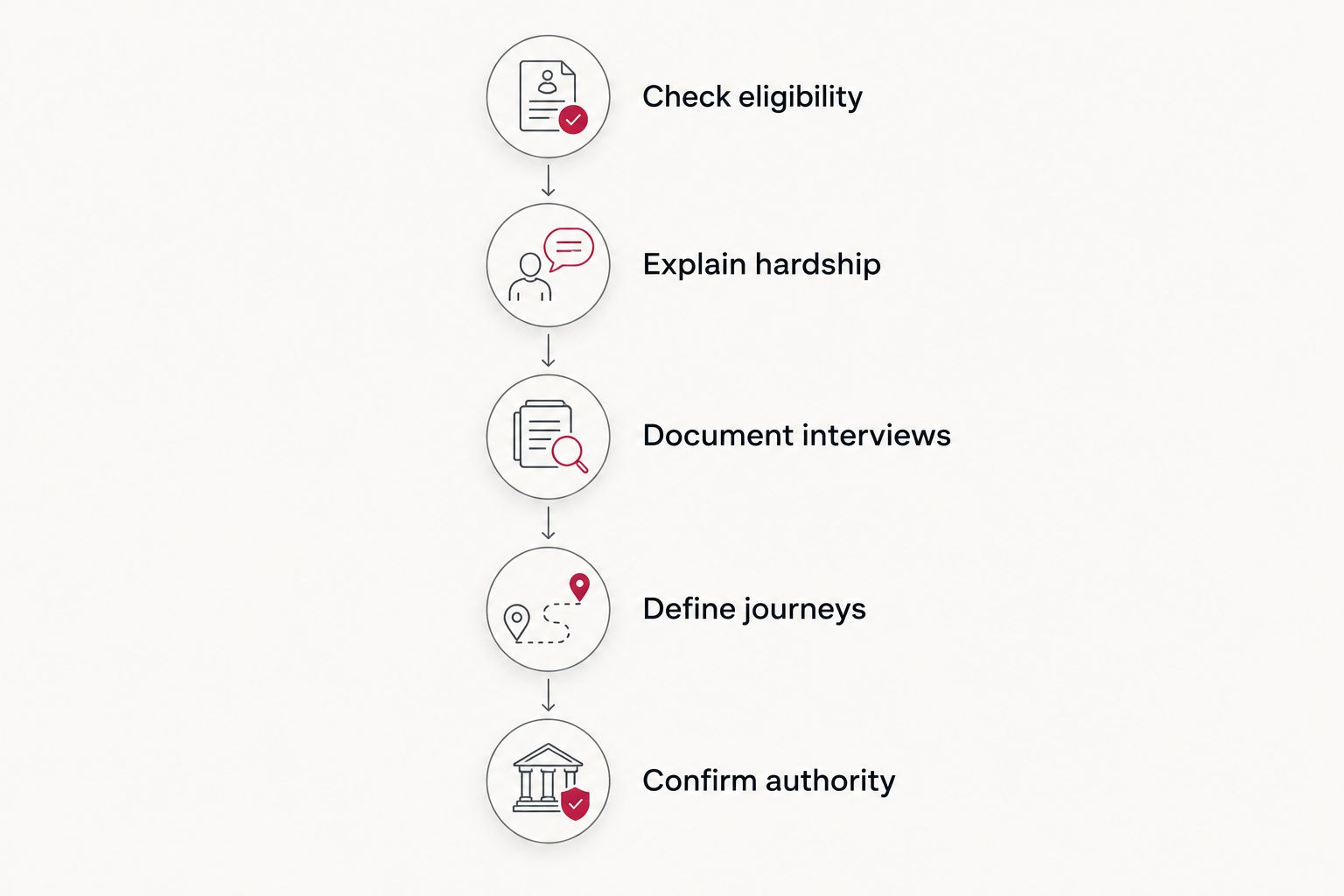
This sequence separates preparing a persuasive application from receiving permission. Neither a completed affidavit nor a filed application replaces an issued limited licence.
What evidence helps explain interview-related hardship?
Your evidence should answer a practical question: why does this particular driving restriction create the hardship you describe? Build that explanation from your actual circumstances, not from a generic statement that you need a job.
Interview details
Keep the invitation or recruiter’s correspondence. Identify the employer, interview location and appointment details where known. If the appointment changes, keep the updated correspondence too.
Distinguish a confirmed interview from a possible opportunity. Do not present an expression of interest, an unanswered application or an informal conversation as a booked appointment.
Transport alternatives
Explain the alternatives you have checked and why they do not meet the particular journey. Relevant evidence can include public transport timetables, walking connections and correspondence about remote attendance.
Be specific about the difficulty. A statement that public transport is unsuitable says little unless you explain the actual connection between the available service and the appointment.
Financial circumstances
Explain your income position and the consequences of remaining unable to attend suitable interviews. Use records that support the facts you state, such as employment correspondence, income records or household commitments.
Keep the distinction between evidence and prediction clear. An interview is an opportunity to seek work, not proof that employment or a particular income will follow.
Effects on other people
If you rely on hardship to someone else, identify that person and explain the effect on them. Describe the connection between your inability to drive, the interview opportunity and their circumstances.
The affidavit should explain the evidence, not just attach it. A reader should understand why each document matters without having to reconstruct your situation.
Why permission for interview travel varies
Different applications ask the court to consider different facts. For your 2026 application, keep these factors separate so that a strong point in one area does not hide an unanswered question elsewhere:
- Eligibility: The type of suspension or disqualification affects whether the limited licence route is open to you.
- Hardship evidence: Your explanation must address the statutory hardship requirement, not simply the usefulness of driving.
- Appointment certainty: Confirmed interview details give a clearer basis for describing a journey than an undefined request for future travel.
- Transport alternatives: Explain the alternatives relevant to the actual appointment and your circumstances.
- Requested conditions: The proposed driving purpose, area and times need to match what you are asking the court to authorise.
- Existing authority: If you already hold a limited licence, its conditions are the starting point for deciding whether a trip is permitted.
No single item guarantees approval. A detailed invitation does not resolve an eligibility issue, and financial pressure does not expand the conditions of an existing licence.
What if you already have a work licence?
Read the court order and your limited licence before agreeing to drive to the interview. Check the permitted purpose, times, locations and any other restrictions that apply to you.
Do not assume permission to travel to your current workplace includes travel to a prospective employer. The interview might fall outside the authorised purpose even when it takes place during your usual working hours.
If the wording does not clearly cover the journey, obtain advice about the correct process before driving. Ask whether a change to the court-authorised conditions and corresponding licensing steps are needed.
In 2026, the practical rule remains straightforward: an appointment change does not change your licence conditions. Keep the updated invitation and check it against the authority you hold.
The same caution applies if an interview becomes a trial shift, induction or paid work. Do not treat those activities as interchangeable when checking your permitted driving purpose.
Can you ask for permission before interviews are confirmed?
You can explain that you are seeking employment, but a general intention to attend interviews is not the same as evidence of a specific journey. Describe the facts you know and identify what remains undecided.
For example, explain the kind of work you are seeking and retain genuine recruitment correspondence. Do not invent an employer, destination or schedule to make the application look complete.
A request covering uncertain future appointments needs careful attention to its proposed conditions. Ask for advice on how to describe the request without claiming that unknown journeys are already authorised.
Does a job offer automatically let you drive to work?
No. A job offer does not itself authorise driving during a suspension or disqualification, and it does not rewrite an existing limited licence.
Keep the offer and confirmed employment details as evidence. Then check whether your existing authority covers the new work or whether further court and licensing steps are required before you drive.
Should you prepare the documents yourself or get help?
There are 3 preparation options to consider: preparing the documents yourself, using a document-preparation service or instructing a lawyer. Choose according to the work you need done and whether you need legal advice about eligibility or conditions.
| Preparation option | Best for | Main benefit | Limit to understand |
|---|---|---|---|
| Prepare documents yourself | Drivers confident about researching requirements and drafting their own evidence | You control the documents and supporting material | You take responsibility for checking requirements and presenting a coherent application |
| NZ Limited Licence | Drivers seeking paid preparation of applications, affidavits and document bundles | Fast, careful document preparation across all 58 District Courts in New Zealand | Document preparation does not decide eligibility or guarantee court approval |
| Instruct a local lawyer | Drivers needing legal advice about their circumstances or representation | You can seek advice on the legal issues and discuss representation | Confirm the lawyer’s agreed scope; advice, drafting and attendance are separate tasks |
NZ Limited Licence is best for drivers who need limited licence application documents prepared. The service prepares court-ready applications, affidavits and complete document bundles nationwide, with fast and careful preparation as its focus.
That preparation remains separate from the court’s decision. If your main question is whether unusual circumstances make you eligible, or how disputed conditions should be interpreted, seek legal advice rather than treating document preparation as a court ruling.
Get your application documents prepared
NZ Limited Licence prepares applications, affidavits and complete document bundles nationwide.
Which official sources should you check in 2026?
Use the Land Transport Act’s limited licence provisions for the legal framework. Use NZ Transport Agency Waka Kotahi’s official limited licence guidance for the licensing steps, including what follows a court order.
For filing and hearing arrangements, check the Ministry of Justice’s District Court information and confirm the relevant court’s requirements. Keep procedural instructions separate from advice about the merits of your application.
These official sources address different parts of the process. Legislation sets the framework; court information addresses court procedure; NZTA guidance addresses the licence. A preparation service does not replace any of them.
When checking guidance for a 2026 application, read the current official version rather than relying on an old saved copy or another driver’s experience. Different facts and different conditions can produce different outcomes.
FAQ
Can I drive to a job interview while my limited licence application is being processed?
No. Preparing or filing an application does not authorise driving. You need the required authority, and the journey must fall within its conditions.
Is an interview invitation enough to get a work licence?
No. An interview invitation supports the proposed journey, but it does not establish eligibility or satisfy the hardship requirement by itself. Explain the consequences of being unable to attend and support those facts.
Does my existing work licence cover interviews with another employer?
Only if its conditions permit that journey. Check the authorised purpose and other restrictions; do not assume permission for your current job covers a prospective employer.
Can I include several interviews in my application?
Describe each genuine appointment and the permission you seek. The court decides what conditions to authorise, so supplying several invitations does not automatically create permission for every trip.
What should I do if my interview time changes?
Check the new appointment against your licence conditions before driving. Keep the updated invitation and seek advice if the journey no longer fits the authorised times or purpose.
Should I use a lawyer or a document-preparation service?
Use a document-preparation service when you need application documents prepared; seek a lawyer when you need legal advice or representation. Confirm the scope of the service before instructing either.
Can I drive once the court approves my limited licence application?
Do not treat the court order alone as the issued licence. Follow NZTA’s limited licence issue requirements and check the resulting conditions before driving.
One last thing
Check the whole journey, not just the interview itself. The appointment, travel there and travel back all need to fit the driving authority you hold.
Before departure, compare the actual destination and timing with your conditions. A genuine employment purpose does not excuse driving outside them. If something does not fit, arrange another way to attend and resolve the permission question before driving.