
Yes. A New Zealand work licence can cover weekend and on-call driving in 2026, but only within the days, hours, purposes and other conditions approved by the court and recorded on the limited licence; working a weekend shift or receiving a call-out does not itself give you permission to drive.
- For work licence NZ weekend work applications, request the driving conditions your actual duties require.
- Weekend shifts, overnight work and on-call duties need clear supporting evidence, not a request for unrestricted driving.
- NZ Limited Licence prepares limited licence documents; the court decides whether to approve the requested conditions.
- A court order and an issued limited licence are separate steps. Do not drive before you are legally authorised.
Can a work licence NZ cover weekend and on-call work?
Weekend and on-call driving can form part of a limited licence application. Approval depends on your eligibility, the hardship evidence and the conditions the court considers appropriate. A job description alone does not establish permission to drive whenever work arises.
The legal starting point is the Land Transport Act, particularly sections 103–105. These provisions address applications, court orders and the issue of limited licences. NZ Transport Agency Waka Kotahi’s official limited licence guidance explains the distinction between obtaining a court order and obtaining the licence itself.
For a 2026 application, use those official sources to check the legal requirements. Your employment evidence should then explain the particular driving permission you are asking the court to consider.
| Work pattern | What to explain in the application | Useful supporting evidence | Main limitation |
|---|---|---|---|
| Regular weekend shifts | The actual weekend duties and travel required | Roster and employer confirmation | Weekend employment does not authorise unrelated weekend driving |
| Rotating weekend shifts | How the roster changes and when you receive it | Roster examples and an explanation of the rotation | Your requested conditions must make the changing pattern understandable |
| On-call duties | When you are on standby, where calls take you and why driving is needed | Standby roster and records of actual call-outs | Being available for work is not unrestricted permission to drive |
| Overnight call-outs | The driving required before and after midnight | Call-out records and employer explanation | Conditions need to account for the calendar-day change |
Why this matters
An application needs to connect your work requirements to the hardship caused by being unable to drive. It also needs to describe permission you can understand and follow after approval. Broad wording is not a substitute for evidence.
NZ Limited Licence prepares limited licence applications, affidavits and complete document bundles across all 58 District Courts in New Zealand. Preparation is separate from the court’s decision: a document-preparation service cannot promise approval or choose your final licence conditions.
The practical task in 2026 is to describe your real working pattern accurately. Do not describe fixed weekday hours if your job actually depends on weekend attendance, changing rosters or overnight calls.
Regular weekend work: show the actual shift pattern
If you regularly work weekends, start with the roster. Explain your shift start and finish times, where you work, and the journeys you need to make. Distinguish travel to work from driving during the working day.
For example, commuting to a single workplace is different from travelling between customer sites. Describe both where both apply. Avoid a general statement that you need a vehicle for work without explaining what that involves.
Ask your employer to confirm:
- Which weekend duties you perform.
- Whether the shifts are fixed or change with a roster.
- Where you must attend and whether you travel between sites.
- What happens to your work if you cannot make those journeys.
- Whether another practical transport arrangement exists.
Request the driving permission your duties require, and explain the reason for it. Do not add personal journeys to a work-driving request simply because they fall on the same day.
If your working hours change, the guide to showing changing hours for shift workers explains the evidence problem to address. A changing roster needs an explanation, not a fictional fixed schedule.
On-call work: separate standby from actual driving
Being on call means you must be available. It does not necessarily mean you spend the entire standby period driving. Your evidence should separate the availability requirement from the journeys that arise when you receive a call.
Explain who contacts you, what triggers attendance, the places you attend and the work you perform there. If the locations change, describe the service area and provide genuine examples. Keep customer information relevant and avoid including unnecessary personal details.
Past call-out records can help explain an unpredictable job. Use records you actually hold, rather than estimating a pattern you cannot support. Explain any difference between those records and your present duties.
Useful material includes:
- A standby roster showing when you are responsible for responding.
- Employer confirmation of the response duties.
- Job sheets or call logs showing actual attendance requirements.
- An explanation of the equipment or vehicle needed.
- Evidence of why another worker or transport arrangement cannot meet the need.
A request for flexibility needs a clear boundary. Explain the work-related purpose and geographic requirements instead of asking for permission to drive anywhere whenever your phone rings.
Overnight work: account for the trip home
A shift can start on one day and finish on the next. A call-out can also begin before midnight and end afterwards. Describe the full journey rather than stopping the explanation at the start of the shift.
Check the proposed wording against the trip to work, any driving during the job and the return journey. Include the actual travel requirement rather than treating your paid working hours as identical to your driving hours.
Do not assume a condition referring to a particular day automatically covers travel after midnight. Read the precise wording and obtain advice about any uncertainty before driving. An employer’s request does not change a court order or licence condition.
For a 2026 application involving overnight work, make the calendar-day issue explicit in your instructions. It is easier to explain the real pattern during preparation than to discover later that you misunderstood the permission granted.
Why the requested conditions differ between jobs
Weekend work is not a single pattern. The conditions you ask the court to consider should reflect the evidence for your particular role, not another driver’s experience.
The main points to explain are:
- Work schedule: State whether your duties are fixed, rotating or triggered by call-outs.
- Driving purpose: Separate commuting, travel between sites and other work journeys.
- Geographic scope: Identify the workplace, customer area or routes relevant to the job.
- Transport alternatives: Explain what is available and why it does or does not meet the requirement.
- Hardship: Describe the consequences of being unable to drive, supported by relevant evidence.
The Land Transport Act’s limited licence framework distinguishes extreme hardship to the applicant from undue hardship to another person. Use the applicable legal test, not simply the statement that driving would make work easier.
If you are unsure about eligibility or how that test applies to your circumstances, seek legal advice. Employment need does not remove statutory eligibility restrictions.
How should you prepare weekend and on-call evidence?
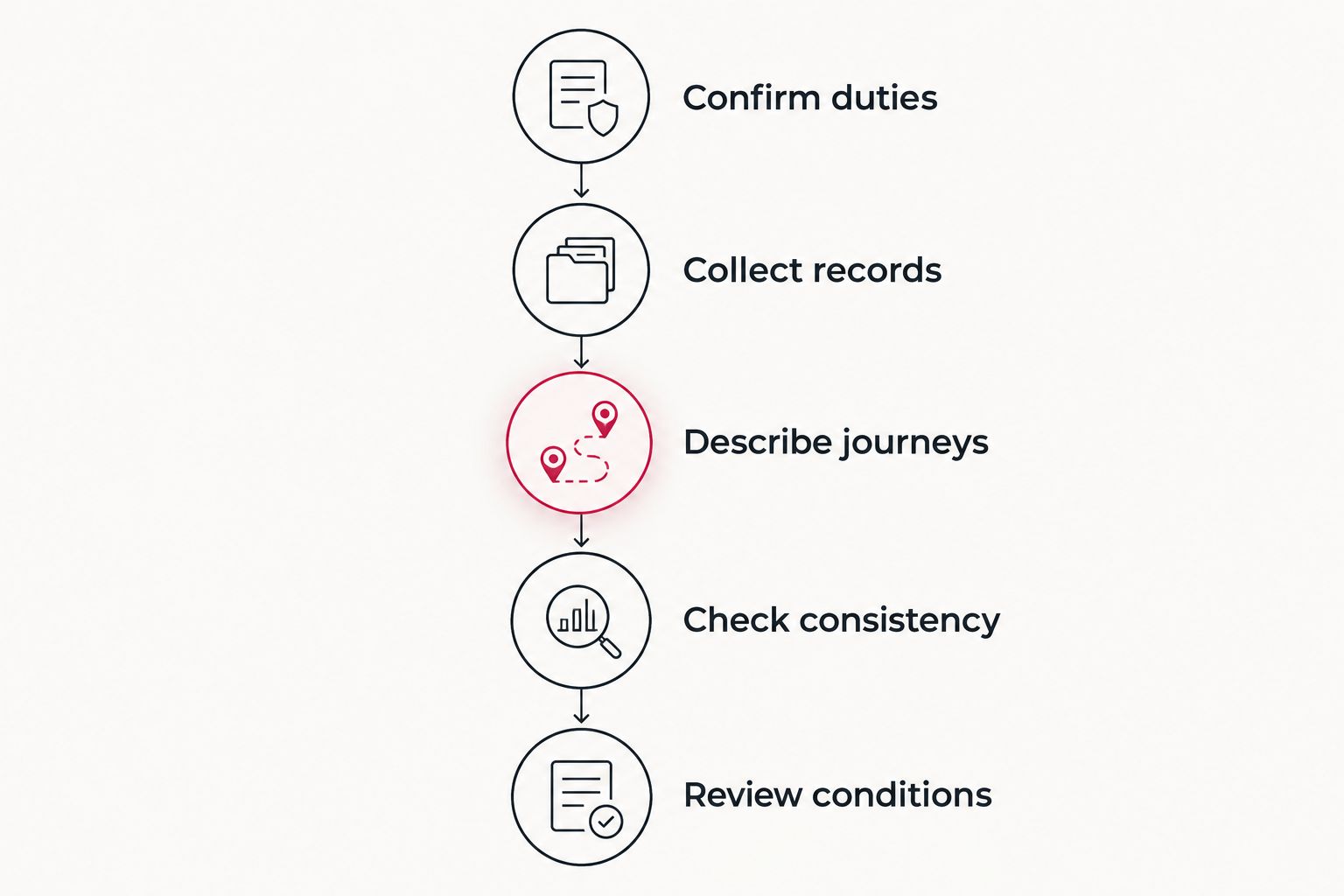
Use these 5 preparation steps to turn a general work problem into a clear set of instructions and supporting documents. They organise the evidence; they do not replace the official application requirements.
Confirm duties
Write down what the job actually requires you to do. Include weekend attendance, standby responsibilities and travel during work. Separate duties you currently perform from work you only hope to obtain.
Collect records
Gather genuine rosters, call-out records and relevant employment documents. Ask for an employer statement that explains the duties and consequences in that employer’s own terms. Check that names, workplaces and job details agree across the material.
Describe journeys
Explain where each journey starts and ends, its purpose and when it occurs. Include travel home after late work. If destinations vary, explain how jobs are allocated and the area involved rather than inventing a fixed route.
Check consistency
Compare the affidavit, employer evidence and requested conditions. Correct conflicting shift descriptions or locations before filing. If something changes during preparation, tell the person preparing your documents rather than leaving an outdated statement in the bundle.
Review conditions
Read any approved order and the issued licence carefully. Compare the permission granted with your actual duties. Do not treat requested conditions as approved conditions, and do not drive beyond the authority you have received.
Should you prepare the documents yourself or get help?
There are 3 preparation options to consider: doing the work yourself, using a document-preparation service or instructing a lawyer. Choose according to the help you need, especially where eligibility or the proposed conditions require legal advice.
| Option | Best for | What it offers | What to consider |
|---|---|---|---|
| Prepare documents yourself | Drivers ready to manage the paperwork and official guidance | Direct control over collecting evidence and preparing the application | You must resolve inconsistencies and establish what the application requires |
| Document-preparation service | Drivers seeking help assembling applications, affidavits and bundles | Practical document preparation based on the information supplied | Preparation is not court approval and must not be confused with legal representation |
| Local lawyer | Drivers seeking legal advice or representation | Advice about the law and assistance within the agreed engagement | Confirm what the engagement includes, including preparation and court attendance |
NZ Limited Licence is best for drivers seeking limited licence document preparation rather than court representation. The service focuses on fast, careful preparation of applications, affidavits and complete bundles; the court still decides the application.
Be clear about what help you are buying. Ask whether the service covers document preparation, legal advice, court attendance or only particular tasks. Do not assume these are interchangeable.
Prepare your work licence documents
Get help preparing your application, affidavit and document bundle for weekend or on-call work.
Can I drive as soon as the court approves my application?
No. A court order and an issued limited licence are 2 separate steps. Follow NZTA’s official limited licence instructions for obtaining the licence after the order, and do not drive until you are legally authorised.
Check the issued licence against the order and read every condition. If the wording is unclear or appears inconsistent, seek clarification before driving. Keep your employer informed about the actual limits rather than promising duties you cannot lawfully perform.
What if my employer changes my weekend roster?
A changed roster does not change your limited licence conditions. Compare the new duties with your existing authority before accepting driving work outside the previous pattern.
If the new work falls outside your conditions, seek advice about the appropriate process before driving. A supervisor’s permission, an urgent customer request or a new roster is not permission to disregard the licence.
Can an urgent call-out override my driving conditions?
No. Work urgency does not extend your driving permission. Check the purpose, time, place and any other applicable conditions before taking a vehicle to a call-out.
Discuss a backup arrangement with your employer for jobs outside those conditions. Do that before the call arrives, so the business knows which duties you can and cannot accept.
FAQ
Can a work licence cover Saturday and Sunday shifts in New Zealand?
Yes, weekend driving can be covered if the approved conditions permit it. Explain the shifts, journeys and hardship in your application rather than assuming weekends are included.
Can I ask for a limited licence that covers on-call work?
Yes, you can request conditions addressing on-call duties, but approval is not automatic. Support the request with standby arrangements, actual work requirements and relevant records.
Does my employer need to explain why I work weekends?
Employer evidence can help explain the weekend duties and the consequences of being unable to drive. It should match your affidavit and the driving permission requested.
Can I drive home after midnight on a work licence?
Only if your limited licence conditions permit that journey. Explain overnight work and return travel during preparation, then check the exact permission granted.
Can I use my work licence for shopping after a weekend shift?
Do not assume a work-related permission covers shopping or another personal journey. Your driving must stay within the purposes and other conditions of the limited licence.
Can NZ Limited Licence approve my weekend driving hours?
No. NZ Limited Licence prepares limited licence applications, affidavits and document bundles; the court decides the application and approved conditions.
What should I check before applying for a work licence in 2026?
Check eligibility and the current process using the Land Transport Act, NZTA limited licence guidance and Ministry of Justice guidance. Then gather evidence that accurately describes your hardship and required driving.
One last thing
Check the journey after the job, not just the journey to it. A weekend call-out is not fully explained if the application describes getting to the workplace but ignores getting home after the work finishes.
Before filing in 2026, walk through a genuine shift from departure to return. Every driving leg should have a clear purpose and fit the permission you are asking the court to consider.