
Caregiver limited licensing is permission to drive under specific conditions, with the aim of preventing undue hardship to someone who depends on your care. For a limited licence NZ caregiver application, explain who needs your help, which journeys are essential and what happens without them; caring responsibilities alone do not establish eligibility.
- A limited licence NZ caregiver application needs evidence of another person's undue hardship, not just your transport difficulties.
- NZ Limited Licence prepares caregiver application documents; the court decides whether to grant the application.
- Connect each requested journey to a care need, supporting evidence and realistic transport alternatives.
- Check eligibility before preparing affidavits, and do not drive until the required limited licence has been issued.
Why limited licensing matters for caregivers
A missed care journey can affect someone other than the suspended or disqualified driver. Your application needs to make that consequence clear. The court needs more than a statement that you usually provide transport.
The legal distinction matters. Section 105 of the Land Transport Act 1998 distinguishes extreme hardship to the applicant from undue hardship to another person. For a caregiver, the second test is central when the application relies on the consequences for the person receiving care.
Start your 2026 application with the actual care arrangements, not a general account of how difficult life has become. Identify the person affected, their transport needs and the practical consequences of losing your help.
NZ Limited Licence is best for caregivers seeking limited licence document preparation rather than legal representation. NZ Limited Licence prepares applications, affidavits and document bundles nationwide. Preparation supports the application; it does not replace the court's decision.
Build a caregiver application around the evidence
Check your eligibility before collecting documents
First, establish exactly why you cannot drive. A demerit suspension and a drink-driving disqualification are not interchangeable. The offence, order and licence status affect the legal checks that come before an application.
For your 2026 eligibility check, use NZ Transport Agency Waka Kotahi's official limited licence guidance alongside sections 103–105 of the Land Transport Act 1998. Those sources cover eligibility restrictions, timing and the court's power to make an order. Do not assume that being a caregiver removes a restriction.
Check the documents yourself before paying for preparation. If you cannot interpret the disqualification or identify which restrictions apply, get legal advice before building the hardship case. A strong care need cannot fix an ineligible application.
- Find your suspension notice or court disqualification details.
- Record the offence or reason for suspension accurately.
- Check applicable eligibility restrictions and timing with official guidance.
- Ask a lawyer about any unresolved legal issue before proceeding.
Describe who depends on your driving
Write a plain account of the care relationship yourself. Explain what you do, how often you do it and which parts require driving. Separate transport from the other support you provide.
The person receiving care does not become a convincing hardship case simply because you call them dependent. Describe the practical dependency. For example, explain whether you take them to appointments, collect essential supplies or travel to provide care at their home. Include only activities that actually apply.
Keep the distinction between your difficulty and their hardship visible. Losing your normal routine describes your position. Explaining that a person cannot reach necessary care without your transport describes the effect on them.
- Identify the person receiving care and your relationship.
- Describe the care tasks that require travel.
- Explain the consequences of each missed essential journey.
- Identify who can confirm the arrangements from direct knowledge.
Choose who will prepare the application
You can start by drafting a factual summary and gathering supporting records yourself. That work remains useful whether you prepare the application independently, use document preparation or instruct a lawyer.
Read the guide to preparing work licence documents yourself before deciding. The practical question is whether you can turn your circumstances into accurate documents and deal with the legal issues involved.
NZ Limited Licence offers fast, careful preparation of applications, affidavits and complete document bundles across all 58 District Courts in New Zealand. The service fits applicants who need document preparation. A local lawyer is the appropriate option when you need legal advice or representation as well.
None of these options can promise approval. Choose the level of help your circumstances require, rather than treating every caregiver application as a routine form-filling exercise.
- Prepare an initial factual summary yourself.
- Decide whether you need document preparation, legal advice or both.
- Confirm what the chosen service includes before instructing it.
- Keep responsibility for checking the accuracy of your own account.
Map the essential care journeys
Make a journey list before drafting the affidavit. For each trip, record the purpose, destination, timing and person affected. Explain why driving is needed for that particular task.
A suggested starting point is a 7-day care log. This is a planning tool, not a legal requirement. If care is irregular, use the actual appointment schedule instead; do not force changing needs into a weekly pattern that misrepresents them.
Describe both directions of a journey where relevant. Taking someone to an appointment and bringing them home are separate practical needs. Also distinguish travel with the person receiving care from travel to reach their home.
For a 2026 application, use current arrangements. An old appointment pattern is not evidence of the journeys you now need permission to make.
- Record the purpose and destination of each essential journey.
- Explain outward and return travel where both are necessary.
- Separate regular care trips from occasional appointments.
- Mark any changing times that need explanation.
Gather evidence that supports the hardship
Collect existing records before requesting new letters. Appointment confirmations, care schedules and correspondence can establish what happens and when. Select documents that support the facts you actually intend to rely on.
Ask supporting people to explain what they know directly. A useful letter connects a care need to the transport problem. A vague statement that you are helpful leaves the court to infer the hardship.
Keep medical information relevant. The point is to explain the functional effect on travel and care, not to include an entire medical history. Seek the person's agreement before requesting or sharing sensitive records where you can, and ask the relevant provider about its consent requirements.
If you have a large collection, prepare a 1-page evidence index for your own organisation. This is a practical suggestion, not a prescribed court format.
- Match each important statement to a supporting record where available.
- Request factual letters from people with direct knowledge.
- Include relevant appointment or care schedules.
- Remove unrelated sensitive material from your working bundle.
Explain why alternatives do not meet the need
Test the alternatives before saying there are none. Consider public transport, taxis, other drivers and changes to the care arrangement. Explain their actual suitability for the journeys in your application.
A bus route existing nearby does not settle whether it works for a particular care journey. Equally, preferring to drive does not establish hardship. Describe the relevant timetable, access needs, appointment time and availability of another driver without exaggeration.
For your 2026 application, use current transport information and current family arrangements. If another person can cover some trips, say so. Your application should explain the remaining gap, not conceal help that is available.
Do not claim that every alternative must be exhausted as a universal rule. Instead, provide enough detail to show why the proposed driving permission addresses a real, specific problem.
- Check transport options for the actual destinations and times.
- Describe mobility or access needs relevant to those options.
- Identify which journeys another driver can cover.
- Explain the essential journeys that remain uncovered.
Align the affidavit, evidence and requested conditions
Read the whole application as one account. The care schedule, supporting letters and requested driving conditions should describe the same need. Conflicting times or destinations make that account harder to understand.
An affidavit is a sworn or affirmed statement, not an informal letter. Follow the applicable witnessing requirements and the court's filing instructions. Do not sign it in advance if the required process calls for signing before an authorised witness.
Under section 105 of the Land Transport Act 1998, the court considers the hardship case and public safety when deciding whether to make an order. Ask for driving that addresses the supported need, not unrestricted use of a vehicle.
Use Ministry of Justice District Court information to confirm filing arrangements for your 2026 application. After an order, follow NZTA's limited licence issue process before driving.
- Check names, dates, destinations and times across the documents.
- Connect the proposed conditions to the evidenced care journeys.
- Follow the affidavit witnessing and filing requirements.
- Do not treat filing or a court order alone as permission to drive.
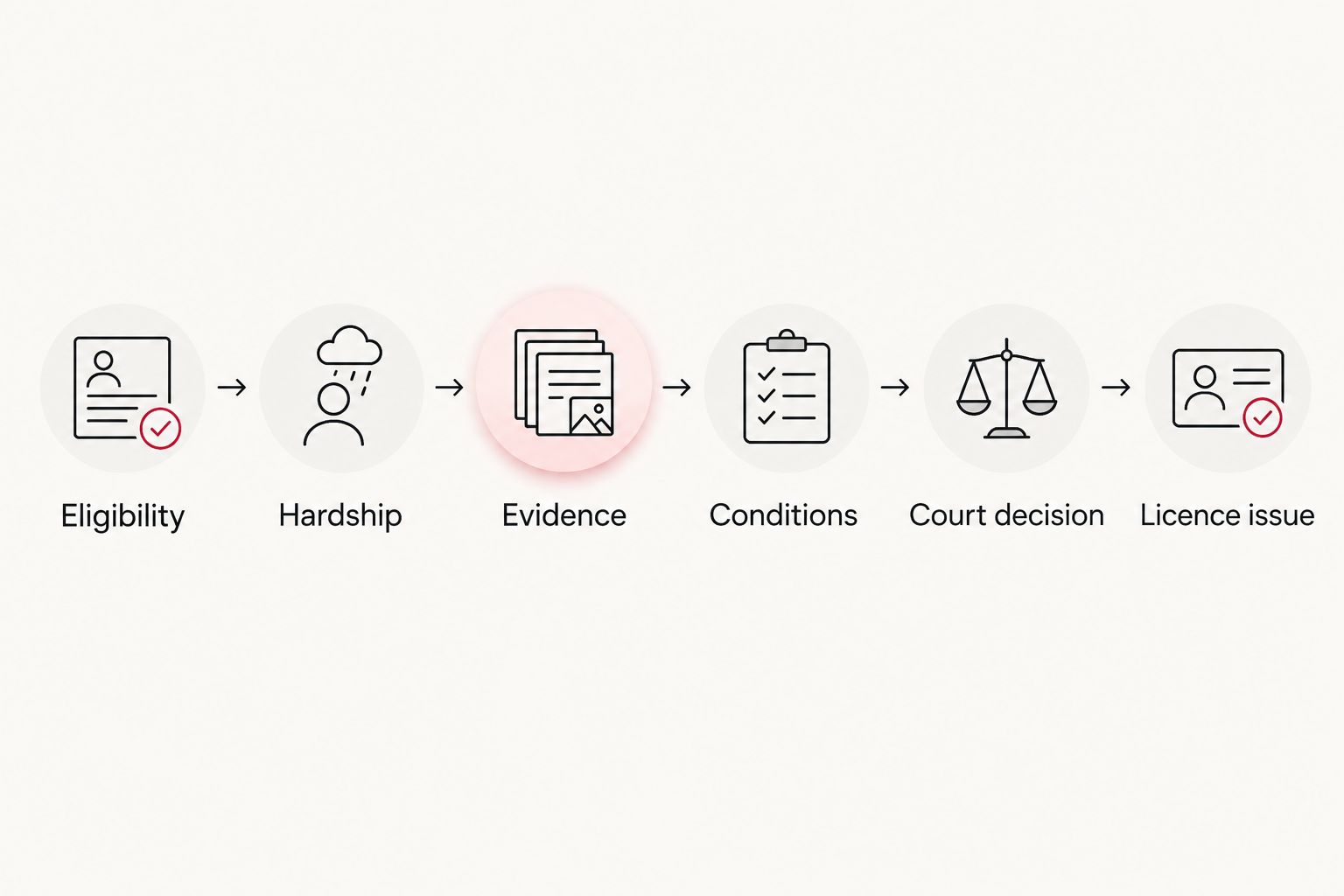
The process has distinct stages: establish eligibility, describe the hardship, support it with evidence and request suitable conditions. Document preparation comes before the court decision; licence issue comes after a successful application.
Compare your preparation options
Choose preparation support according to the work you need done. Gathering evidence, drafting court documents and obtaining legal advice are different tasks. A service that suits one task does not automatically cover the others.
| Option | Best for | Main advantage | Key limitation |
|---|---|---|---|
| Prepare documents yourself | Caregivers able to understand the requirements and organise their evidence | You control the drafting and know the care arrangements directly | You must identify the requirements and check consistency yourself |
| NZ Limited Licence document preparation | Caregivers who need applications, affidavits and a complete document bundle prepared | Fast, careful preparation with nationwide coverage | Document preparation does not determine eligibility or guarantee approval |
| Local lawyer | Caregivers needing legal advice, representation or help with disputed issues | Legal advice can address the particular facts and restrictions | Confirm the lawyer's scope, including preparation and any court appearance |
Ask what happens after the documents are prepared. Confirm who handles filing, questions about the application and any court appearance. Do not assume these are included simply because someone prepares the bundle.
Once you have identified the care journeys and gathered the supporting material, document preparation becomes a concrete next step rather than a substitute for evidence.
Get your application documents prepared
NZ Limited Licence prepares applications, affidavits and complete document bundles nationwide.
Common mistakes caregivers make
Describing inconvenience instead of another person's hardship
Saying you cannot maintain your normal routine centres the application on you. Explain what the person receiving care loses: access to an essential appointment, necessary support or another specific care activity. Then support that account.
Treating all family travel as essential care
School runs, shopping and family visits do not explain themselves. Identify the actual care need behind each requested journey. Avoid adding unrelated driving just because it would be convenient to include it.
Using letters that praise you but prove little
A letter calling you reliable does not establish a transport dependency. Ask the writer to explain the care arrangement, what they know personally and what happens when the journey cannot take place.
Requesting conditions that do not match the schedule
A fixed driving window is a poor description of genuinely changing appointments. Conversely, broad permission is not justified by a narrow recurring journey. Keep the requested conditions tied to the evidence, and get advice where the arrangements are difficult to express.
Driving before the process is complete
Submitting an application does not restore your right to drive. NZTA's official limited licence guidance distinguishes the court process from licence issue. Follow the required steps and the resulting conditions; do not rely on an anticipated approval.
FAQ
Can I get a limited licence in NZ because I am a caregiver?
Caregiving does not automatically qualify you for a limited licence. You must meet the applicable eligibility rules and establish the hardship relied on under section 105 of the Land Transport Act 1998; the court decides the application.
What does undue hardship to another person mean for a caregiver?
Your application must explain the hardship suffered by someone other than you because you cannot drive. Identify the care they depend on, the essential journeys involved and the consequences when those journeys cannot happen.
What evidence should I collect for a caregiver application?
Collect records that support the care need, journey schedule and consequences of losing transport. Relevant appointment confirmations, care schedules and factual supporting letters help connect your account to evidence.
Does a caregiver supporting letter need medical details?
Include medical information only where it is relevant to the care or transport need. A factual explanation of functional needs is more useful than unrelated medical history; check consent requirements before requesting records.
Can I prepare the limited licence documents myself?
You can prepare your own documents, but you remain responsible for meeting the applicable requirements. Use official NZTA and Ministry of Justice guidance, and obtain legal advice if eligibility or the legal issues are unclear.
Is document preparation the same as hiring a lawyer?
Document preparation and legal representation are different services. Confirm whether your chosen provider prepares the bundle, gives legal advice, handles filing or appears in court rather than assuming all tasks are included.
Can I drive as soon as the court approves my application?
Do not drive until you have completed the required limited licence issue process. Follow NZTA's instructions after the court order and drive only within the conditions that apply.
One last thing
Start with the journey you cannot replace. It gives the application a clear centre: the person affected, the care required, the transport gap and the evidence. Before signing your 2026 affidavit, check that every requested driving condition connects back to that account. More documents are not a substitute for a clear explanation.