
Hospitality workers’ limited licence is restricted driving permission aimed at keeping essential work journeys lawful when a driver qualifies after suspension or disqualification. This guide explains limited licence NZ for hospitality workers, with a focus on late finishes, changing rosters and the evidence behind your application.
- NZ Limited Licence prepares limited licence NZ for hospitality workers applications, affidavits and document bundles; the court decides.
- Use rosters, employer evidence and transport checks to explain hardship, not just inconvenience.
- A work licence does not restore unrestricted driving; the conditions control each permitted journey.
- Choose document preparation for paperwork support and a lawyer when you need legal advice or representation.
Why limited licences matter for hospitality workers
A hospitality job can involve early preparation, late closing duties, split shifts or work at different venues. Your application needs to explain your actual arrangements. A statement that you work in hospitality tells the court little about why driving matters to your employment.
The strongest starting point is a specific work journey linked to a specific consequence if you cannot make it. Explain where you work, when you must arrive or leave, and what happens to your employment without suitable transport.
NZ Limited Licence prepares court-ready applications, affidavits and complete document bundles nationwide. Preparation is separate from the court’s decision and the licensing steps that follow.
For a 2026 application, use official sources for the legal framework: New Zealand Legislation’s Land Transport Act, particularly sections 103–105, and NZ Transport Agency Waka Kotahi’s guidance titled Limited licences. These sources cover eligibility, the court process and obtaining the licence. They do not establish the facts of your individual case.
There is no hospitality exemption. Under the statutory hardship test, the court considers extreme hardship to you or undue hardship to another person, alongside the other legal requirements. Losing convenient transport is not the same thing as demonstrating that test.
How to prepare your hospitality work licence application
1. Check your licence position before drafting
Start with your suspension notice or court order. Identify exactly why you cannot drive, when the restriction begins and how long it lasts. Do not rely on the description you remember hearing at court or on advice given to a colleague with a different situation.
Demerit suspensions and drink-driving disqualifications need their own eligibility checks. Alcohol interlock requirements, indefinite disqualification and other restrictions need particular care; do not assume an ordinary limited licence application is the correct route.
Use NZTA’s Limited licences guidance and the eligibility provisions in the Land Transport Act before preparing a 2026 application. Get legal advice where your status or eligibility is unclear. An urgent work problem does not remove a legal restriction.
Gather these facts first:
- The notice or order stating your suspension or disqualification.
- Your current licence class and any existing conditions.
- The reason for the restriction and its relevant dates.
- Any interlock, zero-alcohol or other requirements recorded in your documents.
- Any question about eligibility that needs a lawyer’s advice.
2. Describe the hardship, not just the job
Write a plain account of what you do and what you stand to lose. Separate driving to work from driving during work. A chef travelling to one kitchen has a different work pattern from an employee moving between venues during a shift.
Explain the consequences with evidence. If your employer says you cannot keep your current shifts without reliable transport, ask for that position in writing. Do not turn a possible change into a definite dismissal or claim lost income that your records do not support.
You can prepare this account yourself. From this stage, NZ Limited Licence offers a faster route to preparing the application, affidavits and complete document bundle from your information. You still need to provide accurate facts and supporting records.
Build the account around:
- Your role, employer and workplace address.
- The journeys your work actually requires.
- The shifts or duties affected by the driving restriction.
- The employment or financial consequences you can substantiate.
- The effect on another person, if that forms part of your application.
3. Turn changing shifts into a clear schedule
Start with your existing rosters rather than inventing a standard working week. As a practical organising step, gather 14 days of recent rosters, then add further records if those days do not show your normal pattern. This is a preparation suggestion, not a court evidence rule.
Explain what changes and what stays fixed. Your venue might stay the same while finishing times vary, or your employer might allocate work across several locations. Distinguish rostered finishing time from the time closing duties actually end.
The guide to showing changing hours for shift workers covers this evidence problem in more detail. For your 2026 application, use current records rather than an old roster that no longer reflects your job.
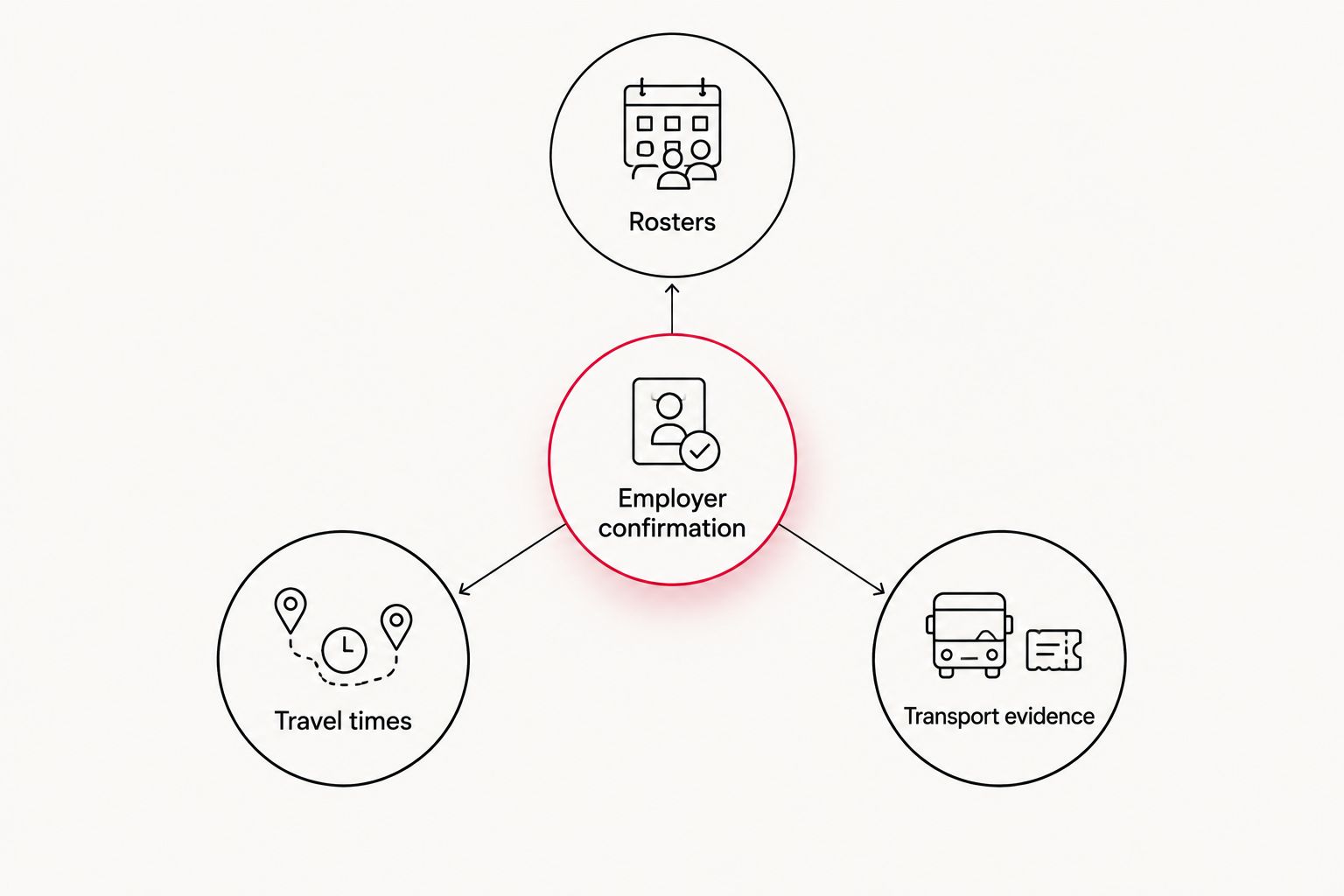
Organise the supporting material under:
- Rosters: dated records showing your actual shifts.
- Travel times: realistic journeys between home and work.
- Transport evidence: services operating when you need them.
- Employer confirmation: an explanation of changing hours or closing duties.
4. Test the alternatives for each difficult journey
Check transport yourself before saying there is no alternative. Look at the actual departure time, arrival time, walking connections and return journey. A bus that reaches the area after your shift begins does not solve that trip, but explain the mismatch rather than simply calling public transport unsuitable.
Treat each journey separately. A workable afternoon service does not establish a workable late-night return. Equally, an inconvenient journey is not automatically impossible. Record what the alternative does and does not solve.
Keep dated evidence for your 2026 application. Where you rely on taxi expense, use actual quotes or receipts and explain the effect using your own financial records. Where you rely on another person being unable to drive you, explain their real availability.
Check and record:
- Public transport timetables for the relevant days and hours.
- Walking connections between home, stops and the workplace.
- Actual taxi or other transport quotes where relevant.
- Whether a colleague or household member can help.
- Whether your employer can adjust shifts, duties or location.
5. Ask your employer for facts they can confirm
Give your employer a short list of questions. Ask them to explain your role, the relevant shifts and why a transport problem affects the business or your continued employment. A letter saying you are a valued employee does not explain the required journeys.
Keep the employer’s evidence within their knowledge. Your manager can confirm staffing arrangements and workplace duties. Your manager should not present your household finances or private transport discussions as facts they personally witnessed.
If you work for 2 employers, collect separate evidence for each job. That example is not a limit on how many jobs matter; it shows why combining different workplaces into one vague account creates confusion. The application and employer evidence should describe the same arrangements.
Ask the employer to confirm:
- Your role, workplace and employment arrangements.
- Your usual shifts and the reason hours change.
- Any driving duties within the job.
- What adjustments have been considered.
- The consequences the employer can genuinely confirm.
6. Draft the documents around the driving you need
Prepare a journey summary before turning it into formal documents. Match each requested driving purpose to evidence: the workplace, relevant times, route and reason for the trip. Avoid asking for unrestricted flexibility simply because hospitality rosters change.
A shift crossing midnight needs particular attention. For example, a finish at 1 am falls on the next calendar day. Make sure your account of the shift and the requested driving period do not contradict each other. This is a drafting check, not permission to drive at that time.
Check the official District Court limited licence application material for the filing process, and the Ministry of Justice’s affidavit guidance for witnessing requirements. Do not sign an affidavit as though it were an ordinary form. Your evidence must be true, and the formal requirements matter.
Review the bundle for:
- Consistent names, addresses and dates throughout.
- Driving purposes supported by your work evidence.
- Hours that account for travel and midnight crossings.
- Clear references to supporting documents.
- Affidavits completed using the required witnessing process.
7. Separate preparation, court approval and lawful driving
Finishing your documents does not restore your right to drive. Neither does paying a document preparer or arranging a hearing. Keep those stages separate when discussing your return to work with your employer.
NZTA’s Limited licences guidance distinguishes the court order from obtaining the limited licence. Follow the required licensing steps after a successful application and understand the conditions before driving. Do not treat the order alone as permission to resume work journeys.
For a 2026 application, confirm current filing and licensing instructions with the relevant official agencies. A preparation service controls its paperwork work, not the court’s timetable or decision. Ask a lawyer about legal questions, objections or disputed conditions.
Before any return to driving:
- Confirm the court’s decision and read the order.
- Complete the required NZTA licensing steps.
- Read the issued licence and its conditions.
- Check that the planned journey is permitted.
- Keep your employer informed about the actual restrictions.
Compare your document preparation options
NZ Limited Licence is best for hospitality workers who want their limited licence application, affidavits and document bundle prepared. Its role is document preparation, not deciding eligibility disputes or guaranteeing approval.
Choose the level of help that matches your problem. If your main difficulty is organising clear evidence and formal documents, preparation support addresses that task. If your difficulty is understanding a contested legal position, ask a lawyer for advice.
| Option | Best for | Main advantage | Key limitation |
|---|---|---|---|
| Prepare the documents yourself | Drivers comfortable checking official requirements and drafting their own evidence | You control the drafting and work directly from your records | You must identify omissions, inconsistencies and formal requirements yourself |
| NZ Limited Licence document preparation | Hospitality workers wanting fast, careful preparation of applications, affidavits and complete bundles | A service focused on preparing the court documents | Preparation does not replace legal representation or the court’s decision |
| Local lawyer | Drivers needing individual legal advice, representation or help with disputed issues | You can seek advice about your particular legal position and proposed approach | Confirm the scope of the engagement; do not assume every filing or licensing task is included |
Ask any provider what information you must supply, what documents they prepare and what remains your responsibility. Clear instructions matter whichever option you choose.
Get your application documents prepared
NZ Limited Licence prepares applications, affidavits and complete court document bundles nationwide.
Common mistakes hospitality workers make
Treating every late shift as the same
A closing shift on one night does not prove the transport position for every shift. Connect the actual hours to the available transport. Explain exceptions instead of forcing the whole roster into one account.
Requesting flexibility without explaining it
A request to drive whenever work requires leaves the underlying need unclear. Show how shifts are allocated, when you receive rosters and which journeys the requested conditions need to address. Ask for conditions that reflect evidence, not convenience.
Mixing commuting with work duties
Travelling to a restaurant and collecting supplies for that restaurant are different purposes. Identify each separately if both genuinely apply. Do not assume permission for one journey automatically covers the other.
Describing income loss without supporting records
Hospitality earnings can include different kinds of recorded payments. Use records that show your actual position, and distinguish confirmed losses from possible future losses. Unsupported estimates weaken the clarity of your account.
Confusing quick preparation with quick permission
Fast document preparation helps you organise the application promptly. It does not establish a hearing date, guarantee approval or authorise driving. Keep alternative transport arrangements in place until you can lawfully drive.
FAQ
Can a hospitality worker get a limited licence in New Zealand?
A hospitality worker can apply if they meet the applicable eligibility requirements. The court considers the statutory hardship test and other legal requirements; working late shifts does not create automatic eligibility.
What is the best evidence for a hospitality work licence application?
Use evidence that connects your actual shifts, necessary journeys and hardship. Rosters, employer confirmation and dated transport checks help explain that connection, but the required evidence depends on your circumstances.
Can a limited licence cover late-night restaurant shifts?
Late-night work journeys need to be addressed in the application and permitted by the resulting conditions. Explain the finishing times, travel required and transport alternatives; do not assume all late-night driving will be allowed.
What if I work at more than one hospitality venue?
Identify each workplace and explain the journeys associated with it. Provide evidence for each employment arrangement and distinguish travel between venues from travel between home and work.
Should I prepare the documents myself or use a service?
Prepare the documents yourself if you can check the official requirements and accurately organise the evidence. Use a document-preparation service for paperwork support, and seek a lawyer when you need individual legal advice or representation.
Does NZ Limited Licence decide whether my application succeeds?
No. NZ Limited Licence prepares applications, affidavits and document bundles; the court decides the application. Document preparation does not guarantee approval or permission to drive.
Can I drive to work as soon as the court grants an order?
Do not treat the court order alone as permission to drive. Follow NZTA’s required steps to obtain the limited licence and comply with its conditions before making a work journey.
One last thing
Check the journey home, not just the journey to work. A roster can show that you start on one day and finish on the next, while your evidence describes only the starting day. That small mismatch can leave your account unclear.
Before submitting your 2026 application, trace one actual shift from leaving home to returning home. Check every address, date, time and transport claim against the records. Then repeat that check for any different shift pattern. Clear evidence starts with a journey someone else can follow.