
Courier drivers’ limited licence preparation is the process of documenting a request for restricted driving with the aim of protecting work where the legal hardship test is met. This 2026 guide to limited licence NZ for courier drivers explains how to show delivery work, income loss and realistic driving conditions—not just the journey to the depot.
- Limited licence NZ for courier drivers requires evidence of hardship, delivery duties and clearly defined driving needs.
- NZ Limited Licence suits courier drivers seeking application document preparation, not a guarantee of court approval.
- Match delivery hours, work areas and vehicle details across your application, affidavit and supporting evidence.
- Check eligibility before preparing documents; a work need alone does not establish entitlement to a limited licence.
Why limited licence preparation matters for courier drivers
A courier’s driving is part of the work itself. An application that describes only travel between home and a depot leaves the delivery round unexplained. Your evidence should distinguish depot travel, loading, deliveries, collections and the return journey.
Employment status also changes the evidence. An employed driver can request confirmation from an employer. An owner-driver needs business records that connect lost driving to lost income. The guide to proving lost self-employed income explains that evidence problem in more detail.
Needing a vehicle for work is not the whole legal test. Under section 104 of the Land Transport Act, the court considers extreme hardship to the applicant or undue hardship to another person. Eligibility restrictions also apply. For a 2026 application, check the current legislation and NZ Transport Agency Waka Kotahi guidance rather than relying on another driver’s outcome.
How to prepare a courier driver’s application
Check your eligibility
Start with the suspension notice or court order. Identify exactly why you cannot drive, when the restriction starts and what licence classes it affects. Demerit suspensions and court-imposed disqualifications are not interchangeable situations.
NZTA’s official limited licence guidance explains eligibility and the steps involved. Section 103 of the Land Transport Act addresses who can apply; section 104 covers the court’s decision. Read those provisions against your circumstances. An alcohol interlock requirement, indefinite disqualification or uncertainty about your status needs specific checking before document preparation begins.
Do not book deliveries on the assumption that submitting an application restores permission to drive. It does not.
- Find your suspension notice or disqualification order.
- Record the reason, start date and affected licence classes.
- Check current eligibility restrictions and any applicable waiting period.
- Identify any alcohol interlock or other licensing requirements.
- Seek legal advice where your eligibility is unclear.
Map your delivery work
Prepare a delivery schedule yourself before paying anyone to draft documents. Use an ordinary working week as the starting point, then identify genuine variations. A suggested 7-day schedule helps separate working days, non-working days and occasional duties; it is a planning aid, not a prescribed court form.
Show where driving begins and ends. Explain whether you collect parcels from a depot, deliver within an assigned area, make business collections or return undelivered items. If dispatch changes your stops during the day, describe how the work area is set instead of pretending every address is fixed.
Keep exceptional work separate from normal work. A possible future delivery is not the same as an existing obligation.
- List your depot, delivery area and usual start and finish points.
- Separate commuting from driving during the delivery round.
- Record loading, collection and return-to-depot duties.
- Explain changing stops within your assigned area.
- Mark weekend or relief work separately.
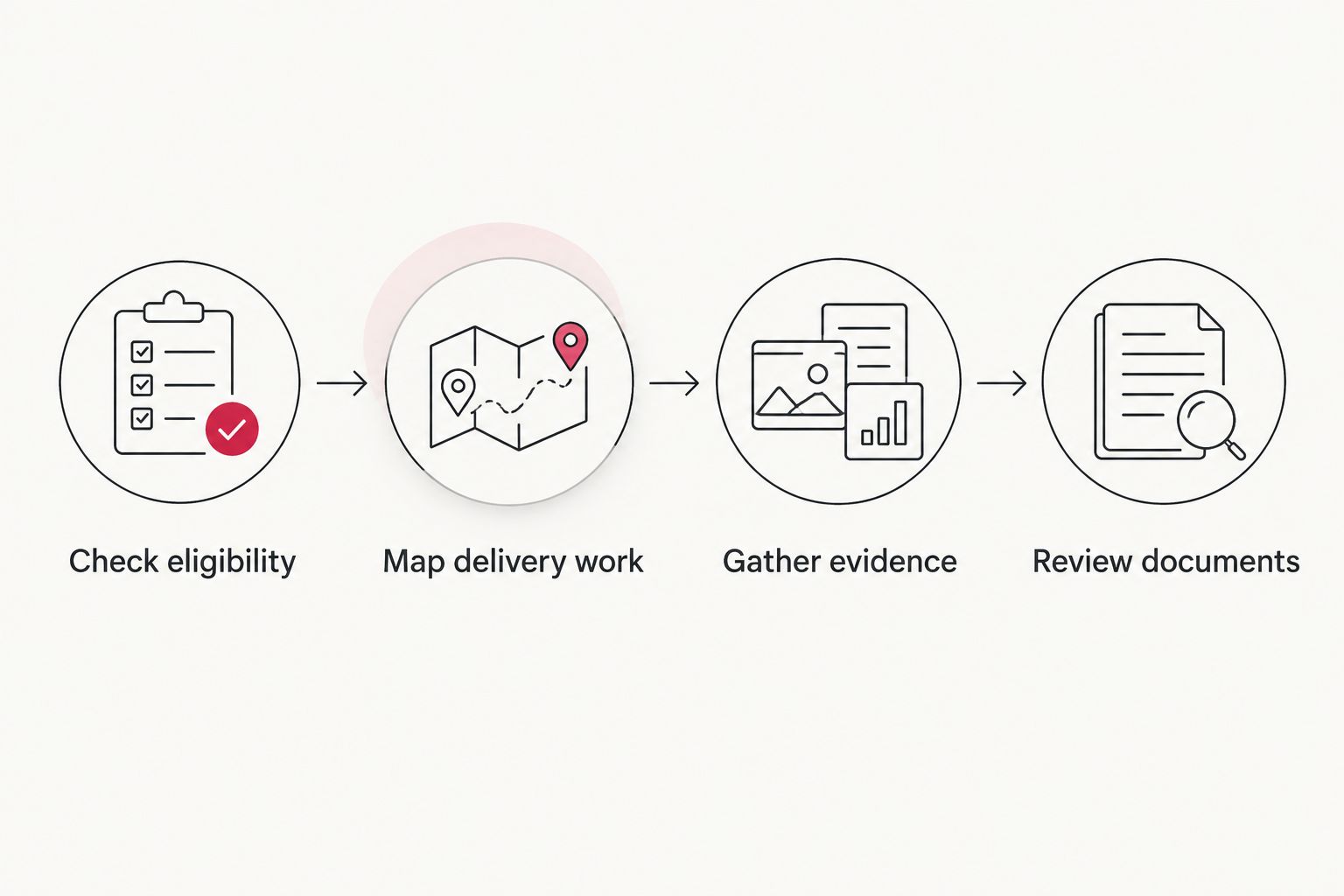
Your preparation follows a practical sequence: check the legal position, describe the work, then support the request with evidence. The court decides whether the application justifies an order.
Choose your preparation route
NZ Limited Licence suits courier drivers who need court-ready application documents prepared, rather than representation in court. You can also prepare documents yourself or instruct a lawyer. Choose according to the work you need done, not a promise of approval.
For paid preparation, NZ Limited Licence prepares applications, affidavits and complete document bundles across all 58 District Courts in New Zealand. The service focuses on fast, careful preparation. The court controls its decision and timetable; preparation speed does not determine either.
A document-preparation service works from the facts and records you provide. It cannot supply missing evidence of your delivery duties or replace legal advice about a disputed issue.
- Prepare documents yourself if you can manage the forms and evidence.
- Use document preparation when you want help turning records into a bundle.
- Instruct a lawyer when you need legal advice or representation.
- Confirm what the chosen service includes before instructing it.
- Keep responsibility for checking the accuracy of your facts.
Gather evidence of hardship
Explain the actual consequence of losing the ability to drive. For an employee, that means evidence about duties, available non-driving work and the effect on employment. For an owner-driver, it means records showing the delivery income at risk and the business obligations that continue.
Do not equate turnover with take-home income. Fuel, vehicle and business expenses affect what the figures mean. A suggested 4-week income summary can organise recent records, but use a period that fairly represents your work. It is not a legal minimum, and a quiet or unusually busy period needs explanation.
For your 2026 application, use current contracts and rosters. Explain older records rather than letting them imply that previous arrangements still apply.
- Obtain employer or contracting-party confirmation of your duties.
- Gather payslips, invoices or settlement statements relevant to the claim.
- Separate gross receipts, business expenses and personal income.
- Explain any claimed hardship to dependants or another person.
- Support consequences with records rather than broad statements.
Explain alternative arrangements
Show what you have considered besides driving yourself. For a courier, public transport might address travel to a depot without solving the delivery round. Explain that distinction clearly. Do not dismiss an alternative that solves part of the problem.
Consider relief drivers, reassignment, another household driver and changes to the delivery contract. If an option is unsuitable, give the factual reason. A statement about relief-driver expense needs an actual quote or other support, not an estimate presented as fact.
The court assesses the hardship evidence under section 104. Your role is to give an accurate account of your circumstances, including arrangements that are available as well as those that are not.
- Separate transport to work from transport needed during work.
- Ask about temporary non-driving duties or reassignment.
- Check whether a relief driver is a practical option.
- Record actual responses, quotes and relevant limitations.
- Explain partial solutions instead of ignoring them.
Define the driving you need
Translate your work pattern into a clear request. Describe the days, hours, areas, purposes and vehicles relevant to your courier duties. Keep the request tied to evidence rather than asking for unrestricted flexibility.
Changing delivery addresses deserve a clear explanation. An assigned delivery area can be described without listing imaginary future stops. Explain how dispatch allocates work, what remains consistent and which variations genuinely occur. If your work crosses several areas, say why.
Check the licence class against the vehicle you actually use. Do not treat a limited licence as permission to drive a vehicle outside your underlying entitlement. Ask for advice if vehicle classes or proposed conditions are unclear.
- Set out normal working days and necessary driving hours.
- Describe delivery areas and depot travel accurately.
- Identify relevant vehicles and the licence classes involved.
- Explain substantiated weekend, relief or collection duties.
- Remove personal trips unrelated to the proposed work purpose.
Review documents and confirm the next steps
Read the application, affidavit and supporting records together. Names, dates, work areas and hours should agree. If the contract describes one depot and your statement describes another, explain the change before submitting the bundle.
Follow current Ministry of Justice guidance and the relevant District Court’s instructions for filing and having affidavits properly sworn or affirmed. Do not sign an affidavit in advance without checking the required process. For a 2026 application, check current forms rather than reusing an old bundle unchanged.
A court order and the licence-issuing process are separate matters. Section 105 of the Land Transport Act concerns issuing the limited licence. Follow NZTA’s current instructions and confirm you are legally entitled to drive before taking any delivery job.
- Compare every stated date, duty, area and working hour.
- Resolve gaps or contradictions in supporting records.
- Confirm filing and affidavit requirements with the appropriate source.
- Read any court order and licence conditions carefully.
- Complete the required licensing steps before resuming driving.
Get your courier application documents prepared
NZ Limited Licence prepares applications, affidavits and complete document bundles for courier drivers.
Compare your preparation options
All three routes depend on accurate information from you. None replaces the court’s assessment of eligibility and hardship. Choose the level of help that matches the problem you need to solve.
| Option | Best for | Main benefit | Key limitation |
|---|---|---|---|
| Prepare documents yourself | Drivers comfortable checking forms and organising evidence | You manage the drafting and supporting records directly | You must identify requirements, inconsistencies and missing evidence yourself |
| NZ Limited Licence document preparation | Drivers wanting applications, affidavits and a complete bundle prepared | Fast, careful preparation for applications nationwide | Document preparation is not a court decision or a substitute for representation |
| Instruct a local lawyer | Drivers needing individual legal advice or representation | Advice can address eligibility, objections and disputed issues | You still need to provide accurate work and hardship evidence |
Choose help for the task, not the outcome being promised. A clear drafting need and a disputed legal issue are different problems. Establish which one you have before instructing anyone.
Common mistakes courier drivers make
Describing only the commute
A letter confirming that you need to reach the depot does not explain why you need to drive parcels afterwards. Describe the delivery round, collections and return duties separately. Make sure supporting evidence covers the work you actually request permission to do.
Treating delivery revenue as personal income
Invoice totals do not explain what you retain after business expenses. Present figures clearly and label them accurately. If losing a contract creates an additional consequence, support that consequence rather than assuming the turnover figure proves it.
Requesting unlimited hours because stops change
Changing addresses do not explain every possible hour or location. Describe your assigned area, dispatch arrangements and genuine variations. Keep the requested driving connected to those facts.
Assuming a business vehicle solves the permission problem
Ownership of the van does not establish your right to drive it. Check the vehicle, licence class and any conditions that apply to you. A contractor’s consent and legal driving permission are different matters.
Resuming deliveries after filing
An application is a request, not permission. Do not accept a delivery round because the paperwork is complete or a hearing is booked. Confirm the court outcome, licensing requirements and conditions before driving.
FAQ
Can a courier driver get a limited licence in New Zealand?
An eligible courier driver can apply, but the court decides whether the legal test is met. Driving for work does not establish entitlement by itself; check sections 103 and 104 of the Land Transport Act and current NZTA guidance.
What should my employer say in a courier driver support letter?
Your employer should explain your actual driving duties, work arrangements and the consequences of being unable to drive. Include delivery areas, hours and any available alternative duties, and keep the information consistent with your application.
What evidence should a self-employed courier gather?
A self-employed courier should gather records connecting driving duties to the claimed income loss and hardship. Contracts, invoices, settlement statements and expense records help explain the business position without confusing turnover with personal income.
Can a limited licence cover changing delivery addresses?
Changing delivery addresses need a clear explanation in the requested conditions and supporting evidence. Describe your assigned area and dispatch arrangements; the court decides what driving conditions to authorise.
Is a document-preparation service better than a lawyer?
Document preparation suits a drafting and bundle-preparation need; a lawyer suits a need for individual legal advice or representation. Choose according to the issue, especially where eligibility or an objection needs legal assessment.
Can I drive once the application has been filed?
No. Filing a limited licence application does not give permission to drive. Follow the court process and NZTA licensing requirements before resuming deliveries.
Where should I check the rules for a 2026 application?
Check current NZTA limited licence guidance, Ministry of Justice court guidance and sections 103–105 of the Land Transport Act. Use those official sources to confirm eligibility, procedure and the steps required before driving.
One last thing
Read your proposed driving conditions against a real delivery day. Start at home, follow the depot visit, delivery round, collections and return journey. Mark any necessary driving that your description fails to explain.
That final check is not a reason to ask for broader permission. It is a way to spot a mismatch between your work evidence and your request before the documents reach court.