
Best first check: confirm eligibility. Best evidence fix: explain the actual hardship. Best final check: make every document agree. These are practical fixes for mistakes that delay a limited licence application in NZ—not a ranking of measured delay rates.
- Mistakes that delay a limited licence application in NZ include unclear hardship evidence and inconsistent driving details.
- NZ Limited Licence suits drivers who need limited licence document preparation rather than preparing the bundle themselves.
- Check eligibility before collecting evidence; document preparation cannot change the legal requirements.
- Match your affidavit, supporting evidence and requested driving conditions before submitting the bundle.
Why this matters
A work problem needs a clear explanation, not just a request to drive again. Your application must connect your circumstances, supporting evidence and requested driving permission.
NZ Limited Licence prepares limited licence applications, affidavits and complete document bundles across all 58 District Courts in New Zealand. Preparation is fast and careful; the court makes the decision.
For your 2026 application, use the Land Transport Act, sections 103–105, and NZ Transport Agency Waka Kotahi’s limited licence guidance as the official starting points. The Act addresses eligibility, restrictions and the hardship test. This checklist explains document preparation; it does not decide whether your particular suspension or disqualification qualifies.
What makes an application ready to submit?
Use these criteria before choosing who prepares your documents:
- Eligibility: your circumstances fit the legal route you intend to use.
- Hardship evidence: specific facts explain the consequences of not driving.
- Driving scope: the requested permission matches the need described.
- Consistency: names, dates, work details and vehicle information agree.
- Execution: affidavits and supporting documents are completed correctly.
- Procedure: you have checked the applicable filing and notification requirements.
These are preparation checks, not a promise of approval. A tidy bundle still needs to meet the legal test.
Application mistakes at a glance
The order below follows the preparation process. Start with eligibility rather than polishing documents for an application that needs legal advice first.
| Priority | Mistake | Best check for | Practical fix | Key limitation |
|---|---|---|---|---|
| 1 | Assuming eligibility | Choosing the correct starting point | Check the exact suspension or disqualification | A template cannot determine every legal issue |
| 2 | Describing inconvenience, not hardship | Explaining consequences | Give specific facts and supporting evidence | Work-related driving alone does not settle the test |
| 3 | Leaving work evidence vague | Showing the driving need | Explain duties, locations and alternatives | A job title does not explain travel |
| 4 | Requesting unclear driving permission | Matching permission to need | Describe the necessary driving precisely | Broad wording is not a substitute for evidence |
| 5 | Letting documents contradict each other | Keeping the bundle consistent | Reconcile details across every document | Correcting one page can leave another outdated |
| 6 | Mishandling affidavits and attachments | Completing the evidence | Check signing, witnessing and references | An unsigned draft is not a finished affidavit |
| 7 | Treating preparation as the whole process | Planning submission | Confirm the applicable procedural steps | A prepared bundle is not a court decision |
| 8 | Choosing the wrong level of help | Getting suitable support | Separate document work from legal advice | No preparation option guarantees approval |
1. Assuming you qualify before checking your circumstances
Best for: establishing the right starting point. A demerit suspension and a court-imposed disqualification are not interchangeable descriptions. Start with the notice or order that applies to you, not the wording a friend used for their case.
For a 2026 eligibility check, consult the Land Transport Act, sections 103–104, alongside NZTA’s limited licence guidance. Restrictions depend on the legal basis of the suspension or disqualification. Special circumstances need individual attention.
A useful eligibility check includes:
- The exact notice or court order.
- The reason you cannot drive.
- Relevant dates and any other licence restrictions.
Benefit: you establish whether document preparation is the appropriate next step. Limitation: identifying a legal complication does not resolve it; get legal advice where the answer is unclear.
Verdict: check eligibility before drafting the application.
2. Explaining inconvenience instead of the hardship
Best for: making the consequences understandable. “I need my licence for work” introduces the problem. It does not explain what happens without driving, who is affected, or why other arrangements do not address the need.
The Land Transport Act, section 105, distinguishes extreme hardship to the applicant from undue hardship to another person. Those are legal tests, not interchangeable labels for inconvenience.
Explain your actual circumstances. Describe the work or responsibility at risk, the consequences, and the evidence supporting each statement. If you rely on another person’s hardship, explain that person’s situation rather than making the application entirely about yourself.
Benefit: specific evidence lets the reader understand the connection between driving and the claimed hardship. Limitation: a detailed account does not automatically satisfy the legal test.
For business owners, the guide to affidavits proving lost self-employed income addresses a relevant evidence question.
Verdict: replace general claims with facts you can support.
3. Leaving your work evidence too vague
Best for: showing why the job involves driving. Your job title does not explain your travel. An electrician, caregiver or shift worker needs to describe their own duties rather than rely on assumptions about the occupation.
Explain where you work, what journeys the role involves and which duties require those journeys. Separate travelling to work from driving during work. They are different practical needs and should not become a single unexplained statement.
Where relevant, describe the transport arrangements you investigated and why they do not meet the particular need. Do not claim that every alternative is impossible unless your facts support that statement.
Useful supporting detail includes:
- Work locations and duties.
- Relevant working patterns.
- The practical consequences of being unable to make necessary journeys.
Benefit: work evidence supports the account in your affidavit. Limitation: an employer’s support does not determine the court’s decision.
Verdict: explain the work, not just the occupation.
4. Asking for driving permission that is unclear
Best for: connecting the request to the evidence. A request for unrestricted work driving leaves important questions unanswered. Explain the driving you actually need rather than copying broad wording from another application.
Your 2026 work pattern should match the facts in your documents. Describe relevant days, working hours, locations, routes or areas, and vehicles accurately. Where work changes, explain the variation instead of inventing a fixed schedule.
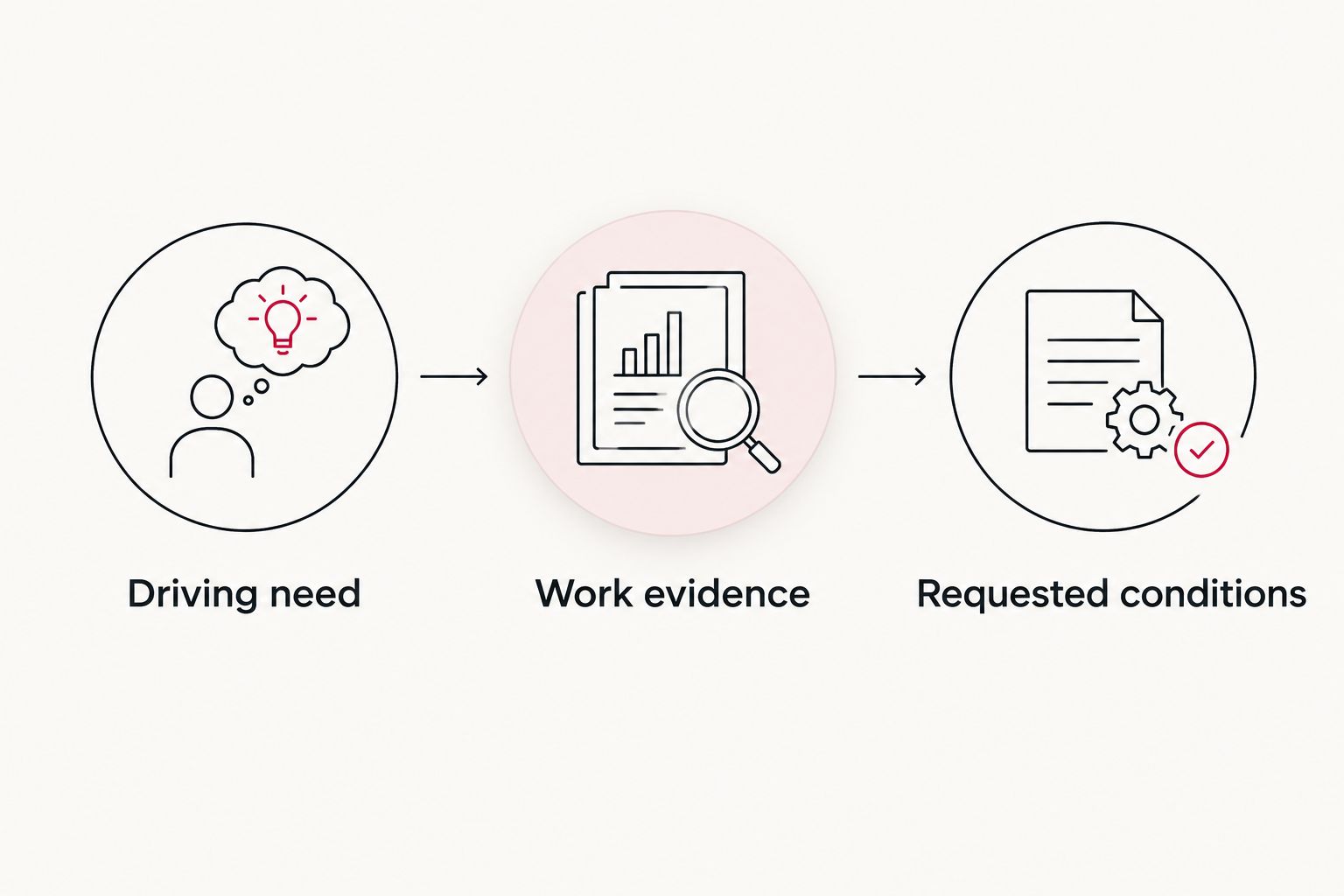
A useful drafting sequence is:
- Driving need: identify the task that requires travel.
- Work evidence: support the task and its timing.
- Requested conditions: describe permission that fits that need.
Benefit: a precise request is easier to compare with your evidence. Limitation: precise drafting does not entitle you to the conditions requested; the court decides what to grant.
Verdict: ask for permission that your evidence explains.
5. Letting the application contradict its supporting documents
Best for: avoiding preventable correction work. Check the bundle as a single account. A correct employer letter does not fix an affidavit that gives different working hours.
Compare names, dates, employer details, work locations and vehicle information wherever they appear. If your circumstances change during preparation, update every affected document rather than correcting only the most obvious page.
Use a simple cross-check:
- Read the affidavit against the supporting evidence.
- Read the requested conditions against the affidavit.
- Recheck the final versions after amendments.
Benefit: one consistent account removes avoidable ambiguity. Limitation: matching documents can still contain an incorrect fact, so check against original records rather than copying an earlier draft.
Keep superseded drafts separate from the final bundle. A clearly named final version is more useful than several nearly identical files.
Verdict: reconcile the whole bundle, not individual pages.
6. Treating an affidavit like an ordinary letter
Best for: completing evidence properly. An affidavit is a sworn or affirmed statement, not simply a signed explanation. Check the applicable witnessing requirements before signing, using Ministry of Justice guidance on affidavits and the relevant court instructions.
Read every statement before execution. Make sure references to attachments match the documents included, and check that scanned copies remain readable. Do not make casual changes to an executed affidavit; ask how a correction should be handled.
Final evidence checks include:
- The correct document is being signed.
- Required witnessing arrangements are in place.
- Every referenced attachment is included and identifiable.
Benefit: checking execution prevents an unfinished draft being mistaken for completed evidence. Limitation: correct witnessing does not establish that the contents satisfy the hardship test.
Verdict: complete the affidavit properly before treating it as final.
7. Confusing document preparation with the court process
Best for: planning what happens after drafting. A prepared application is not an approved application. Before submitting your 2026 bundle, confirm the applicable filing, Police notification and hearing requirements through Ministry of Justice guidance and the relevant District Court registry.
Keep document preparation, filing, the court’s decision and licensing steps separate in your plan. NZTA’s limited licence guidance explains the licensing stage. Do not treat submitting documents as permission to drive.
Benefit: a process checklist makes the next action clear. Limitation: your work commitments do not establish the court’s timetable or remove legal restrictions.
Record what has actually been completed. “Documents prepared” and “application filed” describe different stages; neither means a limited licence has been issued.
Verdict: confirm each stage instead of assuming preparation finishes the process.
8. Choosing help that does not match the problem
Best for: separating paperwork needs from legal questions. You have 3 preparation options: do it yourself, use a document-preparation service, or engage a lawyer. Choose according to the work you need done, not someone else’s experience.
| Option | Best for | Advantage | Limitation |
|---|---|---|---|
| Prepare it yourself | Drivers ready to manage the paperwork | Direct control of drafting and checking | You take responsibility for understanding and completing the requirements |
| NZ Limited Licence | Drivers needing limited licence document preparation | Fast, careful preparation of applications, affidavits and complete bundles nationwide | Document preparation is not the court’s decision |
| Engage a lawyer | Drivers needing individual legal advice | Legal advice on the particular circumstances and issues | Confirm whether the engagement includes drafting and representation |
NZ Limited Licence is best for drivers who need limited licence application documents prepared rather than drafting the bundle themselves. The service prepares documents across all 58 District Courts; it does not promise court approval.
Self-preparation remains a practical choice if you can manage the requirements. A lawyer is the appropriate choice when the unresolved problem is legal advice rather than document assembly.
Verdict: choose the help that addresses the actual gap.
Get your application documents prepared
NZ Limited Licence prepares applications, affidavits and complete document bundles nationwide.
How these priorities are ordered
This checklist follows dependency, not measured frequency: eligibility comes before evidence, evidence supports requested conditions, and completed documents precede submission. It does not claim that any mistake causes a particular number of days’ delay.
For a 2026 application, resolve the earliest unanswered question first. Better formatting cannot repair an eligibility problem or supply missing facts.
Which preparation option should you choose?
Choose document preparation when you know your circumstances and need help turning them into a coherent bundle. Choose legal advice when you need an answer about eligibility, legal objections or your particular position.
If you prepare the documents yourself, use the same checks. The standard of care does not change with the person doing the typing.
FAQ
What mistakes should I check before submitting a limited licence application?
Check eligibility, hardship evidence, requested driving conditions, consistency and affidavit completion. Then confirm the procedural steps that apply to your application.
Is needing my car for work enough to get a limited licence?
Needing a car for work does not by itself establish the hardship test. Section 105 of the Land Transport Act addresses extreme hardship to the applicant or undue hardship to another person.
Can I prepare my limited licence documents myself?
You can choose to prepare your own documents. You remain responsible for checking eligibility, preparing suitable evidence and completing the applicable court requirements.
Does an employer letter replace my affidavit?
Do not treat an employer letter as a replacement for the applicant's required evidence. It supports relevant work facts; check the document requirements for your application.
What should I do if my work hours keep changing?
Explain the actual working pattern and support it with relevant evidence. Do not present a fixed schedule that contradicts your circumstances.
Does fast document preparation mean a faster court decision?
Fast preparation does not guarantee a faster court decision. Document preparation, court scheduling and the decision are separate parts of the process.
Can I drive once my application has been submitted?
Submitting an application does not give you permission to drive. Follow the applicable court and NZTA requirements before driving under a limited licence.
Should I use a lawyer or a document-preparation service?
Use a lawyer when you need individual legal advice, and a document-preparation service when you need help preparing the application bundle. Confirm the scope of the help before proceeding.
One last thing
Read your requested driving conditions before rereading the rest of the bundle. For each permission requested, ask: which fact explains this, and which document supports it?
That reverse check exposes gaps that proofreading misses. Correct the underlying explanation, not just the wording.