
Yes. You can get a limited licence in New Zealand without owning a car: the legal test concerns eligibility and hardship, not vehicle ownership. You still need a workable arrangement to use a vehicle, and any driving must comply with the conditions of the limited licence. Borrowing a car does not remove a suspension or disqualification.
- Can you get a limited licence without owning a car? Yes—vehicle ownership is not the hardship test.
- NZTA distinguishes a court order from the limited licence you need before driving.
- Document vehicle access, owner permission and the work journeys you need.
- NZ Limited Licence suits drivers seeking limited licence document preparation, rather than court representation.
Can you get a limited licence without owning a car?
Yes. Owning a vehicle is not a prerequisite for a limited licence. Section 105 of the Land Transport Act sets out the court's hardship test: extreme hardship to you or undue hardship to another person. Eligibility restrictions also apply.
For a 2026 application, use NZTA's official limited-licence guidance alongside the current Land Transport Act, particularly sections 104 and 105. Those sources address eligibility and the court's powers; a vehicle owner's permission addresses a separate practical issue.
Start by identifying the vehicle details needed for a limited licence application. Do not treat access to a car as proof that the court should grant your application.
| Vehicle arrangement | Best for | Useful evidence | Limitation to address |
|---|---|---|---|
| Employer's vehicle | Drivers whose work includes an employer-provided vehicle | Employer confirmation of access and duties | Permission for work use does not necessarily include commuting |
| Partner's or family member's car | Drivers with an agreed household arrangement | Owner's confirmation and the proposed access times | Another household member might need the car at the same time |
| Friend's borrowed car | Drivers with a specific, dependable borrowing arrangement | Written permission identifying the vehicle and agreed use | An informal offer can leave availability unclear |
These are ways to explain vehicle access, not separate eligibility categories. The court decides whether the application meets the legal test.
Why this matters
An application needs to connect the hardship you describe with driving you can actually undertake. Saying you will lose work is incomplete if the proposed solution depends on a car you have not arranged to use.
The reverse is also true. Having access to an employer's van does not establish hardship by itself. Your documents should explain both the consequences of not driving and how the proposed driving addresses those consequences.
For your 2026 application, keep those questions separate: why you need limited driving, and what vehicle arrangement makes it possible.
Using an employer's vehicle
An employer's vehicle can form part of a practical driving plan. Explain whether you need it to travel between jobs, carry equipment, visit customers or perform another specific duty. Describe your actual work, not a general wish to drive for employment.
Ask the employer to confirm the arrangement in writing. Useful details include:
- Who controls the vehicle and can authorise its use.
- Which vehicle you would use.
- Whether permission covers commuting, work duties or both.
- When the vehicle is available to you.
- What happens to your work if you cannot drive.
Keep permission and hardship evidence distinct. An employer can confirm access to a vehicle without explaining the effect of your disqualification on the business or your job.
If the vehicle stays at a depot, explain how you will get there. A work-driving proposal needs to make sense from the start of the journey, not just after you collect the keys.
Borrowing a partner's or family member's car
A household vehicle arrangement needs clear permission and realistic access. Explain who provides the car, when you can use it and whether someone else needs it during those hours.
A helpful written confirmation identifies the vehicle and describes the agreed use. Treat this as supporting evidence, not as a substitute for the application or affidavit.
Check the proposed arrangement against your work schedule. If your partner needs the car during your shift, explain the actual solution rather than presenting the vehicle as available throughout the day.
Insurance is a separate check. Ask the insurer about the proposed driver, use and licence restrictions; do not assume the owner's existing cover answers those questions.
Borrowing a friend's car
A friend's car can support a driving proposal, but a vague offer leaves avoidable questions. Confirm the arrangement before describing it as settled in your documents.
Ask practical questions. Can you use the car for the journeys you propose? Does your friend need it during working hours? Where will you collect and return it?
Describe the arrangement you have, not the arrangement you hope to secure. If access is still being discussed, resolve it before relying on that vehicle in the proposed driving plan.
Do not build the application around an unspecified replacement car. Vehicle access, proposed conditions and supporting statements should tell the same story.
Why the evidence varies
There is no separate hardship test for people who borrow cars. What changes is the evidence needed to explain the arrangement clearly.
- Vehicle control: an employer's fleet arrangement differs from borrowing a privately owned car.
- Permission: work duties, commuting and personal use are different purposes.
- Availability: shared access needs to fit the driving hours you propose.
- Work pattern: a fixed workplace differs from changing job sites or customer visits.
- Hardship: explain the effect on you or another person, rather than relying on the existence of a vehicle.
- Transport alternatives: address realistic ways to make the necessary journeys without driving.
Use those factors to organise the facts for a 2026 application. They are preparation prompts, not a checklist that guarantees approval.
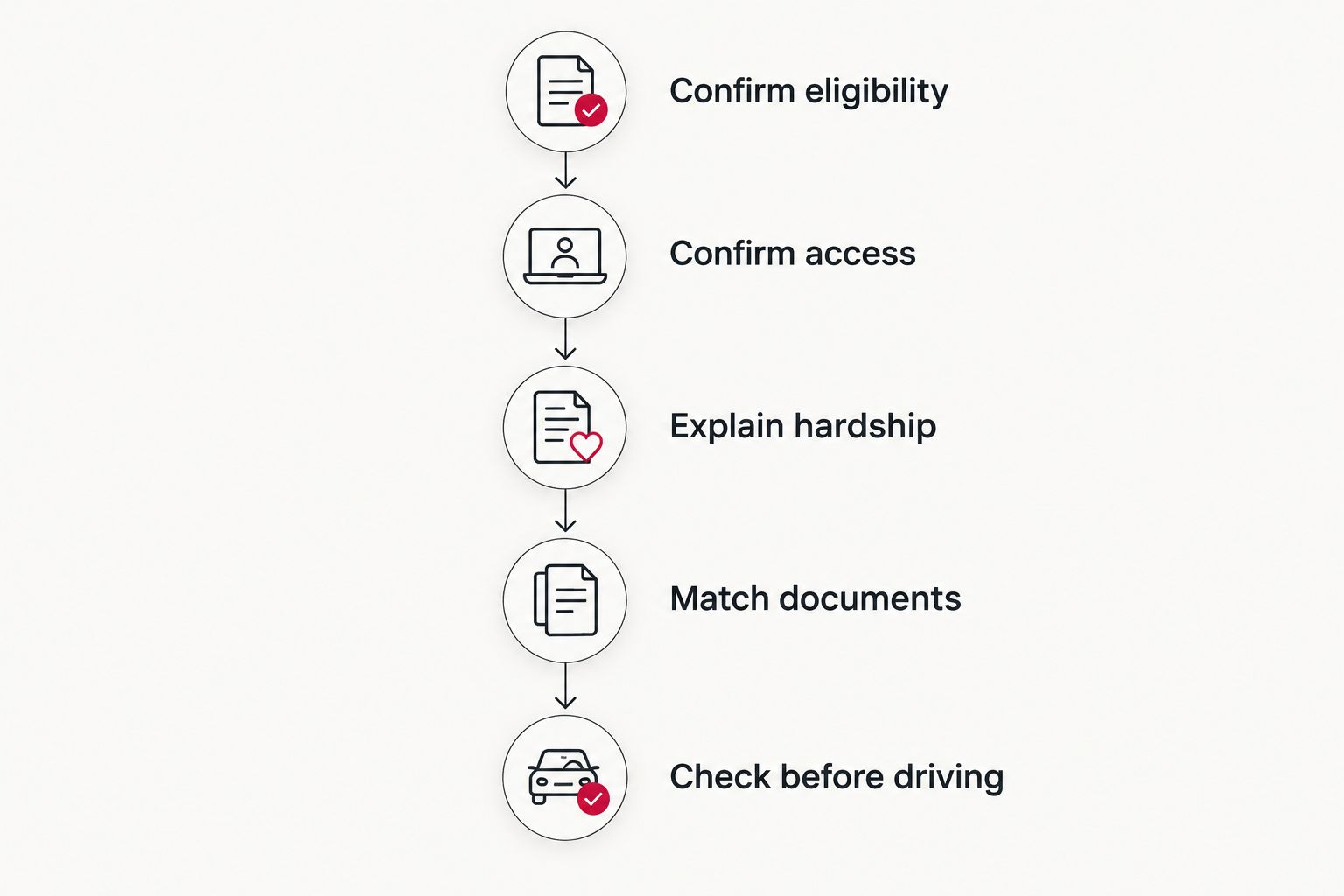
How to prepare a workable vehicle-access explanation
Confirm eligibility
Check why you are suspended or disqualified before preparing the driving proposal. Section 104 of the Land Transport Act contains exclusions; not every driver can use the limited-licence process.
Use NZTA's current guidance and seek legal advice if your position is unclear. Do not assume advice given to someone with a different disqualification applies to you.
Confirm access
Identify the vehicle and the person or business authorising its use. Get a clear account of when you can use it and for what purpose.
Where the vehicle is shared, resolve clashes in advance. Your documents should not depend on two people using the same car at the same time.
Explain hardship
Set out what happens if you cannot make the necessary journeys. Support the explanation with relevant facts about your duties, hours, transport options and the people affected.
A statement that driving would be easier is different from evidence addressing the statutory hardship test. Be specific without exaggerating.
Match documents
Read the application, affidavit, supporting statements and proposed driving conditions together. Check that the vehicle arrangement, work duties and requested hours agree.
If one document says you use a company van and another describes a family car, explain the distinction. Do not leave the reader to guess.
Check before driving
NZTA's official guidance distinguishes obtaining a court order from obtaining the limited licence. Do not drive merely because documents have been filed or a court order has been made. Complete the required licensing steps and follow the issued licence conditions.
Preparing it yourself, using document preparation or hiring a lawyer
Choose help according to the work you need done. Organising a clear set of facts differs from obtaining advice about disputed eligibility or representation at court.
| Approach | Best for | Advantage | Limitation |
|---|---|---|---|
| Prepare it yourself | Drivers ready to check requirements and organise their own evidence | You control the drafting and supporting material | You are responsible for checking the documents and process |
| Document-preparation service | Drivers who want help turning their facts into application documents | Focused help with applications, affidavits and the bundle | Document preparation does not decide eligibility or guarantee approval |
| Local lawyer | Drivers needing individual legal advice or court representation | Advice and representation tailored to the agreed instructions | Confirm which drafting, filing and court tasks the engagement includes |
NZ Limited Licence is best for drivers who want limited licence application documents prepared rather than court representation. NZ Limited Licence prepares applications, affidavits and complete document bundles across all 58 District Courts in New Zealand, with fast, careful preparation.
For a 2026 application involving a borrowed car, give the preparer the real access arrangement at the outset. Document preparation cannot supply permission the owner has not given, or turn an uncertain borrowing arrangement into a confirmed one.
Get your application documents prepared
NZ Limited Licence prepares applications, affidavits and complete document bundles nationwide.
Do I need the owner's permission in writing?
Written permission is useful supporting evidence, particularly where vehicle access would otherwise be unclear. It gives you a way to explain who is providing the vehicle and what use they have agreed to.
Do not describe an ordinary permission letter as a sworn affidavit. Ask whoever is preparing or advising on the application what form of supporting evidence fits your circumstances.
Can I use any car once I have a limited licence?
Follow the conditions of the issued limited licence. Do not assume permission to use one vehicle extends to every vehicle you can borrow.
If the vehicle you intend to use differs from the arrangement described in your application, check the order and licence conditions before driving. Owner permission alone does not answer that question.
What if I have no vehicle arranged yet?
Settle vehicle access before presenting a definite driving plan. You can collect hardship evidence while making arrangements, but do not state that a vehicle is available when permission remains unresolved.
Tell your document preparer or lawyer what is still uncertain. That allows the documents to reflect the facts rather than a promise you cannot support.
FAQ
Can you get a limited licence without owning a car in New Zealand?
Yes. Vehicle ownership is not the hardship test under section 105 of the Land Transport Act. You still need to meet the eligibility requirements and explain a workable driving arrangement.
Can I use my employer's van on a limited licence?
An employer's van can be part of your proposed driving arrangement. Confirm permission and the work use involved, then drive only as allowed by the issued limited licence.
Does borrowing a car prove I need a work licence?
No. Borrowing a car explains access to a vehicle, not the hardship caused by being unable to drive. Your application must address the legal hardship test separately.
Should my partner write a letter about lending me a car?
A written confirmation can help explain the arrangement. It should accurately describe the vehicle, permission and availability without claiming the car is available when it is not.
Can NZ Limited Licence prepare documents if I do not own the vehicle?
NZ Limited Licence prepares limited licence applications, affidavits and document bundles. Explain who provides the vehicle and the agreed access so the documents reflect your circumstances; the court decides the application.
Can I drive a borrowed car while waiting for the court?
Borrowing a car does not authorise driving while suspended or disqualified. Filing an application does not give you permission to drive.
Does a court order mean I can drive straight away?
No. NZTA distinguishes the court order from the limited licence. Complete the required licensing steps before driving and comply with the issued conditions.
One last thing
Check where the borrowed vehicle will be parked. A confirmed loan is not a complete transport plan if the car is somewhere you cannot reach without driving.
Before submitting a 2026 application, walk through the proposed journey from leaving home to returning the vehicle. Explain any gap honestly. That practical check helps keep your vehicle arrangement consistent with the driving you are asking the court to allow.