
A 28-day stand-down applies before the court can grant a limited licence for certain disqualifications, but you can start preparing your application documents earlier. A demerit-point suspension does not carry that same stand-down. Your earliest lawful driving date also depends on eligibility, the court’s decision and getting the limited licence issued—not simply reaching day 28.
- How soon can you apply for a limited licence after disqualification? Separate document preparation, court approval and licence issue.
- The Land Transport Act imposes a 28-day stand-down for certain disqualifications, not every suspension.
- NZTA requires a limited licence to be issued before you drive; a court order alone is insufficient.
- NZ Limited Licence suits drivers who need limited licence application documents prepared rather than preparing the bundle themselves.
How soon can you apply for a limited licence after disqualification?
Start preparing promptly, but check which legal timetable applies before choosing a filing or hearing date. The Land Transport Act’s limited-licence provisions distinguish eligibility from the court’s power to make an order. A waiting period does not mean you must leave your paperwork untouched.
| Your situation | What the timing means | Your next move |
|---|---|---|
| Disqualification subject to the stand-down | The court cannot make the limited licence order until the applicable 28-day period has expired | Prepare evidence and confirm filing arrangements with the court registry |
| Demerit-point suspension | The same 28-day stand-down does not apply | Check eligibility and start preparing your application promptly |
| Eligibility is unclear | Waiting longer does not resolve a legal exclusion | Check the disqualification, suspension notice and driving history before preparing a full application |
| Court order already granted | The order is not itself the issued limited licence | Complete the NZTA licensing process before driving |
NZ Limited Licence prepares limited licence applications, affidavits and document bundles across New Zealand. Document preparation and court approval remain separate steps.
The legal basis for this 2026 guide is the Land Transport Act, sections 103–105, which cover access to limited licences and the court’s powers and conditions. NZTA’s limited-licence guidance explains the licensing step after a court order. Ministry of Justice guidance covers applying through the District Court.
Why this matters
A common timing mistake is treating the waiting period as the whole process. It is only one part. Your documents still need to explain the hardship, support the facts and identify the driving permission you are asking the court to allow.
Another mistake is assuming that the end of the stand-down restores your right to drive. It does not. Do not drive until you hold the issued limited licence and can comply with its conditions.
For a 2026 application, work backwards from the driving you need, not from a promised return-to-work date. Tell your employer that document preparation, a hearing and licence issue are separate stages. Do not promise a driving date before those stages are complete.
Disqualification: check whether the 28-day stand-down applies
The 28-day stand-down is a restriction on when the court can make an order for disqualifications covered by the statutory rule. It is not a universal answer for every driver who has lost the right to drive.
Read the actual disqualification order. Record the offence, the date the order was made and the terms of the disqualification. An assumption based on what happened to a friend is not enough to establish your own timetable.
Before arranging a hearing, ask the registry how it handles filing and scheduling where a stand-down applies. Preparing documents early does not establish that the court can grant the application early. Keep those questions separate.
An urgent work problem does not, by itself, remove a statutory waiting period. Explain the urgency accurately, but do not build your plan around an exception that has not been confirmed for your circumstances.
Demerit suspension: the same stand-down does not apply
A demerit-point suspension does not carry the same 28-day stand-down that applies to certain court disqualifications. NZTA distinguishes suspensions from disqualifications in its limited-licence guidance.
That difference lets an eligible driver progress an application without waiting for that particular period to expire. It does not guarantee an immediate hearing, an order or a licence.
Use the suspension notice to establish what restriction you are dealing with. Then check eligibility and gather your evidence. Do not describe a suspension as a court disqualification throughout the application: the paperwork should match the underlying notice.
Check eligibility before building the bundle
The Land Transport Act sets eligibility restrictions as well as timing rules. A need to drive for work is not enough to establish eligibility. Your offence history, the type of order and any other licence restrictions need checking first.
If your situation involves an alcohol interlock sentence, an indefinite disqualification or another existing restriction, get advice on that specific position. Do not assume that an ordinary work-licence application is the correct route.
For the hardship test, the Act distinguishes extreme hardship to you from undue hardship to another person. Your evidence should address the relevant test, rather than simply saying that not driving is inconvenient.
An employer’s support helps explain the facts, but it does not decide the application. The court decides whether the legal requirements are met and what driving conditions are appropriate.
What can you prepare before the waiting period ends?
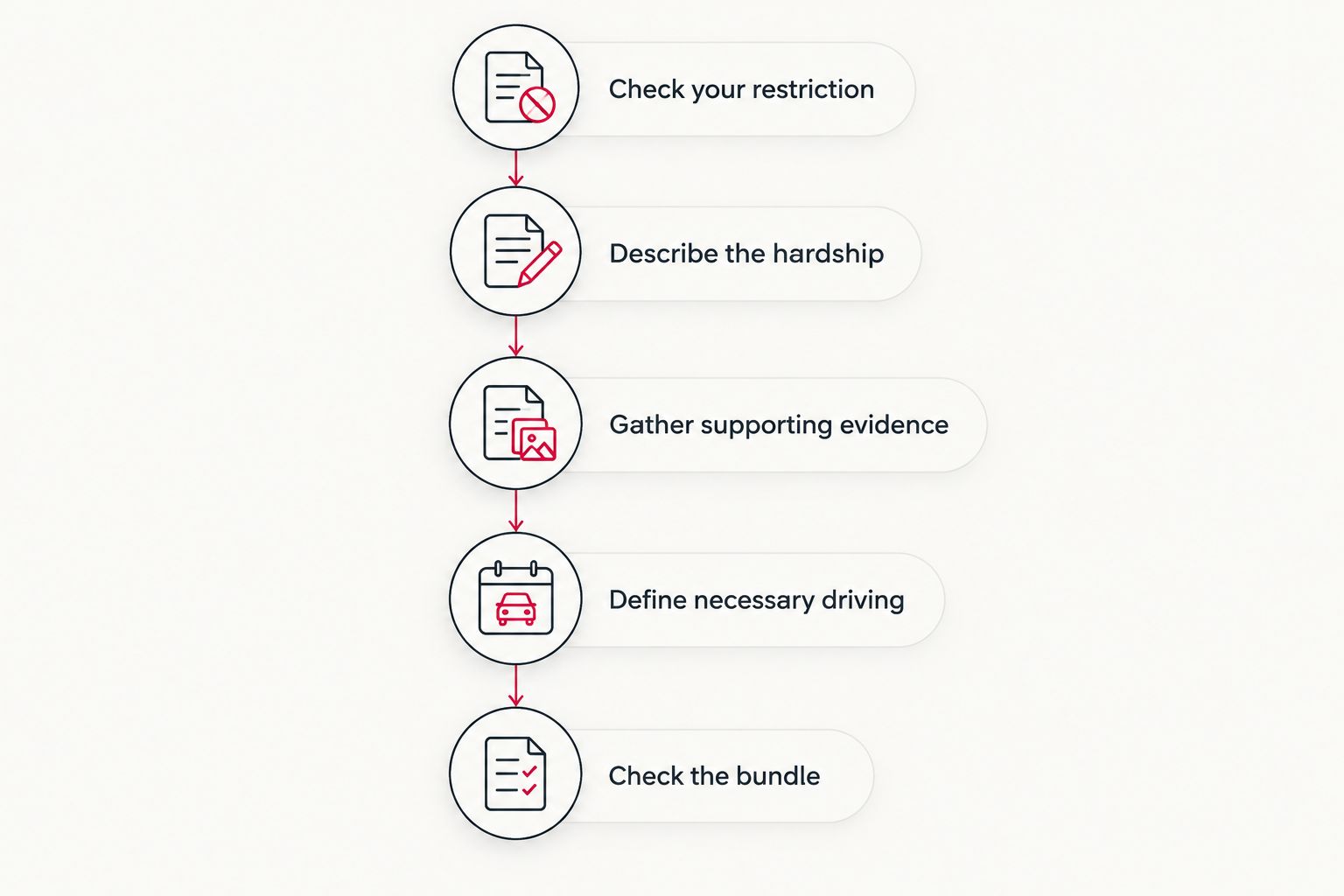
Use the waiting period to make your application specific and consistent. The following preparation sequence keeps the restriction, the hardship evidence and the requested driving conditions connected.
- Check your restriction. Gather the court order or suspension notice and check the dates. Identify any other restriction that needs attention. Keep the original documents available so that details can be checked against them.
- Describe the hardship. Explain what happens without permission to drive. Identify the work, income or responsibilities affected, and distinguish the effect on you from the effect on someone else.
- Gather supporting evidence. Ask your employer or other relevant person for factual support. Work schedules, job locations and information about transport alternatives can help explain the practical problem.
- Define necessary driving. Set out the purposes, days, hours and areas you need. Explain changing shifts or multiple workplaces rather than asking for unrestricted driving without supporting reasons.
- Check the bundle. Compare the application, affidavits and proposed conditions. Resolve conflicting dates, names and work details before arranging signing and filing.
An affidavit is sworn or affirmed evidence, not an informal account. Check the facts before signing and follow the applicable witnessing requirements. A draft that still contains guesses is not ready to swear.
For your 2026 application, make sure supporting statements describe your current circumstances. An old roster or an outdated account of your duties does not explain the driving you now need.
What should your work evidence explain?
Give the court facts it can assess. “I need my licence for work” leaves the practical questions unanswered. Your evidence should connect the driving request to the hardship you describe.
A useful preparation checklist is:
- Work duties: Which tasks require driving, and which can be done without it?
- Work locations: Where must you travel, and does the destination change?
- Working hours: What are your actual start and finish times, including variable shifts?
- Other transport: What public transport, lifts or workplace arrangements have you considered?
- Consequences: What happens to your employment or another person if the necessary driving cannot happen?
Keep statements accurate and supportable. If a lift is available on some days but not others, say so. Explaining the limits of an alternative is more useful than claiming no alternative exists when that is not true.
Why the time until lawful driving varies
There is no single turnaround that follows automatically from the statutory stand-down. Your application has several distinct dependencies:
- The legal restriction: A demerit suspension and a disqualification do not necessarily follow the same timetable.
- Eligibility: A legal restriction on applying must be resolved before timing becomes the main question.
- Evidence readiness: Missing or contradictory facts need correction before the bundle is ready.
- Court arrangements: Filing acceptance and hearing scheduling are separate from document preparation.
- The court’s decision: The court determines whether to grant an order and on what conditions.
- Licence issue: NZTA’s licensing requirements still apply after an order is made.
For planning in 2026, ask about each stage separately. A document-preparation estimate is not a hearing date, and a hearing date is not a guaranteed date for lawful driving.
Should you prepare it yourself, use a service or hire a lawyer?
Choose the help that matches the problem. Preparing documents, obtaining legal advice and representing someone in court are different tasks.
| Option | Best for | Practical benefit | Limitation to consider |
|---|---|---|---|
| Prepare it yourself | Drivers confident handling their own paperwork | You control the drafting and evidence collection | You must check the requirements and resolve inconsistencies yourself |
| NZ Limited Licence document preparation | Drivers who want application documents prepared | Preparation covers applications, affidavits and document bundles nationwide | Preparation does not determine eligibility or guarantee the court’s decision |
| A local lawyer | Drivers needing individual legal advice or representation | You can seek advice about disputed or complicated legal issues | Confirm the scope of the lawyer’s work before instructing them |
NZ Limited Licence is best for drivers who need limited licence application documents prepared rather than preparing the bundle themselves. The service focuses on fast, careful preparation; the court remains responsible for the decision.
If the main uncertainty is whether the law allows you to apply, resolve that question first. If eligibility is clear and the obstacle is assembling consistent documents, document preparation addresses that task.
Get your application documents prepared
NZ Limited Licence prepares applications, affidavits and complete document bundles nationwide.
Can I start preparing before the 28 days are up?
Yes—document preparation can begin before the 28-day stand-down expires. Gather the restriction notice, work details and supporting evidence while checking the correct filing and hearing arrangements with the registry.
Do not confuse an early start on paperwork with permission to drive. Your existing restriction continues unless and until the required legal and licensing steps are completed.
Can I drive as soon as the court approves the application?
No—the court order alone is not your issued limited licence. NZTA’s limited-licence guidance requires you to complete the licensing step before driving.
Read the order carefully and check that you understand the permitted driving. Permission for specified work travel is not general permission to use the car whenever needed.
Does an urgent application remove the waiting period?
Urgency does not itself remove an applicable 28-day statutory stand-down. Explain a genuine deadline when discussing filing arrangements, but do not treat financial pressure as automatic authority for the court to bypass the law.
If timing or eligibility is disputed, get advice about your specific order. Do not drive while that question is being resolved.
FAQ
How soon can you apply for a limited licence after disqualification?
Start preparing promptly, but check whether the statutory 28-day stand-down applies before arranging a hearing. The rule restricts when the court can make an order for certain disqualifications; confirm filing arrangements with the court registry.
Do I have to wait 28 days after a demerit suspension?
The same 28-day stand-down does not apply to a demerit-point suspension. You still need to establish eligibility, obtain a court order and complete the licensing process before driving.
Can I prepare my limited licence application while disqualified?
Yes, you can prepare your application documents while disqualified. Preparation does not give you permission to drive or remove an applicable stand-down.
Does needing my car for work guarantee a limited licence?
No, needing a car for work does not guarantee a limited licence. The court must assess eligibility, the statutory hardship test and the proposed driving conditions.
Can a document-preparation service approve my work licence?
No, a document-preparation service cannot approve your work licence. The court decides the application, and NZTA handles the licence-issue stage.
Can I drive with just the limited licence court order?
No, a court order alone is not enough to drive. Complete the NZTA licensing process and hold the issued limited licence before driving within its conditions.
Should I use a lawyer if my eligibility is unclear?
Seek individual legal advice if your eligibility is unclear. Resolve the legal issue before committing to an application route or assuming a return-to-driving date.
One last thing
Write down separate milestones: documents ready, court order made, licence issued. Ask which milestone a quoted timeframe actually describes. That question prevents a preparation estimate from becoming an unsupported promise to your employer.
For a 2026 application, keep a single checked record of your restriction dates, work details and requested driving conditions. Use it throughout the bundle. Consistent facts make the application clearer; they do not replace the court’s assessment.