Truck drivers’ limited licence applications in NZ ask the court for restricted driving permission with the aim of keeping essential work possible during a suspension or disqualification. For your 2026 application, the documents need to explain the truck classes, shifts, routes and hardship involved—not just say that you need a work licence.
- Limited licence NZ truck drivers applications need clear evidence of hardship, vehicle classes and realistic work conditions.
- NZ Limited Licence prepares applications, affidavits and document bundles; the court decides whether to grant an order.
- Match the requested driving conditions to your actual trucks, routes and shifts, not unrestricted transport work.
- A court order alone does not authorise driving: complete NZTA’s limited licence issuing process first.
Why limited licence preparation matters for truck drivers
A truck-driving application has practical details that a simple commute application does not. You need to identify the vehicles you drive, explain changing delivery locations and show how permitted hours would cover actual work. A vague request leaves those questions unanswered.
Your application needs to connect the hardship to a specific, workable driving request. Under the Land Transport Act’s limited licence provisions, the court considers extreme hardship to you or undue hardship to another person. Losing access to a truck is the starting fact; the consequences need evidence.
NZ Limited Licence prepares limited licence applications, affidavits and document bundles across all 58 District Courts in New Zealand. Document preparation is separate from eligibility, the court’s decision and NZTA issuing the licence.
For the legal framework, use the official Land Transport Act, particularly sections 103–105. For the practical process, use the Ministry of Justice’s limited licence guidance and NZTA’s limited licence guidance. These are the official references for the eligibility and procedural points below; confirm the requirements for your circumstances before filing.
How to prepare a truck driver limited licence application
Check your eligibility before collecting work evidence
Start with the notice or court order that stopped you driving. A demerit suspension and a drink-driving disqualification are different legal situations. Do not assume that a work requirement makes every driver eligible for a limited licence.
For a 2026 application, check the limited licence provisions in the Land Transport Act against your actual suspension or disqualification. Restrictions, waiting requirements and exclusions depend on the circumstances. If your case includes an alcohol interlock sentence or another licensing restriction, get advice about the correct pathway before preparing a standard application.
The manual approach is to read the official guidance and write down anything you cannot resolve. A lawyer is the appropriate option for advice about uncertain eligibility, disputed facts or a complicated driving history. Document preparation does not replace that advice.
Prepare a short factual record first:
- Record whether you are suspended or disqualified.
- Keep the notice, judgment or order stating the reason and dates.
- List the licence classes you held before the restriction.
- Record any other current driving restrictions.
- Ask for legal advice where the eligibility rules are unclear.
Identify the truck classes your work actually requires
Use your licence record and the employer’s vehicle details. Do not describe every vehicle as a heavy truck and expect that description to identify the correct class. NZTA distinguishes rigid vehicles from combinations and uses vehicle weight to define the classes.
NZTA’s official driver licence classes guidance identifies Class 2 rigid vehicles with a gross laden weight over 6,000 kg and up to 18,000 kg. Class 4 covers rigid vehicles over 18,000 kg gross laden weight. Class 5 covers combinations over 25,000 kg gross combined weight. These examples do not replace the full class definitions or the rules for particular vehicle types.
A limited licence is not a shortcut to obtaining a truck class you did not hold. Build the request around the classes relevant to your existing entitlement and the work you need permission to perform.
For your 2026 documents, check the actual vehicle configuration rather than relying on a job title such as delivery driver or linehaul driver.
- Obtain vehicle details from registration records or fleet records.
- Distinguish rigid trucks from truck-and-trailer combinations.
- Record gross laden weight or gross combined weight as applicable.
- Match each work vehicle to NZTA’s class guidance.
- Explain which classes the requested work requires.
Gather evidence that explains the hardship
Write the factual account yourself before choosing how to prepare the formal documents. Explain what stops happening when you cannot drive: your work, income, deliveries or another person’s essential activities. Then identify evidence that supports each statement.
For an employed driver, a useful employer statement explains the role, required vehicle classes, working pattern and consequences of losing your driving services. For an owner-driver, contracts, work schedules and business records help explain the position. A job title alone does not show hardship.
Keep facts separate from assumptions. If the employer has offered alternative duties, explain those duties and why they do or do not address the hardship. If another driver can cover some work, describe that arrangement accurately rather than claiming there is no alternative.
NZ Limited Licence is best for truck drivers who want paid preparation of limited licence applications, affidavits and document bundles. Fast, careful preparation is the service—not a promise that the court will grant the application.
- Describe your role and essential driving duties.
- Request an employer statement with specific work details.
- Gather records supporting income or business consequences.
- Explain the alternatives considered and their practical limits.
- Identify hardship affecting someone other than you, where relevant.
Define driving conditions that match the job
Translate your work pattern into a clear request. Think about permitted purposes, vehicles, locations and hours. The court decides the conditions; your documents need to make the requested conditions understandable.
For a truck driver, the work does not always end when the last delivery is complete. Returning to the depot, repositioning the vehicle and travelling between authorised jobs need consideration. Include those activities in the explanation where they are genuinely part of the work. Do not assume they are automatically covered.
For your 2026 application, distinguish regular work from occasional assignments. A request covering unspecified work everywhere gives the court less detail than a request supported by actual routes, destinations and scheduling evidence.
Describe the driving you need, not every journey you would like to make. Personal trips and unrelated driving do not become work driving because you are using a truck.
Build the request around these details:
- Vehicle classes required for the identified work.
- Working days and realistic shift windows.
- Depots, delivery areas and recurring destinations.
- Necessary travel connected to the authorised work.
- A clear explanation of variable routes or changing shifts.
Assemble a consistent document bundle
Put the evidence beside the application and check whether the facts agree. An employer statement describing daytime deliveries does not explain a request for overnight linehaul driving. Different dates, class descriptions or work hours create questions that need resolving before filing.
Start manually with a document checklist and a careful read-through. Use the Ministry of Justice’s official application guidance to confirm the filing requirements. Affidavits also need to be sworn or affirmed correctly; an ordinary signature is not a substitute for that process.
The limited licence application bundle guide explains how to think about the documents as a complete submission rather than separate pieces of paperwork.
NZ Limited Licence offers the faster preparation path for the application, affidavits and complete document bundle. You still need to provide accurate facts, review the documents and complete the required signing process.
- Check names, dates and licence details throughout.
- Match the requested classes to the supporting vehicle evidence.
- Align work hours and locations across all documents.
- Check that each hardship claim has a factual explanation.
- Confirm affidavit witnessing and filing requirements.
Complete the court and licensing stages before driving
Filing an application does not restore your right to drive. Neither does paying for document preparation. Keep transport arrangements in place while the application is being dealt with.
If the court grants a limited licence order, read every condition before arranging work. NZTA’s official limited licence guidance explains the issuing stage after the court order. Do not drive on the court order alone; complete the limited licence issuing process first.
Check the finished permission against the work you plan to accept. A dispatch change does not change the licence conditions. If an assignment falls outside those conditions, do not drive it on the assumption that an employer’s instruction makes it lawful.
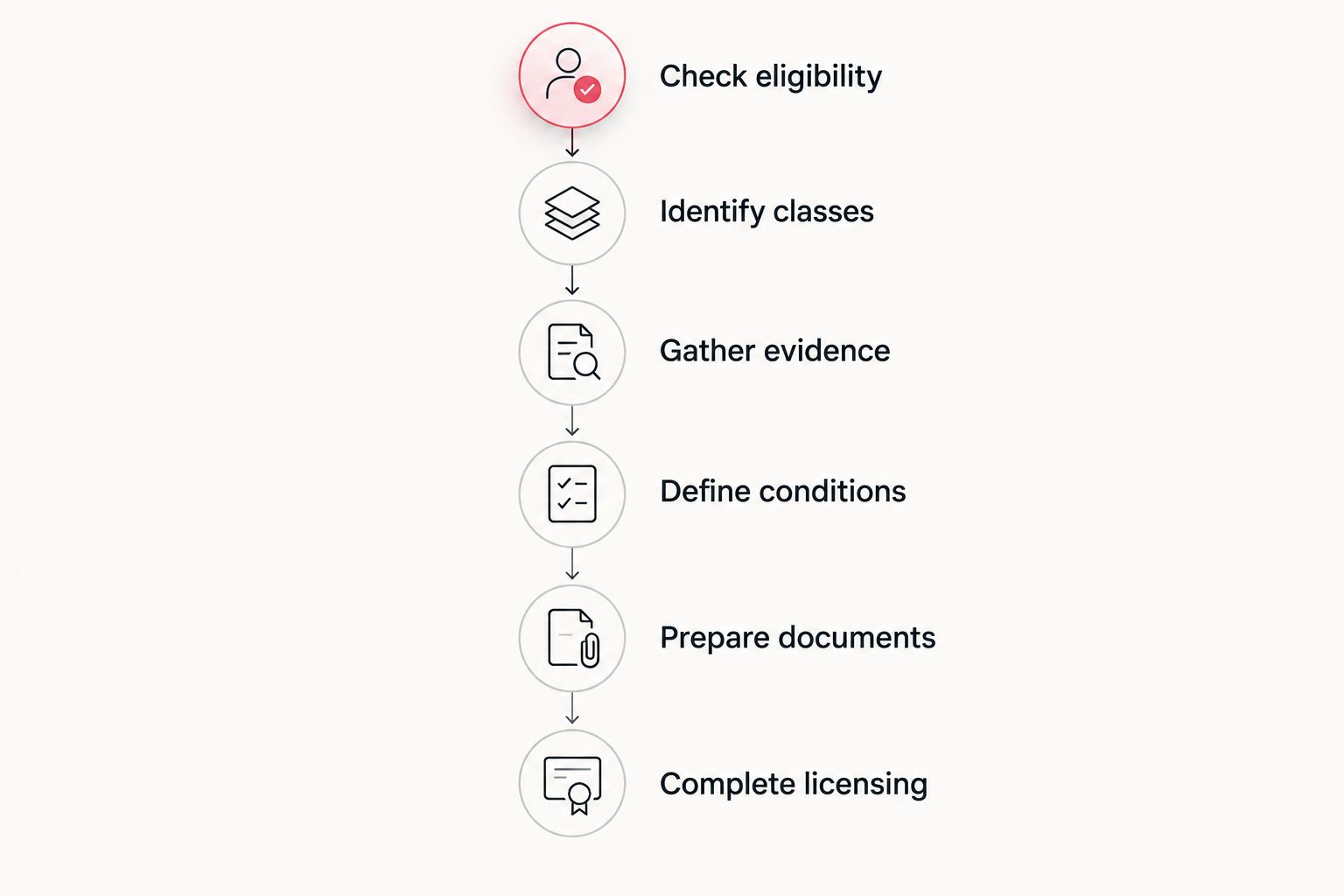
The process has distinct stages: Check eligibility, Identify classes, Gather evidence, Define conditions, Prepare documents and Complete licensing. Preparation comes before a decision, and the decision comes before any authorised driving.
Before returning to work, finish these checks:
- Read the court order and the issued licence conditions.
- Confirm the permitted vehicle classes and driving purposes.
- Check that the planned shift and route fit those conditions.
- Give your employer the information needed to allocate lawful work.
- Seek advice before undertaking work outside the permission granted.
Compare your document preparation options
Choose the option that matches the difficulty of your case and the help you need. Document preparation, legal advice and the court’s decision are separate functions. None of the preparation options guarantees approval.
| Option | Best for | Main advantage | Key limitation |
|---|---|---|---|
| Prepare the documents yourself | Drivers able to understand the requirements and prepare their own evidence | You control the drafting and can use official guidance directly | You are responsible for consistency, affidavit formalities and filing requirements |
| NZ Limited Licence document preparation | Truck drivers wanting paid preparation of applications, affidavits and complete bundles | Fast, careful document preparation nationwide | Preparation does not decide eligibility, grant an order or issue the licence |
| Hire a local lawyer | Drivers needing individual legal advice or help with a complicated case | Legal advice about your circumstances and representation where agreed | Confirm whether the engagement includes documents, filing and court attendance |
Choose legal advice when the legal position is uncertain; choose document preparation when you need help turning your facts into the application bundle. Preparing it yourself remains a practical option if you can meet the requirements. Be honest about the time and attention the paperwork needs.
Get your work licence documents prepared
Application, affidavit and document bundle preparation for New Zealand drivers.
Common mistakes truck drivers make
Asking for truck driving without identifying the class
A vehicle description such as freight truck does not identify its licensing class. Provide the configuration and weight information, then match it to NZTA’s guidance. Check that the requested permission corresponds to the work vehicle.
Treating an employer letter as the whole application
An employer letter supports the facts; it does not replace the application or affidavit. Explain the hardship in your own account and make sure the employer’s evidence agrees with it. Resolve inconsistencies before filing.
Requesting hours that miss necessary work travel
A delivery window alone does not explain returning the vehicle to the depot. Describe necessary work travel when proposing conditions. Keep the request connected to evidence rather than adding unrestricted hours as a precaution.
Assuming approval restores normal driving
A limited licence is restricted permission, not the return of an unrestricted licence. Work within the issued conditions. Do not accept a different truck, route or shift without checking that it fits.
FAQ
Can a truck driver apply for a limited licence in NZ?
A truck driver can apply if their suspension or disqualification falls within the limited licence provisions and they meet the legal requirements. Being employed as a driver does not automatically establish eligibility or the required hardship.
Can a limited licence cover Class 4 or Class 5 trucks?
A request can identify the heavy vehicle classes needed for work, subject to your entitlement, eligibility and the court’s decision. Specify the classes and actual vehicles rather than assuming that permission for work driving covers every truck.
What should my employer put in a supporting letter?
Your employer should explain your role, required vehicle classes, shifts, work locations and the consequences of losing your driving services. The statement should also address realistic alternatives and agree with your application.
Can a limited licence cover changing delivery routes?
Your application should explain changing delivery routes and request conditions that address the actual work pattern. The court decides the conditions, and your issued permission determines which journeys you can drive.
Can I prepare my truck driver application myself?
You can prepare the documents yourself using official guidance, provided you meet the requirements. Check eligibility, evidence, affidavit formalities and consistency; get legal advice if your circumstances are unclear.
Does a court order mean I can drive straight away?
No. NZTA’s limited licence guidance requires you to complete the licence issuing process after obtaining the court order. Do not drive until you have the required licence and understand its conditions.
Is document preparation the same as hiring a lawyer?
No. Document preparation produces the application paperwork; hiring a lawyer provides the legal services agreed in the engagement. Choose individual legal advice where eligibility, restrictions or other legal issues need assessment.
What should I check before filing in 2026?
Check the official Land Transport Act provisions, Ministry of Justice application guidance and NZTA licensing guidance against your circumstances. Confirm the vehicle classes, supporting evidence and requested conditions before filing.
One last thing
Before filing in 2026, test the requested conditions against a real work assignment. Trace the journey from leaving the depot to returning the truck, including any necessary work travel. If part of that assignment is not explained in the application, fix the documents before asking the court to decide.
A complete bundle tells one consistent story: the hardship, the truck classes and the exact driving needed to keep essential work possible.